Argentina
Argentine Republic
Population
45.42M
Area
2,780,400 km²
GDP
$633.27B
GDP Per Capita
$26,500
Pop. Density
16/km²
Quick Facts
Currency
$Argentine peso(ARS)
Calling Code
+54
Timezone
UTC-03:00
Languages
Guaraní, Spanish+more
Driving Side
right
Demonym
Argentine
Background
In 1816, the United Provinces of the Río de la Plata declared their independence from Spain. After Bolivia, Paraguay, and Uruguay went their separate ways, the area that remained became Argentina. European immigrants heavily shaped the country's population and culture, with Italy and Spain providing the largest percentage of newcomers from 1860 to 1930. Until about the mid-20th century, much of Argentina's history was dominated by periods of internal political unrest and conflict between civilian and military factions.
After World War II, former President Juan Domingo PERÓN -- the founder of the Peronist political movement -- introduced an era of populism, serving three non-consecutive terms in office until his death in 1974. Direct and indirect military interference in government throughout the PERÓN years led to a military junta taking power in 1976. In 1982, the junta failed in its bid to seize the Falkland Islands (Islas Malvinas) by force from the United Kingdom. Democracy was reinstated in 1983 and has persisted despite numerous challenges, the most formidable of which was a severe economic crisis in 2001-02 that led to violent public protests and the successive resignations of several presidents. The years 2003-15 saw Peronist rule by Néstor KIRCHNER (2003-07) and his spouse Cristina FERNÁNDEZ DE KIRCHNER (2007-15), who oversaw several years of strong economic growth (2003-11) followed by a gradual deterioration in the government’s fiscal situation and eventual economic stagnation and isolation. Argentina underwent a brief period of economic reform and international reintegration under Mauricio MACRI (2015-19), but a recession in 2018-19 and frustration with MACRI’s economic policies ushered in a new Peronist government in 2019 led by President Alberto FERNÁNDEZ and Vice President Cristina FERNÁNDEZ DE KIRCHNER. Argentina's high public debts, its pandemic-related inflationary pressures, and systemic monetary woes served as the catalyst for the 2023 elections, culminating with President Javier MILEI's electoral success. Argentina has since eliminated half of its government agencies and is seeking shock therapy to amend taxation and monetary policies.
Historical Trends
GDP (USD)
↑174.5% since 2006Population
↑15.3% since 2006Life Expectancy at Birth
Latest: 77.4 yearsData source: World Bank Open Data
Geography21
Location
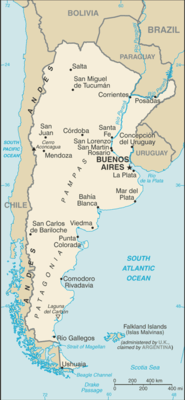
Southern South America, bordering the South Atlantic Ocean, between Chile and Uruguay
Geographic coordinates
34 00 S, 64 00 W
Map references
South America
Area
land: 2,736,690 sq km
water: 43,710 sq km
Area - comparative
slightly less than three-tenths the size of the US
Land boundaries
border countries: Bolivia 942 km; Brazil 1,263 km; Chile 6,691 km; Paraguay 2,531 km; Uruguay 541 km
Coastline
4,989 km
Maritime claims
contiguous zone: 24 nm
exclusive economic zone: 200 nm
continental shelf: 200 nm or to the edge of the continental margin
Climate
mostly temperate; arid in southeast; subantarctic in southwest
Terrain
rich plains of the Pampas in northern half, flat to rolling plateau of Patagonia in south, rugged Andes along western border
Elevation
lowest point: Laguna del Carbón (located between Puerto San Julián and Comandante Luis Piedra Buena in the province of Santa Cruz) -105 m
mean elevation: 595 m
Natural resources
fertile plains of the pampas, lead, zinc, tin, copper, iron ore, manganese, petroleum, uranium, arable land
Land use
agricultural land
agricultural land: arable land
agricultural land: permanent crops
agricultural land: permanent pasture
forest
other
Irrigated land
13,910 sq km (2018)
Major lakes (area sq km)
salt water lake(s): Laguna Mar Chiquita - 1,850 sq km;
Major rivers (by length in km)
note: [s] after country name indicates river source; [m] after country name indicates river mouth
Major watersheds (area sq km)
Major aquifers
Population distribution
one third of the population lives in Buenos Aires; pockets of agglomeration occur throughout the northern and central parts of the country; Patagonia to the south remains sparsely populated
Natural hazards
volcanism: volcanic activity in the Andes Mountains along the Chilean border; Copahue (2,997 m) last erupted in 2000; other historically active volcanoes include Llullaillaco, Maipo, Planchón-Peteroa, San José, Tromen, Tupungatito, and Viedma
Geography - note
People & Society35
Population
male: 22,535,980
female: 22,882,118
Nationality
adjective: Argentine
Ethnic groups
European (mostly Spanish and Italian descent) and Mestizo (mixed European and Indigenous ancestry) 97.2%, Indigenous 2.4%, African descent 0.4% (2010 est.)
Languages
major-language sample(s):
La Libreta Informativa del Mundo, la fuente indispensable de información básica. (Spanish)
The World Factbook, the indispensable source for basic information.
Religions
Roman Catholic 62.9%, Evangelical 15.3% (Pentecostal 13%, other Evangelical 2.3%), Jehovah's Witness and Church of Jesus Christ 1.4%, other 1.2% (includes Muslim, Jewish), none 18.9% (includes agnostic and atheist), unspecified 0.3% (2019 est.)
Age structure
15-64 years: 63.9% (male 15,071,215/female 14,956,069)
65 years and over: 12.8% (2024 est.) (male 2,570,596/female 3,461,743)
Dependency ratios
youth dependency ratio: 30.3 (2025 est.)
elderly dependency ratio: 19.6 (2025 est.)
potential support ratio: 5.1 (2025 est.)
Median age
male: 32.1 years
female: 34.6 years
Population growth rate
0.26% (2025 est.)
Birth rate
10.47 births/1,000 population (2025 est.)
Death rate
7.94 deaths/1,000 population (2025 est.)
Net migration rate
0.06 migrant(s)/1,000 population (2025 est.)
Population distribution
one third of the population lives in Buenos Aires; pockets of agglomeration occur throughout the northern and central parts of the country; Patagonia to the south remains sparsely populated
Urbanization
rate of urbanization: 0.97% annual rate of change (2020-25 est.)
Major urban areas - population
Sex ratio
0-14 years: 1.06 male(s)/female
15-64 years: 1.01 male(s)/female
65 years and over: 0.74 male(s)/female
total population: 0.98 male(s)/female (2024 est.)
Maternal mortality ratio
33 deaths/100,000 live births (2023 est.)
Infant mortality rate
male: 9.9 deaths/1,000 live births
female: 7.9 deaths/1,000 live births
Life expectancy at birth
male: 75.8 years
female: 82 years
Total fertility rate
1.43 children born/woman (2025 est.)
Gross reproduction rate
0.69 (2025 est.)
Drinking water source
unimproved: urban: urban: 0.2% of population (2022 est.)
unimproved: total: total: (2020 est.) NA
Health expenditure
Health expenditure (as % of national budget): 15.2% of national budget (2022 est.)
Physician density
5.11 physicians/1,000 population (2023)
Hospital bed density
3.3 beds/1,000 population (2021 est.)
Sanitation facility access
unimproved: urban: urban: 0% of population (2022 est.)
Obesity - adult prevalence rate
28.3% (2016)
Alcohol consumption per capita
beer: 3.62 liters of pure alcohol (2019 est.)
wine: 2.88 liters of pure alcohol (2019 est.)
spirits: 0.72 liters of pure alcohol (2019 est.)
other alcohols: 0.72 liters of pure alcohol (2019 est.)
Tobacco use
male: 26.9% (2025 est.)
female: 17.1% (2025 est.)
Children under the age of 5 years underweight
2% (2018 est.)
Currently married women (ages 15-49)
49.7% (2020 est.)
Child marriage
women married by age 18: 15.5% (2020)
Education expenditure
Education expenditure (% national budget): 14% national budget (2023 est.)
Literacy
male: 99.1% (2020 est.)
female: 99.2% (2020 est.)
School life expectancy (primary to tertiary education)
male: 17 years (2022 est.)
female: 21 years (2022 est.)
Government25
Country name
conventional short form: Argentina
local long form: República Argentina
local short form: Argentina
etymology: the name is derived from one of the Spanish words for "silver," but the origin is unclear; it may have described the land next to the Rio de la Plata ("Silver River"), a major river that forms the boundary between Argentina and Uruguay; another possible source is the Spanish explorers in the 16th century mistakenly believing that the silver ornaments they bought from inhabitants came from a local source of silver
Government type
presidential republic
Capital
geographic coordinates: 34 36 S, 58 22 W
time difference: UTC-3 (2 hours ahead of Washington, DC, during Standard Time)
etymology: the name translates as "fair winds" in Spanish; the full original name, Nuestra Senora Santa Maria de los Buenos Aires, was given only to the port; the city was founded separately from the port in 1536 and was named Ciudad de la Santissima Trinidad (City of the Most Holy Trinity); the shortened version of the port name eventually became the city name
Administrative divisions
Legal system
Constitution
amendment process: a declaration of proposed amendments requires two-thirds majority vote by both houses of the National Congress followed by approval by an ad hoc, multi-member constitutional convention
International law organization participation
has not submitted an ICJ jurisdiction declaration; accepts ICCt jurisdiction
Citizenship
citizenship by descent only: yes
dual citizenship recognized: yes
residency requirement for naturalization: 2 years
Suffrage
18-70 years of age; universal and compulsory; 16-17 years of age: optional for national elections
Executive branch
chief of state
head of government
cabinet
election/appointment process
most recent election date
election results
2023: Javier Gerardo MILEI elected president in second round; percent vote in first round - Sergio Tomás MASSA (FR) 36.7%, Javier Gerardo MILEI (PL) 30%, Patricia BULLRICH 23.8% (JxC/PRO), Juan SCHIARETTI (PJ) 6.8%, Myriam BREGMAN (PTS) 2.7%; percent of vote in second round - Javier Gerardo MILEI 55.7%, Sergio Tomás MASSA 44.3%
2019: Alberto Ángel FERNÁNDEZ elected president; percent of vote - Alberto Angel FERNÁNDEZ (TODOS) 48.1%, Mauricio MACRI (PRO) 40.4%, Roberto LAVAGNA (independent) 6.2%, other 5.3%
expected date of next election
Legislative branch
legislative structure: bicameral
Legislative branch - lower chamber
chamber name
number of seats
electoral system
scope of elections
term in office
most recent election date
parties elected and seats per party
percentage of women in chamber
expected date of next election
Legislative branch - upper chamber
chamber name
number of seats
electoral system
scope of elections
term in office
most recent election date
parties elected and seats per party
percentage of women in chamber
expected date of next election
Judicial branch
judge selection and term of office: judges nominated by the president and approved by the Senate; ministers can serve until mandatory retirement at age 75; extensions beyond 75 require renomination by the president and approval by the Senate
subordinate courts: federal-level appellate, district, and territorial courts; provincial-level supreme, appellate, and first-instance courts
Political parties
Civic Coalition ARI or CC-ARI
Consenso Federal (Federal Consensus) or CF
Frente Cívico por Santiago (Civic Front for Santiago)
Frente de Izquierda y de los Trabajadores – Unidad (Workers' Left Front) or FIT-U (coalition of leftist parties in lower house; includes PTS, PO, and MST)
Frente de la Concordia Misionero (Front for the Renewal of Social Concord) or FRCS
Frente Renovador (Renewal Front) or FR
Generación por un Encuentro Nacional (Generation for a National Encounter) or GEN
Hacemos por Córdoba (We do for Cordoba) or HC
Hacemos por Nuestro Pais (We Do For Our Country) or NHP
Juntos por el Cambio (Together for Change) or JxC (includes CC-ARI, PRO, and UCR); note - primary opposition coalition since 2019
Juntos Somos Río Negro (Together We Are Rio Negro) or JSRN
Partido Justicialista (Justicialist Party) or PJ
La Cámpora
La Libertad Avanza (The Liberty Advances) or LLA
Movimiento Popular Neuquino (Neuquén People's Movement) or MPN
Movimiento Socialista de los Trabajadores (Workers' Socialist Movement) or MST
Partido de los Trabajadores Socialistas (Socialist Workers' Party) or PTS
Partido Demócrata (Democratic Party) or PDN
Partido Libertario (Libertarian Party) or PL; note - party is also a founding member of the coalition La Libertad Avanza
Partido Obrero (Workers' Party) or PO
Partido Socialista or PS
Propuesta Republicana (Republican Proposal) or PRO
Unidad Federal (coalition of provencial parties in the lower house; includes FRCS and JSRN)
Unión Cívica Radical (Radical Civic Union) or UCR
Unión por la Patria (Union for the Homeland) or UP (formerly Frente de Todos (Everyone's Front) or FdT) (includes FR, La Cámpora, and PJ); note - ruling coalition since 2019; includes several national and provincial Peronist political parties
Vamos con Vos (Let's Go with You) or VcV
Diplomatic representation in the US
chief of mission
chancery
telephone
FAX
email address and website
eeeuu@mrecic.gov.ar
https://eeeuu.cancilleria.gob.ar/en
consulate(s) general
Diplomatic representation from the US
chief of mission
embassy
Avenida Colombia 4300, (C1425GMN) Buenos Aires
mailing address
telephone
FAX
email address and website
Buenosairespublicaffairs@state.gov
https://ar.usembassy.gov/
International organization participation
AfDB (nonregional member), Australia Group, BCIE, BIS, CAN (associate), CD, CABEI, CELAC, FAO, FATF, G-15, G-20, G-24, G-77, IADB, IAEA, IBRD, ICAO, ICC (national committees), ICCt, ICRM, IDA, IFAD, IFC, IFRCS, IHO, ILO, IMF, IMO, IMSO, Interpol, IOC, IOM, IPU, ISO, ITSO, ITU, ITUC (NGOs), LAES, LAIA, Mercosur, MIGA, MINURSO, MINUSTAH, NAM (observer), NSG, OAS, OPANAL, OPCW, Paris Club (associate), PCA, PROSUR, SICA (observer), UN, UNASUR, UNCTAD, UNDOF, UNESCO, UNFICYP, UNHCR, UNHRC, UNIDO, Union Latina (observer), UNOOSA, UNTSO, UNWTO, UPU, Wassenaar Arrangement, WCO, WFTU (NGOs), WHO, WIPO, WMO, WTO, ZC
Independence
9 July 1816 (from Spain)
National holiday
Revolution Day (May Revolution Day), 25 May (1810)
Flag
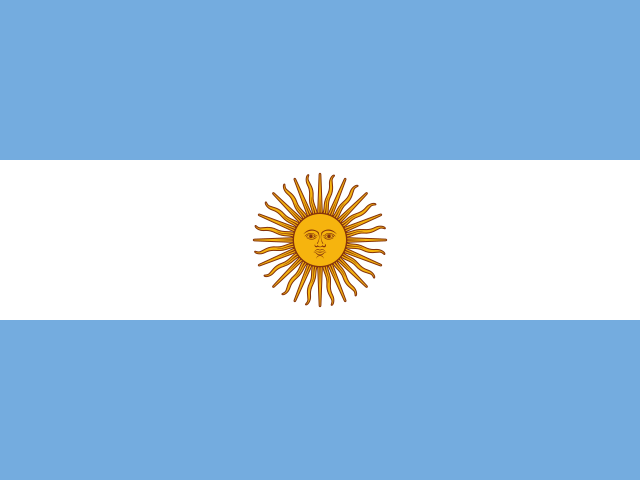
meaning: the colors represent the clear skies and snow of the Andes Mountains; the sun commemorates the first mass demonstration in favor of independence on 25 May 1810, when the sun broke through the clouds; the sun is designed to look like Inti, the Incan god of the sun
National symbol(s)
Sun of May (a sun-with-face symbol)
National color(s)
sky blue, white
National anthem(s)
lyrics/music: Vicente LOPEZ y PLANES/Jose Blas PARERA
history: adopted 1813; Vicente LOPEZ was inspired to write the anthem after watching a play about the 1810 May Revolution against Spain; a 1900 presidential decree declared that only the first and last verses would be considered official, rather than the original nine verses
National heritage
selected World Heritage Site locales: Los Glaciares National Park (n); Jesuit Missions of the Guaranis (c); Iguazú National Park (n); Cueva de las Manos (c); Valdés Península (n); Ischigualasto/Talampaya National Parks (n); Jesuit Block and Estancias of Córdoba (c); Quebrada de Humahuaca (c); Qhapaq Ñan/Andean Road System (c)
Economy32
Economic overview
large diversified economy; financial risks from debt obligations, rapid inflation, and reduced investor appetites; resource-rich, export-led growth model; increasing trade relations with China; G20 and OAS leader; tendency to nationalize businesses and under-report inflation
Real GDP (purchasing power parity)
Real GDP (purchasing power parity) 2023: $1.234 trillion (2023 est.)
Real GDP (purchasing power parity) 2022: $1.255 trillion (2022 est.)
Real GDP growth rate
Real GDP growth rate 2023: -1.6% (2023 est.)
Real GDP growth rate 2022: 5.3% (2022 est.)
Real GDP per capita
Real GDP per capita 2023: $27,100 (2023 est.)
Real GDP per capita 2022: $27,600 (2022 est.)
GDP (official exchange rate)
Inflation rate (consumer prices)
Inflation rate (consumer prices) 2021: 47.1% (2021 est.)
Inflation rate (consumer prices) 2020: 40.5% (2020 est.)
GDP - composition, by sector of origin
industry: 24% (2024 est.)
services: 53.4% (2024 est.)
GDP - composition, by end use
household consumption
government consumption
investment in fixed capital
investment in inventories
exports of goods and services
imports of goods and services
Agricultural products
Industries
food processing, motor vehicles, consumer durables, textiles, chemicals and petrochemicals, printing, metallurgy, steel
Industrial production growth rate
Labor force
Unemployment rate
Unemployment rate 2023: 6.2% (2023 est.)
Unemployment rate 2022: 6.9% (2022 est.)
Youth unemployment rate (ages 15-24)
male: 19.8% (2024 est.)
female: 23% (2024 est.)
Population below poverty line
Gini Index coefficient - distribution of family income
Average household expenditures
on alcohol and tobacco: 1.9% of household expenditures (2023 est.)
Household income or consumption by percentage share
highest 10%: 31% (2023 est.)
Remittances
Remittances 2023: 0.2% of GDP (2023 est.)
Remittances 2022: 0.2% of GDP (2022 est.)
Budget
expenditures: $139.037 billion (2023 est.)
Public debt
Taxes and other revenues
Current account balance
Current account balance 2023: -$20.956 billion (2023 est.)
Current account balance 2022: -$4.055 billion (2022 est.)
Exports
Exports 2023: $82.947 billion (2023 est.)
Exports 2022: $102.928 billion (2022 est.)
Exports - partners
Exports - commodities
Imports
Imports 2023: $92.3 billion (2023 est.)
Imports 2022: $97.399 billion (2022 est.)
Imports - partners
Imports - commodities
Reserves of foreign exchange and gold
Reserves of foreign exchange and gold 2023: $23.081 billion (2023 est.)
Reserves of foreign exchange and gold 2022: $44.795 billion (2022 est.)
Debt - external
Exchange rates
Currency
Exchange rates 2024
Exchange rates 2023
Exchange rates 2022
Exchange rates 2021
Exchange rates 2020
Energy8
Electricity access
Electricity
consumption: 114.667 billion kWh (2023 est.)
exports: 31 million kWh (2023 est.)
imports: 11.393 billion kWh (2023 est.)
transmission/distribution losses: 27.027 billion kWh (2023 est.)
Electricity generation sources
fossil fuels
nuclear
solar
wind
hydroelectricity
biomass and waste
Nuclear energy
Number of nuclear reactors under construction: 1 (2025)
Net capacity of operational nuclear reactors: 1.64GW (2025 est.)
Percent of total electricity production: 6.3% (2023 est.)
Coal
consumption: 2.534 million metric tons (2023 est.)
exports: 300 metric tons (2023 est.)
imports: 1.936 million metric tons (2023 est.)
proven reserves: 799.999 million metric tons (2023 est.)
Petroleum
refined petroleum consumption: 749,000 bbl/day (2023 est.)
crude oil estimated reserves: 2.483 billion barrels (2021 est.)
Natural gas
consumption: 46.028 billion cubic meters (2023 est.)
exports: 2.344 billion cubic meters (2023 est.)
imports: 5.225 billion cubic meters (2023 est.)
proven reserves: 396.464 billion cubic meters (2021 est.)
Energy consumption per capita
Communications6
Telephones - fixed lines
subscriptions per 100 inhabitants: 14 (2024 est.)
Telephones - mobile cellular
subscriptions per 100 inhabitants: 140 (2024 est.)
Broadcast media
one of South America's biggest media markets; dozens of TV networks, hundreds of radio stations, and more than 150 daily newspapers (2023)
Internet country code
.ar
Internet users
Broadband - fixed subscriptions
subscriptions per 100 inhabitants: 25 (2023 est.)
Transportation6
Civil aircraft registration country code prefix
LV
Airports
764 (2025)
Heliports
148 (2025)
Railways
Merchant marine
by type: container ship 1, bulk carrier 1 general cargo 8, oil tanker 33, other 158
Ports
total ports
large
medium
small
very small
ports with oil terminals
key ports
Military & Security7
Military and security forces
Ministry of Security: Gendarmería Nacional Argentina (National Gendarmerie), Coast Guard (Prefectura Naval) (2025)
Military expenditures
Military Expenditures 2023: 0.5% of GDP (2023 est.)
Military Expenditures 2022: 0.6% of GDP (2022 est.)
Military Expenditures 2021: 0.8% of GDP (2021 est.)
Military Expenditures 2020: 0.8% of GDP (2020 est.)
Military and security service personnel strengths
approximately 75,000 active-duty Armed Forces (45,000 Army; 15,000 Navy, including about 3,500 marines; 15,000 Air Force) (2025)
Military equipment inventories and acquisitions
the inventory of Argentina's armed forces is a mix of domestically produced and imported weapons, largely from Europe and the US; in recent years, France and the US have been the leading suppliers of equipment; Argentina has an indigenous defense industry that produces air, land, and naval systems (2025)
Military service age and obligation
note 2: in 2025, the Argentine Government announced the creation of a Voluntary Military Service program for people aged 18–28 to be managed by the Ministries of Defense and Human Capital; the program's goals include to instill values like discipline and patriotism while offering training in trades such as cooking, mechanics, and security, alongside opportunities to complete compulsory education
Military deployments
230 Cyprus (UNFICYP) (2025)
Military - note
Argentina participates in the Tripartite Command, an interagency security mechanism created by Argentina, Brazil, and Paraguay to exchange information and combat transnational threats, such as crime and terrorism, in the Tri-Border Area; in addition, Argentina and Chile have a joint peacekeeping force known as the Combined Southern Cross Peacekeeping Force, designed to be made available to the UN; Argentina has Major Non-NATO Ally (MNNA) status with the US, a designation under US law that provides foreign partners with certain benefits in the areas of defense trade and security cooperation
the Army and Navy were both created in 1810 during the Argentine War of Independence, while the Air Force was established in 1945; the military conducted coups d'état in 1930, 1943, 1955, 1962, 1966, and 1976; the 1976 coup, aka the "National Reorganization Process," marked the beginning of the so-called "Dirty War," a period of state-sponsored terrorism that saw the deaths or disappearances of thousands of Argentinians; the defeat in the 1982 Falklands War led to the downfall of the military junta (2025)
Transnational Issues1
Refugees and internally displaced persons
IDPs: 74 (2024 est.)
stateless persons: 34 (2024 est.)