
Côte d'Ivoire
Republic of Côte d'Ivoire
Population
31.86M
Area
322,463 km²
GDP
$86.54B
GDP Per Capita
$6,700
Pop. Density
99/km²
Quick Facts
Currency
FrWest African CFA franc(XOF)
Calling Code
+225
Timezone
UTC
Languages
French+more
Driving Side
right
Demonym
Ivorian
Background
Cote d’Ivoire achieved independence from France in 1960 but has maintained close ties. Foreign investment and the export and production of cocoa drove economic growth that led Cote d’Ivoire to become one of the most prosperous states in West Africa. Then in 1999, a military coup overthrew the government, and a year later, junta leader Robert GUEI held rigged elections and declared himself the winner. Popular protests forced him to step aside, and Laurent GBAGBO was elected. Ivoirian dissidents and members of the military launched a failed coup in 2002 that developed into a civil war. In 2003, a cease-fire resulted in rebels holding the north, the government holding the south, and peacekeeping forces occupying a buffer zone in the middle. In 2007, President GBAGBO and former rebel leader Guillaume SORO signed an agreement in which SORO joined GBAGBO's government as prime minister. The two agreed to reunite the country by dismantling the buffer zone, integrating rebel forces into the national armed forces, and holding elections.
In 2010, Alassane Dramane OUATTARA won the presidential election, but GBAGBO refused to hand over power, resulting in five months of violent conflict. Armed OUATTARA supporters and UN and French troops eventually forced GBAGBO to step down in 2011. OUATTARA won a second term in 2015 and a controversial third term in 2020 -- despite the two-term limit in the Ivoirian constitution -- in an election boycotted by the opposition. Through political compromise with OUATTARA, the opposition participated peacefully in 2021 legislative elections and won a substantial minority of seats. Also in 2021, the International Criminal Court in The Hague ruled on a final acquittal for GBAGBO, who was on trial for crimes against humanity, paving the way for GBAGBO’s return to Abidjan the same year. GBAGBO has publicly met with OUATTARA since his return as a demonstration of political reconciliation.
Historical Trends
GDP (USD)
↑244.6% since 2006Population
↑55.4% since 2006Life Expectancy at Birth
Latest: 61.9 yearsData source: World Bank Open Data
Geography19
Location
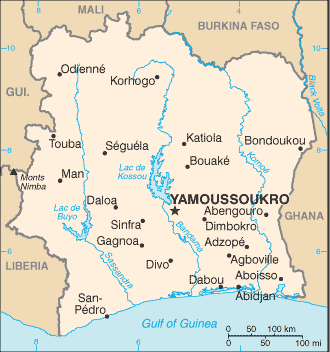
Western Africa, bordering the North Atlantic Ocean, between Ghana and Liberia
Geographic coordinates
8 00 N, 5 00 W
Map references
Africa
Area
land: 318,003 sq km
water: 4,460 sq km
Area - comparative
slightly larger than New Mexico
Land boundaries
border countries: Burkina Faso 545 km; Ghana 720 km; Guinea 816 km; Liberia 778 km; Mali 599 km
Coastline
515 km
Maritime claims
exclusive economic zone: 200 nm
continental shelf: 200 nm
Climate
tropical along coast, semiarid in far north; three seasons - warm and dry (November to March), hot and dry (March to May), hot and wet (June to October)
Terrain
mostly flat to undulating plains; mountains in northwest
Elevation
lowest point: Gulf of Guinea 0 m
mean elevation: 250 m
Natural resources
petroleum, natural gas, diamonds, manganese, iron ore, cobalt, bauxite, copper, gold, nickel, tantalum, silica sand, clay, cocoa beans, coffee, palm oil, hydropower
Land use
agricultural land
agricultural land: arable land
agricultural land: permanent crops
agricultural land: permanent pasture
forest
other
Irrigated land
730 sq km (2012)
Major lakes (area sq km)
Major watersheds (area sq km)
Population distribution
the population is primarily located in the forested south, with the highest concentration of people residing in and around the cities on the Atlantic coast; most of the northern savanna remains sparsely populated, with higher concentrations located along transportation corridors, as shown in this population distribution map
Natural hazards
coast has heavy surf and no natural harbors; during the rainy season torrential flooding is possible
Geography - note
most of the inhabitants live along the sandy coastal region; apart from the capital area, the forested interior is sparsely populated
People & Society35
Population
male: 15,992,906
female: 15,863,065
Nationality
adjective: Ivoirian
Ethnic groups
Akan 38%, Voltaique or Gur 22%, Northern Mande 22%, Kru 9.1%, Southern Mande 8.6%, other 0.3% (2021 est.)
Languages
major-language sample(s):
The World Factbook, une source indispensable d'informations de base. (French)
The World Factbook, the indispensable source for basic information.
Religions
Age structure
15-64 years: 60.9% (male 9,200,957/female 9,060,748)
65 years and over: 3% (2024 est.) (male 401,967/female 490,196)
Dependency ratios
youth dependency ratio: 67.5 (2025 est.)
elderly dependency ratio: 4.7 (2025 est.)
potential support ratio: 21.2 (2025 est.)
Median age
male: 21.2 years
female: 21.2 years
Population growth rate
2.33% (2025 est.)
Birth rate
29.87 births/1,000 population (2025 est.)
Death rate
6.93 deaths/1,000 population (2025 est.)
Net migration rate
0.39 migrant(s)/1,000 population (2025 est.)
Population distribution
the population is primarily located in the forested south, with the highest concentration of people residing in and around the cities on the Atlantic coast; most of the northern savanna remains sparsely populated, with higher concentrations located along transportation corridors, as shown in this population distribution map
Urbanization
rate of urbanization: 3.38% annual rate of change (2020-25 est.)
Major urban areas - population
231,000 YAMOUSSOUKRO (capital) (2018), 5.686 million ABIDJAN (seat of government) (2023)
Sex ratio
0-14 years: 1.01 male(s)/female
15-64 years: 1.02 male(s)/female
65 years and over: 0.82 male(s)/female
total population: 1.01 male(s)/female (2024 est.)
Mother's mean age at first birth
Maternal mortality ratio
359 deaths/100,000 live births (2023 est.)
Infant mortality rate
male: 59.5 deaths/1,000 live births
female: 45.2 deaths/1,000 live births
Life expectancy at birth
male: 60.9 years
female: 65.4 years
Total fertility rate
3.85 children born/woman (2025 est.)
Gross reproduction rate
1.9 (2025 est.)
Drinking water source
improved: urban
improved: rural
improved: total
unimproved: urban
unimproved: rural
unimproved: total
Health expenditure
Health expenditure (as % of national budget): 6.2% of national budget (2022 est.)
Physician density
0.17 physicians/1,000 population (2023)
Sanitation facility access
improved: urban
improved: rural
improved: total
unimproved: urban
unimproved: rural
unimproved: total
Obesity - adult prevalence rate
10.3% (2016)
Alcohol consumption per capita
beer: 1.13 liters of pure alcohol (2019 est.)
wine: 0.33 liters of pure alcohol (2019 est.)
spirits: 0.2 liters of pure alcohol (2019 est.)
other alcohols: 0.04 liters of pure alcohol (2019 est.)
Tobacco use
male: 14.9% (2025 est.)
female: 0.6% (2025 est.)
Children under the age of 5 years underweight
13.6% (2021 est.)
Currently married women (ages 15-49)
62.7% (2021 est.)
Child marriage
women married by age 18: 25.8% (2021)
men married by age 18: 1.9% (2021)
Education expenditure
Education expenditure (% national budget): 17.6% national budget (2024 est.)
Literacy
male: 60.2% (2021 est.)
female: 40.3% (2021 est.)
School life expectancy (primary to tertiary education)
male: 11 years (2023 est.)
female: 11 years (2023 est.)
Government25
Country name
conventional long form
conventional short form
local long form
local short form
former
etymology
Government type
presidential republic
Capital
geographic coordinates: 6 49 N, 5 16 W
time difference: UTC 0 (5 hours ahead of Washington, DC, during Standard Time)
etymology: formerly a village named N'Gokro, Yamoussoukro is named after Queen YAMOUSSOU, who ruled during the early 20th century; Abidjan's name may have come from a misunderstanding when a French explorer asked a group of women the name of the village -- thinking it was a question about what they were doing, they replied "t'chan m’bi djan," which in the Ebrie language means "I return from cutting leaves," so the explorer recorded the name of the locale as Abidjan
Administrative divisions
Legal system
civil law system based on the French civil code; Constitutional Chamber of the Supreme Court reviews legislation
Constitution
amendment process: proposed by the president of the republic or by Parliament; consideration of drafts or proposals requires an absolute majority vote by the parliamentary membership; passage of amendments affecting presidential elections, presidential term of office and vacancies, and amendment procedures requires approval by absolute majority in a referendum; passage of other proposals by the president requires at least four-fifths majority vote by Parliament; constitutional articles on the sovereignty of the state and its republican and secular form of government cannot be amended
International law organization participation
accepts compulsory ICJ jurisdiction with reservations; accepts ICCt jurisdiction
Citizenship
citizenship by descent only: at least one parent must be a citizen of Cote d'Ivoire
dual citizenship recognized: no
residency requirement for naturalization: 5 years
Suffrage
18 years of age; universal
Executive branch
chief of state
head of government
cabinet
election/appointment process
most recent election date
election results
2020: Alassane OUATTARA reelected president; percent of vote - Alassane OUATTARA (RDR) 94.3%, Kouadio Konan BERTIN (PDCI-RDA) 2.0%, other 3.7%
expected date of next election
Legislative branch
legislative structure: bicameral
Legislative branch - lower chamber
chamber name
number of seats
electoral system
scope of elections
term in office
most recent election date
parties elected and seats per party
percentage of women in chamber
expected date of next election
Legislative branch - upper chamber
chamber name
number of seats
scope of elections
term in office
most recent election date
percentage of women in chamber
expected date of next election
Judicial branch
judge selection and term of office: judges nominated by the Superior Council of the Magistrature, a 7-member body consisting of the national president (chairman), 3 "bench" judges, and 3 public prosecutors; judges appointed for life
subordinate courts: Courts of Appeal (organized into civil, criminal, and social chambers); first instance courts; peace courts
Political parties
Democratic Party of Cote d'Ivoire or PDCI
Ivorian Popular Front or FPI
Liberty and Democracy for the Republic or LIDER
Movement of the Future Forces or MFA
Pan-African Congress for People's Justice and Equality or COJEP
Rally of Houphouetists for Democracy and Peace or RHDP
Rally of the Republicans or RDR
Together for Democracy and Sovereignty or EDS
Together to Build (UDPCI, FPI,and allies)
Union for Cote d'Ivoire or UPCI
Union for Democracy and Peace in Cote d'Ivoire or UDPCI
Diplomatic representation in the US
chancery: 2424 Massachusetts Avenue NW, Washington, DC 20008
telephone: [1] (202) 797-0300
FAX: [1] (202) 204-3967
email address and website:
info@ambacidc.org
Ambassade de Cote D’ivoire aux USA (ambaciusa.org)
Diplomatic representation from the US
chief of mission
embassy
mailing address
telephone
FAX
email address and website
AbjAmCit@state.gov
https://ci.usembassy.gov/
International organization participation
ACP, AfDB, AU, ECOWAS, EITI (compliant country), Entente, FAO, FZ, G-24, G-77, IAEA, IBRD, ICAO, ICC, ICCt, ICRM, IDA, IDB, IFAD, IFC, IFRCS, ILO, IMF, IMO, Interpol, IOC, IOM, IPU, ISO, ITSO, ITU, ITUC (NGOs), MIGA, MINUSCA, MONUSCO, NAM, OIC, OIF, OPCW, UN, UNCTAD, UNESCO, UNHCR, UNHRC, UNIDO, UNMISS, Union Latina, UNWTO, UPU, WADB (regional), WAEMU, WCO, WFTU (NGOs), WHO, WIPO, WMO, WTO
Independence
7 August 1960 (from France)
National holiday
Independence Day, 7 August (1960)
Flag
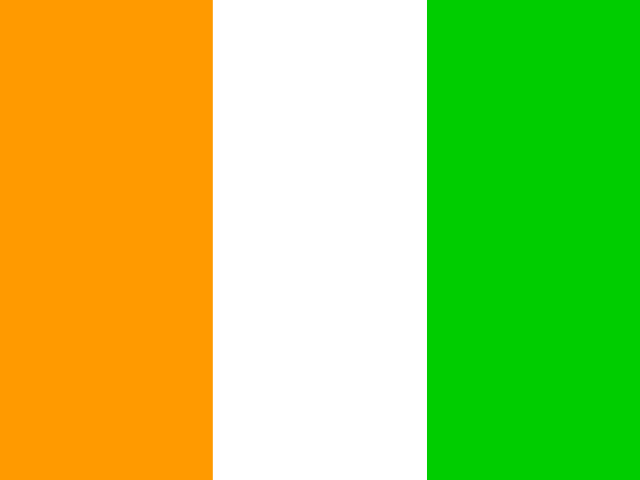
meaning: orange stands for the savannah and fertility, white for peace and unity, green for the forests of the south and the hope for a bright future; design based on France's flag
National symbol(s)
elephant
National color(s)
orange, white, green
National anthem(s)
lyrics/music: Mathieu EKRA, Joachim BONY, and Pierre Marie COTY/Pierre Marie COTY and Pierre Michel PANGO
history: adopted 1960; named after the former capital city of Abidjan
National heritage
selected World Heritage Site locales: Comoé National Park (n); Historic Grand-Bassam (c); Mount Nimba Strict Nature Reserve (n); Sudanese-style Mosques (c); Taï National Park (n)
Economy31
Economic overview
Real GDP (purchasing power parity)
Real GDP (purchasing power parity) 2023: $202.943 billion (2023 est.)
Real GDP (purchasing power parity) 2022: $190.645 billion (2022 est.)
Real GDP growth rate
Real GDP growth rate 2023: 6.5% (2023 est.)
Real GDP growth rate 2022: 6.4% (2022 est.)
Real GDP per capita
Real GDP per capita 2023: $6,500 (2023 est.)
Real GDP per capita 2022: $6,300 (2022 est.)
GDP (official exchange rate)
Inflation rate (consumer prices)
Inflation rate (consumer prices) 2023: 4.4% (2023 est.)
Inflation rate (consumer prices) 2022: 5.3% (2022 est.)
GDP - composition, by sector of origin
industry: 22.1% (2024 est.)
services: 53.9% (2024 est.)
GDP - composition, by end use
household consumption
government consumption
investment in fixed capital
investment in inventories
exports of goods and services
imports of goods and services
Agricultural products
Industries
foodstuffs, beverages; wood products, oil refining, gold mining, truck and bus assembly, textiles, fertilizer, building materials, electricity
Industrial production growth rate
Labor force
Unemployment rate
Unemployment rate 2023: 2.3% (2023 est.)
Unemployment rate 2022: 2.4% (2022 est.)
Youth unemployment rate (ages 15-24)
male: 3.5% (2024 est.)
female: 4.4% (2024 est.)
Population below poverty line
Gini Index coefficient - distribution of family income
Average household expenditures
on alcohol and tobacco: 3.2% of household expenditures (2023 est.)
Household income or consumption by percentage share
highest 10%: 27.8% (2021 est.)
Remittances
Remittances 2022: 1.5% of GDP (2022 est.)
Remittances 2021: 0.6% of GDP (2021 est.)
Budget
expenditures: $16.03 billion (2023 est.)
Public debt
Taxes and other revenues
Current account balance
Current account balance 2021: -$2.874 billion (2021 est.)
Current account balance 2020: -$1.974 billion (2020 est.)
Exports
Exports 2021: $16.23 billion (2021 est.)
Exports 2020: $13.232 billion (2020 est.)
Exports - partners
Exports - commodities
Imports
Imports 2021: $16.191 billion (2021 est.)
Imports 2020: $12.66 billion (2020 est.)
Imports - partners
Imports - commodities
Debt - external
Exchange rates
Currency
Exchange rates 2024
Exchange rates 2023
Exchange rates 2022
Exchange rates 2021
Exchange rates 2020
Energy6
Electricity access
electrification - urban areas: 95%
electrification - rural areas: 45.3%
Electricity
consumption: 8.746 billion kWh (2023 est.)
exports: 971 million kWh (2023 est.)
imports: 222.79 million kWh (2023 est.)
transmission/distribution losses: 1.638 billion kWh (2023 est.)
Electricity generation sources
solar: 0.2% of total installed capacity (2023 est.)
hydroelectricity: 30.1% of total installed capacity (2023 est.)
biomass and waste: 0.8% of total installed capacity (2023 est.)
Petroleum
refined petroleum consumption: 87,000 bbl/day (2023 est.)
crude oil estimated reserves: 100 million barrels (2021 est.)
Natural gas
consumption: 2.474 billion cubic meters (2023 est.)
proven reserves: 28.317 billion cubic meters (2021 est.)
Energy consumption per capita
Communications6
Telephones - fixed lines
subscriptions per 100 inhabitants: (2024 est.) less than 1
Telephones - mobile cellular
subscriptions per 100 inhabitants: 184 (2024 est.)
Broadcast media
Internet country code
.ci
Internet users
Broadband - fixed subscriptions
subscriptions per 100 inhabitants: 1 (2023 est.)
Transportation6
Civil aircraft registration country code prefix
TU
Airports
29 (2025)
Heliports
1 (2025)
Railways
narrow gauge: 660 km (2008) 1.000-m gauge
Merchant marine
by type: oil tanker 2, other 23
Ports
total ports
large
medium
small
very small
ports with oil terminals
key ports
Military & Security7
Military and security forces
Ministry of Security and Civil Protection: National Police (2025)
Military expenditures
Military Expenditures 2023: 0.9% of GDP (2023 est.)
Military Expenditures 2022: 0.9% of GDP (2022 est.)
Military Expenditures 2021: 1.1% of GDP (2021 est.)
Military Expenditures 2020: 1.1% of GDP (2020 est.)
Military and security service personnel strengths
approximately 25-30,000 active FACI, including Gendarmerie personnel (2025)
Military equipment inventories and acquisitions
Military service age and obligation
18-26 (up to 35 for healthcare professionals) years of age for voluntary military service for men and women; conscription is authorized but reportedly not enforced (2025)
Military deployments
180 Central African Republic (MINUSCA) (2025)
Military - note
the FACI has mutinied several times since the late 1990s, most recently in 2017, and has had a large role in the country’s political turmoil; it was established in 1960 from home defense units the French colonial government began standing up in 1950 (2025)
Transnational Issues1
Refugees and internally displaced persons
stateless persons: 930,978 (2024 est.)
Compare Côte d'Ivoire
See how Côte d'Ivoire compares to other countries side by side.
Compare Countries