Congo (Brazzaville)
Republic of the Congo
Population
6.10M
Area
342,000 km²
GDP
$15.72B
GDP Per Capita
$6,200
Pop. Density
18/km²
Quick Facts
Currency
FrCentral African CFA franc(XAF)
Calling Code
+242
Timezone
UTC+01:00
Languages
French, Kikongo, Lingala+more
Driving Side
right
Demonym
Congolese
Background
Historical Trends
GDP (USD)
↑94.7% since 2006Population
↑65.0% since 2006Life Expectancy at Birth
Latest: 65.8 yearsData source: World Bank Open Data
Geography20
Location
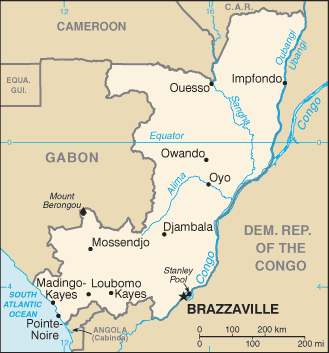
Central Africa, bordering the South Atlantic Ocean, between Angola and Gabon
Geographic coordinates
1 00 S, 15 00 E
Map references
Africa
Area
land: 341,500 sq km
water: 500 sq km
Area - comparative
slightly smaller than Montana; about twice the size of Florida
Land boundaries
border countries: Angola 231 km; Cameroon 494 km; Central African Republic 487 km; Democratic Republic of the Congo 1,775 km; Gabon 2,567 km
Coastline
169 km
Maritime claims
contiguous zone: 24 nm
exclusive economic zone: 200 nm
Climate
tropical; rainy season (March to June); dry season (June to October); persistent high temperatures and humidity; particularly enervating climate astride the Equator
Terrain
coastal plain, southern basin, central plateau, northern basin
Elevation
lowest point: Atlantic Ocean 0 m
mean elevation: 430 m
Natural resources
petroleum, timber, potash, lead, zinc, uranium, copper, phosphates, gold, magnesium, natural gas, hydropower
Land use
agricultural land
agricultural land: arable land
agricultural land: permanent crops
agricultural land: permanent pasture
forest
other
Irrigated land
20 sq km (2012)
Major rivers (by length in km)
note: [s] after country name indicates river source; [m] after country name indicates river mouth
Major watersheds (area sq km)
Major aquifers
Congo Basin
Population distribution
the population is primarily located in the south, in and around the capital of Brazzaville, as shown in this population distribution map
Natural hazards
seasonal flooding
Geography - note
about 70% of the population lives in Brazzaville, Pointe-Noire, or along the railroad between them
People & Society30
Population
male: 3,045,973
female: 3,051,692
Nationality
adjective: Congolese or Congo
Ethnic groups
Kongo (Bakongo) 40.5%, Teke 16.9%, Mbochi 13.1%, foreigner 8.2%, Sangha 5.6%, Mbere/Mbeti/Kele 4.4%, Punu 4.3%, Pygmy 1.6%, Oubanguiens 1.6%, Duma 1.5%, Makaa 1.3%, other and unspecified 1% (2014-15 est.)
Languages
major-language sample(s):
Buku oyo ya bosembo ya Mokili Mobimba Ezali na Makanisi ya Liboso Mpenza. (Lingala)
The World Factbook, the indispensable source for basic information.
Religions
Roman Catholic 33.1%, Awakening Churches/Christian Revival 22.3%, Protestant 19.9%, Salutiste 2.2%, Muslim 1.6%, Kimbanguist 1.5%, other 8.1%, none 11.3% (2007 est.)
Age structure
15-64 years: 57.8% (male 1,770,337/female 1,756,925)
65 years and over: 4.3% (2024 est.) (male 113,338/female 151,099)
Dependency ratios
youth dependency ratio: 65.4 (2024 est.)
elderly dependency ratio: 7.5 (2024 est.)
potential support ratio: 13.3 (2024 est.)
Median age
male: 20.5 years
female: 20.9 years
Population growth rate
2.36% (2025 est.)
Birth rate
28.34 births/1,000 population (2025 est.)
Death rate
4.64 deaths/1,000 population (2025 est.)
Net migration rate
-0.08 migrant(s)/1,000 population (2025 est.)
Population distribution
the population is primarily located in the south, in and around the capital of Brazzaville, as shown in this population distribution map
Urbanization
rate of urbanization: 3.19% annual rate of change (2020-25 est.)
Major urban areas - population
2.638 million BRAZZAVILLE (capital), 1.336 million Pointe-Noire (2023)
Sex ratio
0-14 years: 1.02 male(s)/female
15-64 years: 1.01 male(s)/female
65 years and over: 0.75 male(s)/female
total population: 1 male(s)/female (2024 est.)
Mother's mean age at first birth
Maternal mortality ratio
241 deaths/100,000 live births (2023 est.)
Infant mortality rate
male: 33.5 deaths/1,000 live births
female: 27.7 deaths/1,000 live births
Life expectancy at birth
male: 71.5 years
female: 74.3 years
Total fertility rate
3.72 children born/woman (2025 est.)
Gross reproduction rate
1.83 (2025 est.)
Health expenditure
Health expenditure (as % of national budget): 3.5% of national budget (2022 est.)
Physician density
0.17 physicians/1,000 population (2022)
Obesity - adult prevalence rate
9.6% (2016)
Alcohol consumption per capita
beer: 5.11 liters of pure alcohol (2019 est.)
wine: 0.1 liters of pure alcohol (2019 est.)
spirits: 0.52 liters of pure alcohol (2019 est.)
other alcohols: 0.01 liters of pure alcohol (2019 est.)
Tobacco use
male: 30% (2025 est.)
female: 1.7% (2025 est.)
Currently married women (ages 15-49)
51.8% (2023 est.)
Child marriage
women married by age 18: 27.3% (2015)
men married by age 18: 5.6% (2018 est.)
Education expenditure
Education expenditure (% national budget): 14.7% national budget (2023 est.)
Government25
Country name
conventional long form
conventional short form
local long form
local short form
former
etymology
Government type
presidential republic
Capital
geographic coordinates: 4 15 S, 15 17 E
time difference: UTC+1 (6 hours ahead of Washington, DC, during Standard Time)
etymology: named after the Italian-born French explorer and humanitarian, Pierre Savorgnan de BRAZZA (1852-1905), who founded the town in 1883
Administrative divisions
15 departments; Bouenza, Brazzaville, Congo-Oubangui, Cuvette, Cuvette-Ouest, Djoue-Lefini, Kouilou, Lekoumou, Likouala, Niari, Nkeni-Alima, Plateaux, Pointe-Noire, Pool, Sangha
Legal system
mixed system of French civil law and customary law
Constitution
amendment process: proposed by the president of the republic or by Parliament; passage of presidential proposals requires Supreme Court review followed by approval in a referendum; such proposals may also be submitted directly to Parliament, in which case passage requires at least three-quarters majority vote of both houses in joint session; proposals by Parliament require three-fourths majority vote of both houses in joint session; constitutional articles including those affecting the country’s territory, republican form of government, and secularity of the state are not amendable
International law organization participation
has not submitted an ICJ jurisdiction declaration; accepts ICCt jurisdiction
Citizenship
citizenship by descent only: at least one parent must be a citizen of the Republic of the Congo
dual citizenship recognized: no
residency requirement for naturalization: 10 years
Suffrage
18 years of age; universal
Executive branch
chief of state
head of government
cabinet
election/appointment process
most recent election date
election results
2021: Denis SASSOU-Nguesso reelected president in the first round; percent of vote - Denis SASSOU-Nguesso (PCT) 88.4%, Guy Price Parfait KOLELAS (MCDDI) 8.0%, other 3.6%
2016: Denis SASSOU-Nguesso reelected president in the first round; percent of vote - Denis SASSOU-Nguesso (PCT) 60.4%, Guy Price Parfait KOLELAS (MCDDI) 15.1%, Jean-Marie MOKOKO (independent) 13.9%, Pascal Tsaty MABIALA (UPADS) 4.4%, other 6.2%
expected date of next election
Legislative branch
legislative structure: bicameral
Legislative branch - lower chamber
chamber name
number of seats
electoral system
scope of elections
term in office
most recent election date
parties elected and seats per party
percentage of women in chamber
expected date of next election
Legislative branch - upper chamber
chamber name
number of seats
scope of elections
term in office
most recent election date
percentage of women in chamber
expected date of next election
Judicial branch
judge selection and term of office: Supreme Court judges elected by Parliament and serve until age 65; Constitutional Court members appointed by the president of the republic - 3 directly by the president and 6 nominated by Parliament; members appointed for renewable 9-year terms with one third of the membership renewed every 3 years
subordinate courts: Court of Audit and Budgetary Discipline; courts of appeal; regional and district courts; employment tribunals; juvenile courts
Political parties
Action Movement for Renewal or MAR
Citizen's Rally or RC
Congolese Labour Party or PCT
Congolese Movement for Democracy and Integral Development or MCDDI
Congo on the Move or LCEM
Movement for Unity, Solidarity, and Work or MUST
Pan-African Union for Social Development or UPADS
Club 2002-Party for the Unity and the Republic or Club 2002
Patriotic Union for Democracy and Progress or UPDP
Perspectives and Realities Club or CPR
Rally for Democracy and Social Progress or RDPS
Republican and Liberal Party or PRL
Union of Democratic Forces or UDF
Union for Democracy and Republic or UDR
Union of Humanist Democrats or UDH-YUKI
Union for the Republic or UR
Diplomatic representation in the US
chancery: 1720 16th Street NW, Washington, DC 20009
telephone: [1] (202) 726-5500
FAX: [1] (202) 726-1860
email address and website:
info@ambacongo-us.org
http://www.ambacongo-us.org/en-us/home.aspx
Diplomatic representation from the US
embassy: 70-83 Section D, Boulevard Denis Sassou N'Guesso, Brazzaville
mailing address: 2090 Brazzaville Place, Washington DC 20521-2090
telephone: [242] 06 612-2000, [242] 05 387-9700
email address and website:
BrazzavilleACS@state.gov
https://cg.usembassy.gov/
International organization participation
ACP, AfDB, AU, BDEAC, CEMAC, EITI (compliant country), FAO, FZ, G-77, IAEA, IBRD, ICAO, ICCt, ICRM, IDA, IFAD, IFC, IFRCS, ILO, IMF, IMO, Interpol, IOC, IOM, IPU, ISO (correspondent), ITSO, ITU, ITUC (NGOs), LCBC (observer), MIGA, NAM, OIF, OPCW, UN, UNCTAD, UNESCO, UNHCR, UNIDO, UNWTO, UPU, WCO, WFTU (NGOs), WHO, WIPO, WMO, WTO
Independence
15 August 1960 (from France)
National holiday
Independence Day, 15 August (1960)
Flag
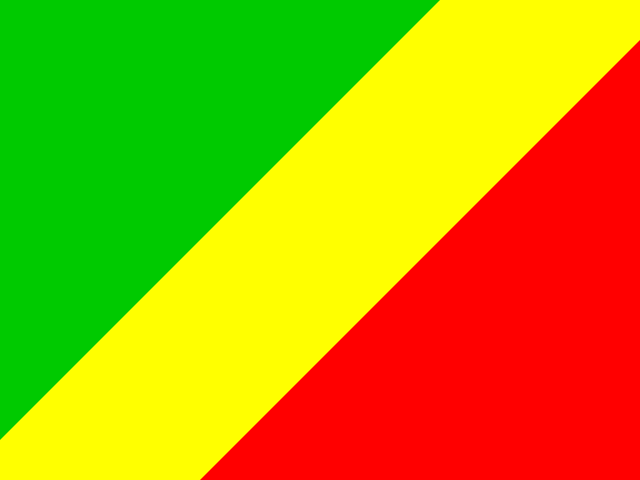
meaning: green stands for agriculture and forests, and yellow for the people's friendship and nobility; the meaning of the red color is not noted but has been associated with the struggle for independence
National symbol(s)
lion, elephant
National color(s)
green, yellow, red
National anthem(s)
lyrics/music: Jacques TONDRA and Georges KIBANGHI/Jean ROYER and Joseph SPADILIERE
history: originally adopted 1959, restored 1991
National heritage
selected World Heritage Site locales: Sangha Trinational Forest; Forest Massif of Odzala-Kokoua
Economy28
Economic overview
primarily an oil- and natural resources-based economy; recovery from mid-2010s oil devaluation has been slow and curtailed by COVID-19; extreme poverty increasing, particularly in southern rural regions; attempting to implement recommended CEMAC reforms; increasing likelihood of debt default
Real GDP (purchasing power parity)
Real GDP (purchasing power parity) 2023: $38.163 billion (2023 est.)
Real GDP (purchasing power parity) 2022: $37.448 billion (2022 est.)
Real GDP growth rate
Real GDP growth rate 2023: 1.9% (2023 est.)
Real GDP growth rate 2022: 1.5% (2022 est.)
Real GDP per capita
Real GDP per capita 2023: $6,200 (2023 est.)
Real GDP per capita 2022: $6,200 (2022 est.)
GDP (official exchange rate)
Inflation rate (consumer prices)
Inflation rate (consumer prices) 2023: 4.3% (2023 est.)
Inflation rate (consumer prices) 2022: 3% (2022 est.)
GDP - composition, by sector of origin
industry: 40.1% (2024 est.)
services: 45% (2024 est.)
GDP - composition, by end use
household consumption
government consumption
investment in fixed capital
investment in inventories
exports of goods and services
imports of goods and services
Agricultural products
Industries
petroleum extraction, cement, lumber, brewing, sugar, palm oil, soap, flour, cigarettes
Industrial production growth rate
Labor force
Unemployment rate
Unemployment rate 2023: 19.9% (2023 est.)
Unemployment rate 2022: 20.2% (2022 est.)
Youth unemployment rate (ages 15-24)
male: 41% (2024 est.)
female: 39% (2024 est.)
Remittances
Remittances 2022: 0.3% of GDP (2022 est.)
Remittances 2021: 0.3% of GDP (2021 est.)
Budget
expenditures: $3.231 billion (2020 est.)
Public debt
Taxes and other revenues
Current account balance
Current account balance 2020: $1.441 billion (2020 est.)
Current account balance 2019: $1.632 billion (2019 est.)
Exports
Exports 2020: $4.67 billion (2020 est.)
Exports 2019: $7.855 billion (2019 est.)
Exports - partners
Exports - commodities
Imports
Imports 2020: $3.279 billion (2020 est.)
Imports 2019: $4.945 billion (2019 est.)
Imports - partners
Imports - commodities
Reserves of foreign exchange and gold
Reserves of foreign exchange and gold 2022: $835.649 million (2022 est.)
Reserves of foreign exchange and gold 2021: $828.56 million (2021 est.)
Debt - external
Exchange rates
Currency
Exchange rates 2024
Exchange rates 2023
Exchange rates 2022
Exchange rates 2021
Exchange rates 2020
Energy7
Electricity access
electrification - urban areas: 67.5%
electrification - rural areas: 12.4%
Electricity
consumption: 2.832 billion kWh (2023 est.)
exports: 31 million kWh (2023 est.)
imports: 30.588 million kWh (2023 est.)
transmission/distribution losses: 2.335 billion kWh (2023 est.)
Electricity generation sources
solar: 0.2% of total installed capacity (2023 est.)
hydroelectricity: 20.2% of total installed capacity (2023 est.)
biomass and waste: 0.2% of total installed capacity (2023 est.)
Coal
Petroleum
refined petroleum consumption: 13,000 bbl/day (2023 est.)
crude oil estimated reserves: 2.882 billion barrels (2021 est.)
Natural gas
consumption: 425 million cubic meters (2023 est.)
proven reserves: 283.99 billion cubic meters (2021 est.)
Energy consumption per capita
Communications6
Telephones - fixed lines
subscriptions per 100 inhabitants: (2022 est.) less than 1
Telephones - mobile cellular
subscriptions per 100 inhabitants: 96 (2024 est.)
Broadcast media
1 state-owned TV and 3 state-owned radio stations; several privately owned TV and radio stations; satellite TV service is available; rebroadcasts of several international broadcasters are available
Internet country code
.cg
Internet users
Broadband - fixed subscriptions
subscriptions per 100 inhabitants: 1 (2023 est.)
Transportation5
Civil aircraft registration country code prefix
TN
Airports
56 (2025)
Railways
narrow gauge: 510 km (2014) 1.067-m gauge
Merchant marine
by type: oil tanker 1, other 10
Ports
total ports
large
medium
small
very small
ports with oil terminals
key ports
Military & Security7
Military and security forces
Ministry of Interior: National Police (2025)
Military expenditures
Military Expenditures 2023: 2% of GDP (2023 est.)
Military Expenditures 2022: 1.8% of GDP (2022 est.)
Military Expenditures 2021: 2.4% of GDP (2021 est.)
Military Expenditures 2020: 2.8% of GDP (2020 est.)
Military and security service personnel strengths
approximately 12-14,000 active FAC, including Gendarmerie (2025)
Military equipment inventories and acquisitions
the FAC has a mixed inventory of Chinese, French, Italian, Russian/Soviet, and South African armaments (2025)
Military service age and obligation
18-25 years of age for voluntary military service for men and women (2025)
Military deployments
has about 175 mostly police personnel deployed to the Central African Republic (MINUSCA) (2025)
Military - note
the FAC's primary focuses are internal and maritime security; since its creation in 1961, the FAC has had a turbulent history; it has been sidelined by some national leaders in favor of personal militias, endured an internal rebellion (1996), and clashed with various rebel groups and political or ethnic militias (1993-1996, 2002-2005, 2017); during the 1997-1999 civil war, the military generally split along ethnic lines, with most northern officers supporting eventual winner SASSOU-Nguesso, and most southerners backing the rebels; others joined ethnic-based factions loyal to regional warlords; forces backing SASSOU-Nguesso were supported by Angolan troops and received some French assistance; the FAC also has undergone at least three reorganizations that included the incorporation of former rebel combatants and various ethnic and political militias; in recent years, France has provided some advice and training, and a military cooperation agreement was signed with Russia in 2019 (2025)
Transnational Issues2
Refugees and internally displaced persons
Trafficking in persons
Compare Congo (Brazzaville)
See how Congo (Brazzaville) compares to other countries side by side.
Compare Countries