DRC
Democratic Republic of the Congo
Population
119.04M
Area
2,344,858 km²
GDP
$70.75B
GDP Per Capita
$1,500
Pop. Density
51/km²
Quick Facts
Currency
FCCongolese franc(CDF)
Calling Code
+243
Primary Timezone
UTC+01:00
Languages
French, Kikongo, Lingala +2+more
Driving Side
right
Demonym
Congolese
Background
The Republic of the Congo gained its independence from Belgium in 1960, but its early years were marred by instability. Col. Joseph MOBUTU seized power and declared himself president in a 1965 coup. He subsequently changed his name to MOBUTU Sese Seko and the country's name to Zaire. MOBUTU retained his position for 32 years, using sham elections and brute force. In 1994, a massive inflow of refugees from conflict in neighboring Rwanda and Burundi sparked ethnic strife and civil war. A rebellion backed by Rwanda and Uganda and fronted by Laurent KABILA toppled the MOBUTU regime in 1997. KABILA renamed the country the Democratic Republic of the Congo (DRC). In 1998, another insurrection -- again backed by Rwanda and Uganda -- challenged the KABILA regime, but troops from Angola, Chad, Namibia, Sudan, and Zimbabwe helped quell the uprising.
In 2001, KABILA was assassinated, and his son, Joseph KABILA, was named head of state. In 2002, the new president negotiated the withdrawal of Rwandan forces occupying the eastern DRC; the remaining warring parties subsequently signed the Pretoria Accord to end the fighting and establish a government of national unity. KABILA was elected as president in 2006 and 2011. The DRC constitution barred him from running for a third term, so in 2016, the DRC Government delayed national elections for two years. This fueled significant civil and political unrest, with sporadic street protests and exacerbation of tensions in the eastern DRC regions.
The results of the 2018 elections were disputed, but opposition candidate Felix TSHISEKEDI, son of long-time opposition leader Etienne TSHISEKEDI, was announced as the election winner. This was the first transfer of power to an opposition candidate without significant violence or a coup since 1960. In 2023, the DRC held its fourth electoral cycle since independence; TSHISEKEDI was proclaimed the winner despite some allegations of fraud, with his Sacred Union alliance retaining a large parliamentary majority.
The DRC continues to experience violence -- particularly in the East -- perpetrated by more than 100 armed groups active in the region, including the March 23 (M23) rebel group, the ISIS-affiliated Allied Democratic Forces (ADF, or ISIS-DRC), the Democratic Forces for the Liberation of Rwanda (FDLR), and assorted local militias known as Mai Mai militias. The UN Organization Stabilization Mission in the DRC (MONUSCO) has operated in the region since 1999 and is the largest and most expensive UN peacekeeping mission in the world.
Historical Trends
GDP (USD)
↑358.3% since 2006Population
↑80.3% since 2006Life Expectancy at Birth
Latest: 61.9 yearsData source: World Bank Open Data
Geography21
Location
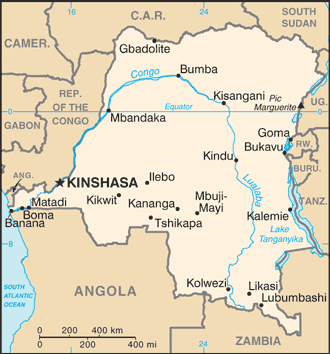
Central Africa, northeast of Angola
Geographic coordinates
0 00 N, 25 00 E
Map references
Africa
Area
land: 2,267,048 sq km
water: 77,810 sq km
Area - comparative
slightly less than one-fourth the size of the US
Land boundaries
border countries: Angola 2,646 km (of which 225 km is the boundary of Angola's discontiguous Cabinda Province); Burundi 236 km; Central African Republic 1,747 km; Republic of the Congo 1,775 km; Rwanda 221 km; South Sudan 714 km; Tanzania 479 km; Uganda 877 km; Zambia 2,332 km
Coastline
37 km
Maritime claims
exclusive economic zone: since 2011, the DRC has had a Common Interest Zone agreement with Angola for the mutual development of off-shore resources
Climate
tropical; hot and humid in equatorial river basin; cooler and drier in southern highlands; cooler and wetter in eastern highlands; north of Equator - wet season (April to October), dry season (December to February); south of Equator - wet season (November to March), dry season (April to October)
Terrain
vast central basin is a low-lying plateau; mountains in east
Elevation
lowest point: Atlantic Ocean 0 m
mean elevation: 726 m
Natural resources
note 2: the DROC is the World's leading producer of cobalt, accounting for as much as 70% of the World's supply; between 20-30% of this cobalt is produced in artisanal and small-scale mining operations
Land use
agricultural land
agricultural land: arable land
agricultural land: permanent crops
agricultural land: permanent pasture
forest
other
Irrigated land
110 sq km (2012)
Major lakes (area sq km)
Major rivers (by length in km)
Zaïre (Congo) river mouth (shared with Zambia [s], Angola, and Republic of Congo) - 2,920 km; Ubangi river mouth (shared with Central African Republic [s] and Republic of Congo) - 2,270 km
note: [s] after country name indicates river source; [m] after country name indicates river mouthMajor watersheds (area sq km)
Indian Ocean drainage: Zambezi (1,332,412 sq km)
Major aquifers
Congo Basin
Population distribution
urban clusters are spread throughout the country, particularly in the northeast along the border with Uganda, Rwanda, and Burundi; the largest city is the capital, Kinshasha, located in the west along the Congo River; the south is least densely populated, as shown in this population distribution map
Natural hazards
volcanism: the active volcano Nyiragongo (3,470 m) poses a major threat to the city of Goma, home to a quarter of a million people; it produces unusually fast-moving lava, known to travel up to 100 km/hr; Nyiragongo has been deemed a Decade Volcano by the International Association of Volcanology and Chemistry of the Earth's Interior, worthy of study due to its explosive history and close proximity to human populations; its neighbor Nyamuragira is Africa's most active volcano; Visoke is the only other historically active volcano
Geography - note
note 2: the Congo River, most of which flows through the DRC, has never been accurately measured along much of its length because of its speed, cataracts, rapids, and turbulence; nonetheless, it is conceded to be the deepest river in the world, with estimates of the point of greatest depth varying between 220 and 250 meters
People & Society34
Population
male: 59,509,076
female: 59,529,749
Nationality
adjective: Congolese or Congo
Ethnic groups
more than 200 African ethnic groups of which the majority are Bantu; the four largest groups - Mongo, Luba, Kongo (all Bantu), and the Mangbetu-Azande (Hamitic) - make up about 45% of the population
Languages
major-language sample(s):
Buku oyo ya bosembo ya Mokili Mobimba Ezali na Makanisi ya Liboso Mpenza. (Lingala)
The World Factbook, the indispensable source for basic information.
Religions
Age structure
15-64 years: 51.8% (male 29,845,450/female 29,884,958)
65 years and over: 2.5% (2024 est.) (male 1,258,442/female 1,621,018)
Dependency ratios
youth dependency ratio: 87.3 (2025 est.)
elderly dependency ratio: 4.8 (2025 est.)
potential support ratio: 20.8 (2025 est.)
Median age
male: 16.7 years
female: 17 years
Population growth rate
3.09% (2025 est.)
Birth rate
38.8 births/1,000 population (2025 est.)
Death rate
7.37 deaths/1,000 population (2025 est.)
Net migration rate
-0.5 migrant(s)/1,000 population (2025 est.)
Population distribution
urban clusters are spread throughout the country, particularly in the northeast along the border with Uganda, Rwanda, and Burundi; the largest city is the capital, Kinshasha, located in the west along the Congo River; the south is least densely populated, as shown in this population distribution map
Urbanization
rate of urbanization: 4.33% annual rate of change (2020-25 est.)
Major urban areas - population
16.316 million KINSHASA (capital), 2.892 million Mbuji-Mayi, 2.812 million Lubumbashi, 1.664 million Kananga, 1.423 million Kisangani, 1.249 million Bukavu (2023)
Sex ratio
0-14 years: 1.01 male(s)/female
15-64 years: 1 male(s)/female
65 years and over: 0.78 male(s)/female
total population: 1 male(s)/female (2024 est.)
Mother's mean age at first birth
Maternal mortality ratio
427 deaths/100,000 live births (2023 est.)
Infant mortality rate
male: 62.9 deaths/1,000 live births
female: 51.9 deaths/1,000 live births
Life expectancy at birth
male: 60.7 years
female: 64.6 years
Total fertility rate
5.42 children born/woman (2025 est.)
Gross reproduction rate
2.67 (2025 est.)
Drinking water source
improved: urban
improved: rural
improved: total
unimproved: urban
unimproved: rural
unimproved: total
Health expenditure
Health expenditure (as % of national budget): 4% of national budget (2022 est.)
Physician density
0.21 physicians/1,000 population (2022)
Sanitation facility access
improved: urban
improved: rural
improved: total
unimproved: urban
unimproved: rural
unimproved: total
Obesity - adult prevalence rate
6.7% (2016)
Alcohol consumption per capita
beer: 0.5 liters of pure alcohol (2019 est.)
wine: 0.01 liters of pure alcohol (2019 est.)
spirits: 0.05 liters of pure alcohol (2019 est.)
other alcohols: 0 liters of pure alcohol (2019 est.)
Tobacco use
male: 18.8% (2025 est.)
female: 2.3% (2025 est.)
Children under the age of 5 years underweight
25% (2023 est.)
Currently married women (ages 15-49)
58.2% (2018 est.)
Child marriage
women married by age 18: 29.1% (2018)
men married by age 18: 5.6% (2018)
Education expenditure
Education expenditure (% national budget): 13.5% national budget (2017 est.)
Literacy
male: 87.5% (2018 est.)
female: 61.6% (2018 est.)
Government25
Country name
conventional long form
conventional short form
local long form
local short form
former
abbreviation
etymology
Government type
semi-presidential republic
Capital
geographic coordinates: 4 19 S, 15 18 E
time difference: UTC+1 (6 hours ahead of Washington, DC, during Standard Time)
time zone note: the DRC has two time zones
etymology: founded as a trading post in 1881 and named Leopoldville in honor of King LEOPOLD II of the Belgians; in 1966, Leopoldville was renamed Kinshasa, a Bantu name of unknown meaning
Administrative divisions
26 provinces; Bas-Uele (Lower Uele), Equateur, Haut-Katanga (Upper Katanga), Haut-Lomami (Upper Lomami), Haut-Uele (Upper Uele), Ituri, Kasai, Kasai-Central, Kasai-Oriental (East Kasai), Kinshasa, Kongo Central, Kwango, Kwilu, Lomami, Lualaba, Mai-Ndombe, Maniema, Mongala, Nord-Kivu (North Kivu), Nord-Ubangi (North Ubangi), Sankuru, Sud-Kivu (South Kivu), Sud-Ubangi (South Ubangi), Tanganyika, Tshopo, Tshuapa
Legal system
civil law system primarily based on Belgian law, but also customary and tribal law
Constitution
amendment process: proposed by the president of the republic, by the government, by either house of Parliament, or by public petition; agreement on the substance of a proposed bill requires absolute majority vote in both houses; passage requires a referendum only if both houses in joint meeting fail to achieve three-fifths majority vote; constitutional articles, including the form of government, universal suffrage, judicial independence, political pluralism, and personal freedoms, cannot be amended
International law organization participation
accepts compulsory ICJ jurisdiction with reservations; accepts ICCt jurisdiction
Citizenship
citizenship by descent only: at least one parent must be a citizen of the Democratic Republic of the Congo
dual citizenship recognized: no
residency requirement for naturalization: 5 years
Suffrage
18 years of age; universal and compulsory
Executive branch
chief of state
head of government
cabinet
election/appointment process
most recent election date
election results
2023: Felix TSHISEKEDI reelected president; percent of vote - Felix TSHISEKEDI (UDPS) 73.3%, Moise KATUMBI (Ensemble) 18.8%, Martin FAYULU (ECIDE) 5.3%, other 2.6%
2018: Felix TSHISEKEDI elected president; percent of vote - Felix TSHISEKEDI (UDPS) 38.6%, Martin FAYULU (Lamuka coalition) 34.8%, Emmanuel Ramazani SHADARY (PPRD) 23.9%, other 2.7%
expected date of next election
Legislative branch
legislative structure: bicameral
Legislative branch - lower chamber
chamber name
number of seats
electoral system
scope of elections
term in office
most recent election date
parties elected and seats per party
percentage of women in chamber
expected date of next election
Legislative branch - upper chamber
chamber name
number of seats
scope of elections
term in office
most recent election date
percentage of women in chamber
expected date of next election
Judicial branch
judge selection and term of office: Court of Cassation judges nominated by the Judicial Service Council, an independent body of public prosecutors and selected judges of the lower courts; judge tenure NA; Constitutional Court judges - 3 nominated by the president, 3 by the Judicial Service Council, and 3 by the legislature; judges appointed by the president to serve 9-year non-renewable terms with one third of the membership renewed every 3 years
subordinate courts: State Security Court; Court of Appeals (organized into administrative and judiciary sections); Tribunal de Grande Instance; magistrates' courts; customary courts
Political parties
Congolese Rally for Democracy or RCD
Convention of Christian Democrats or CDC
Engagement for Citizenship and Development or ECIDE
Forces of Renewal or FR
Movement for the Liberation of the Congo or MLC
Nouvel Elan
Our Congo or CNB ("Congo Na Biso")
People's Party for Reconstruction and Democracy or PPRD
Social Movement for Renewal or MSR
Together for Change ("Ensemble")
Unified Lumumbist Party or PALU
Union for the Congolese Nation or UNC
Union for Democracy and Social Progress or UDPS
Diplomatic representation in the US
chief of mission
chancery
telephone
FAX
email address and website
ambassade@ambardcusa.org
https://www.ambardcusa.org/
representative office
Diplomatic representation from the US
chief of mission
embassy
mailing address
telephone
FAX
email address and website
ACSKinshasa@state.gov
https://cd.usembassy.gov/
International organization participation
ACP, AfDB, AU, CEMAC, CEPGL, COMESA, EAC, EITI (compliant country), FAO, G-24, G-77, IAEA, IBRD, ICAO, ICC (NGOs), ICCt, ICRM, IDA, IFAD, IFC, IFRCS, IHO, ILO, IMF, IMO, Interpol, IOC, IOM, IPU, ISO, ITSO, ITU, ITUC (NGOs), LCBC (observer), MIGA, NAM, OIF, OPCW, PCA, SADC, UN, UNCTAD, UNESCO, UNHCR, UNIDO, UNWTO, UPU, WCO, WFTU (NGOs), WHO, WIPO, WMO, WTO
Independence
30 June 1960 (from Belgium)
National holiday
Independence Day, 30 June (1960)
Flag
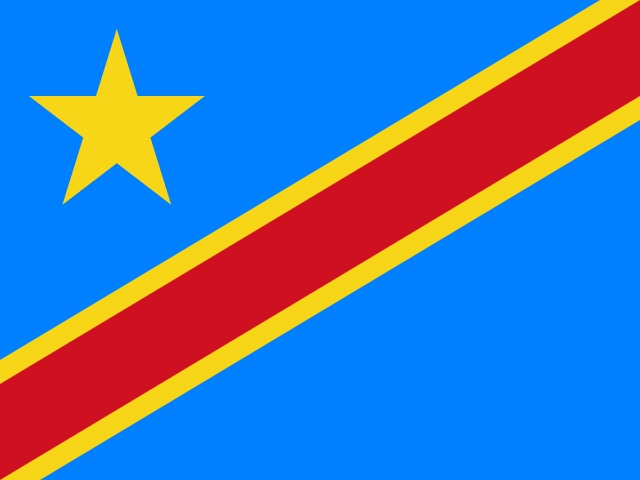
meaning: blue stands for peace and hope, red for the blood of the country's martyrs, and yellow for the country's wealth and prosperity; the star symbolizes unity and a brilliant future for the country
National symbol(s)
leopard
National color(s)
sky blue, red, yellow
National anthem(s)
lyrics/music: Joseph LUTUMBA/Simon-Pierre BOKA di Mpasi Londi
history: adopted 1960; replaced when the country was known as Zaire, but readopted in 1997
National heritage
selected World Heritage Site locales: Garamba National Park; Kahuzi-Biega National Park; Okapi Wildlife Reserve; Salonga National Park; Virunga National Park
Economy31
Economic overview
Real GDP (purchasing power parity)
Real GDP (purchasing power parity) 2023: $154.081 billion (2023 est.)
Real GDP (purchasing power parity) 2022: $141.867 billion (2022 est.)
Real GDP growth rate
Real GDP growth rate 2023: 8.6% (2023 est.)
Real GDP growth rate 2022: 8.9% (2022 est.)
Real GDP per capita
Real GDP per capita 2023: $1,500 (2023 est.)
Real GDP per capita 2022: $1,400 (2022 est.)
GDP (official exchange rate)
Inflation rate (consumer prices)
Inflation rate (consumer prices) 2016: 2.9% (2016 est.)
Inflation rate (consumer prices) 2015: 0.7% (2015 est.)
GDP - composition, by sector of origin
industry: 46.6% (2024 est.)
services: 33% (2024 est.)
GDP - composition, by end use
household consumption
government consumption
investment in fixed capital
investment in inventories
exports of goods and services
imports of goods and services
Agricultural products
Industries
mining (copper, cobalt, gold, diamonds, coltan, zinc, tin, tungsten), mineral processing, consumer products (textiles, plastics, footwear, cigarettes), metal products, processed foods and beverages, timber, cement, commercial ship repair
Industrial production growth rate
Labor force
Unemployment rate
Unemployment rate 2023: 4.5% (2023 est.)
Unemployment rate 2022: 4.6% (2022 est.)
Youth unemployment rate (ages 15-24)
male: 10.8% (2024 est.)
female: 6.6% (2024 est.)
Population below poverty line
Gini Index coefficient - distribution of family income
Household income or consumption by percentage share
highest 10%: 35.7% (2020 est.)
Remittances
Remittances 2022: 5% of GDP (2022 est.)
Remittances 2021: 2.4% of GDP (2021 est.)
Budget
expenditures: $13.026 billion (2022 est.)
Public debt
Taxes and other revenues
Current account balance
Current account balance 2022: -$3.148 billion (2022 est.)
Current account balance 2021: -$587.407 million (2021 est.)
Exports
Exports 2022: $28.753 billion (2022 est.)
Exports 2021: $22.354 billion (2021 est.)
Exports - partners
Exports - commodities
Imports
Imports 2022: $31.699 billion (2022 est.)
Imports 2021: $22.193 billion (2021 est.)
Imports - partners
Imports - commodities
Reserves of foreign exchange and gold
Reserves of foreign exchange and gold 2022: $4.378 billion (2022 est.)
Reserves of foreign exchange and gold 2021: $3.467 billion (2021 est.)
Debt - external
Exchange rates
Currency
Exchange rates 2023
Exchange rates 2022
Exchange rates 2021
Exchange rates 2020
Exchange rates 2019
Energy7
Electricity access
electrification - urban areas: 45.3%
electrification - rural areas: 1%
Electricity
consumption: 16.069 billion kWh (2023 est.)
exports: 62 million kWh (2023 est.)
imports: 1.473 billion kWh (2023 est.)
transmission/distribution losses: 1.242 billion kWh (2023 est.)
Electricity generation sources
hydroelectricity: 86% of total installed capacity (2023 est.)
biomass and waste: 0.2% of total installed capacity (2023 est.)
Coal
imports: 304,000 metric tons (2023 est.)
proven reserves: 987.999 million metric tons (2023 est.)
Petroleum
refined petroleum consumption: 35,000 bbl/day (2023 est.)
crude oil estimated reserves: 180 million barrels (2021 est.)
Natural gas
consumption: 380,000 cubic meters (2019 est.)
proven reserves: 991.09 million cubic meters (2021 est.)
Energy consumption per capita
Communications6
Telephones - fixed lines
subscriptions per 100 inhabitants: (2023 est.) less than 1
Telephones - mobile cellular
subscriptions per 100 inhabitants: 53 (2023 est.)
Broadcast media
state-owned TV station with near-national coverage; more than a dozen privately owned TV stations, including 2 with near-national coverage; 2 state-owned radio stations and over 100 private radio stations; transmissions of at least 2 international broadcasters are available
Internet country code
.cd
Internet users
Broadband - fixed subscriptions
subscriptions per 100 inhabitants: (2022 est.) less than 1
Transportation6
Civil aircraft registration country code prefix
9Q
Airports
273 (2025)
Heliports
1 (2025)
Railways
narrow gauge: 3,882 km (2014) 1.067-m gauge (858 km electrified)
Merchant marine
by type: general cargo 5, oil tanker 2, other 17
Ports
total ports
large
medium
small
very small
ports with oil terminals
key ports
Military & Security6
Military and security forces
Ministry of Interior: Congolese National Police (Police Nationale Congolaise, PNC) (2025)
note 2: community-based self-defense groups, known as Wazalendo militias, are also active in areas contested by illegal armed groups, such as M23
Military expenditures
Military Expenditures 2023: 1.2% of GDP (2023 est.)
Military Expenditures 2022: 0.7% of GDP (2022 est.)
Military Expenditures 2021: 0.7% of GDP (2021 est.)
Military Expenditures 2020: 0.7% of GDP (2020 est.)
Military and security service personnel strengths
estimated 100-150,000 active FARDC (2025)
Military equipment inventories and acquisitions
the FARDC is equipped mostly with Soviet-era and older French armaments; in recent years, it has received some more modern equipment, such as armored vehicles and armed drones, from China, South Africa, Turkey, and the UAE (2025)
Military service age and obligation
Military - note
the UN Organization Stabilization Mission in the Democratic Republic of the Congo (MONUSCO) has operated in the central and eastern parts of the country since 1999; its mandate had been extended to the end of 2026; MONUSCO includes a Force Intervention Brigade (FIB), the first ever UN peacekeeping force specifically tasked to carry out targeted offensive operations to neutralize and disarm groups considered a threat to state authority and civilian security (2025)
Transnational Issues2
Refugees and internally displaced persons
IDPs: 6,895,648 (2024 est.)