Eritrea
State of Eritrea
Population
6.42M
Area
117,600 km²
GDP
$2.54B
GDP Per Capita
$700
Pop. Density
55/km²
Quick Facts
Currency
NfkEritrean nakfa(ERN)
Calling Code
+291
Timezone
UTC+03:00
Languages
Arabic, English, Tigrinya+more
Driving Side
right
Demonym
Eritrean
Background
A two-and-a-half-year border war with Ethiopia that erupted in 1998 ended under UN auspices in 2000. Ethiopia rejected a subsequent 2007 Eritrea-Ethiopia Boundary Commission (EEBC) demarcation. More than a decade of a tense “no peace, no war” stalemate ended in 2018 when the newly elected Ethiopian prime minister accepted the EEBC’s 2007 ruling, and the two countries signed declarations of peace and friendship. Eritrean leaders then engaged in intensive diplomacy around the Horn of Africa, bolstering regional peace, security, and cooperation, as well as brokering rapprochements between governments and opposition groups. In 2018, the UN Security Council lifted an arms embargo that had been imposed on Eritrea since 2009, after the UN Somalia-Eritrea Monitoring Group reported they had not found evidence of Eritrean support in recent years for al-Shabaab. The country’s rapprochement with Ethiopia led to a resumption of economic ties, but the level of air transport, trade, and tourism have remained roughly the same since late 2020.
The Eritrean economy remains agriculture-dependent, and the country is still one of Africa’s poorest nations. Eritrea faced new international condemnation and US sanctions in mid-2021 for its participation in the war in Ethiopia’s Tigray Regional State, where Eritrean forces were found to have committed war crimes and crimes against humanity. As most Eritrean troops were departing northern Ethiopia in January 2023, ISAIAS began a series of diplomatic engagements aimed at bolstering Eritrea’s foreign partnerships and regional influence. Despite the country's improved relations with its neighbors, ISAIAS has not let up on repression, and conscription and militarization continue.
Historical Trends
GDP (USD)
↑70.5% since 2006Population
↑30.8% since 2006Life Expectancy at Birth
Latest: 68.6 yearsData source: World Bank Open Data
Geography17
Location
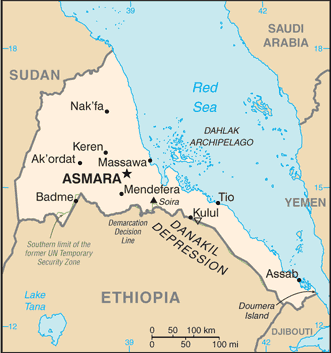
Eastern Africa, bordering the Red Sea, between Djibouti and Sudan
Geographic coordinates
15 00 N, 39 00 E
Map references
Africa
Area
land: 101,000 sq km
water: 16,600 sq km
Area - comparative
slightly smaller than Pennsylvania
Land boundaries
border countries: Djibouti 125 km; Ethiopia 1,033 km; Sudan 682 km
Coastline
2,234 km (mainland on Red Sea 1,151 km; islands in Red Sea 1,083 km)
Maritime claims
Climate
hot, dry desert strip along Red Sea coast; cooler and wetter in the central highlands (up to 61 cm of rainfall annually, heaviest June to September); semiarid in western hills and lowlands
Terrain
dominated by extension of Ethiopian north-south trending highlands, descending on the east to a coastal desert plain, on the northwest to hilly terrain and on the southwest to flat-to-rolling plains
Elevation
lowest point: near Kulul within the Danakil Depression -75 m
mean elevation: 853 m
Natural resources
gold, potash, zinc, copper, salt, possibly oil and natural gas, fish
Land use
agricultural land
agricultural land: arable land
agricultural land: permanent crops
agricultural land: permanent pasture
forest
other
Irrigated land
210 sq km (2012)
Population distribution
density is highest in the center of the country, in and around the cities of Asmara (capital) and Keren; smaller settlements exist in the north and south, as shown in this population distribution map
Natural hazards
volcanism: Dubbi (1,625 m), which last erupted in 1861, was the country's only historically active volcano until Nabro (2,218 m) came to life in 2011
Geography - note
strategic geopolitical position along world's busiest shipping lanes
People & Society29
Population
male: 3,158,281
female: 3,258,154
Nationality
adjective: Eritrean
Ethnic groups
Languages
Tigrinya (official), Arabic (official), English (official), Tigre, Kunama, Afar, other Cushitic languages
Religions
Eritrean Orthodox, Roman Catholic, Evangelical Lutheran, Sunni Muslim
Age structure
15-64 years: 60.3% (male 1,882,547/female 1,944,266)
65 years and over: 4% (2024 est.) (male 101,504/female 153,332)
Dependency ratios
youth dependency ratio: 57.6 (2025 est.)
elderly dependency ratio: 6.6 (2025 est.)
potential support ratio: 15.1 (2025 est.)
Median age
male: 20.8 years
female: 21.8 years
Population growth rate
1.16% (2025 est.)
Birth rate
25.92 births/1,000 population (2025 est.)
Death rate
6.43 deaths/1,000 population (2025 est.)
Net migration rate
-7.95 migrant(s)/1,000 population (2025 est.)
Population distribution
density is highest in the center of the country, in and around the cities of Asmara (capital) and Keren; smaller settlements exist in the north and south, as shown in this population distribution map
Urbanization
rate of urbanization: 3.67% annual rate of change (2020-25 est.)
Major urban areas - population
1.073 million ASMARA (capital) (2023)
Sex ratio
0-14 years: 1.01 male(s)/female
15-64 years: 0.97 male(s)/female
65 years and over: 0.66 male(s)/female
total population: 0.97 male(s)/female (2024 est.)
Mother's mean age at first birth
Maternal mortality ratio
291 deaths/100,000 live births (2023 est.)
Infant mortality rate
male: 46.6 deaths/1,000 live births
female: 32.8 deaths/1,000 live births
Life expectancy at birth
male: 64.9 years
female: 70.2 years
Total fertility rate
3.35 children born/woman (2025 est.)
Gross reproduction rate
1.65 (2025 est.)
Health expenditure
Health expenditure (as % of national budget): 2.4% of national budget (2022 est.)
Physician density
0.09 physicians/1,000 population (2022)
Hospital bed density
1 beds/1,000 population (2020 est.)
Obesity - adult prevalence rate
5% (2016)
Alcohol consumption per capita
beer: 0.42 liters of pure alcohol (2019 est.)
wine: 0 liters of pure alcohol (2019 est.)
spirits: 0 liters of pure alcohol (2019 est.)
other alcohols: 0.51 liters of pure alcohol (2019 est.)
Tobacco use
male: 14.7% (2020 est.)
female: 0.2% (2020 est.)
School life expectancy (primary to tertiary education)
male: 9 years (2015 est.)
female: 7 years (2015 est.)
Government24
Country name
conventional long form
conventional short form
local long form
local short form
former
etymology
Government type
authoritarian
Capital
geographic coordinates: 15 20 N, 38 56 E
time difference: UTC+3 (8 hours ahead of Washington, DC, during Standard Time)
etymology: the name's origin is unclear; according to Tigrinya oral tradition, the name is part of a phrase meaning "the women made them unite," referring to a group of women who made four clans unite to defeat a common enemy; asmara also means "flowery wood" in the Tigrinya language
Administrative divisions
Legal system
mixed system of civil, customary, and Islamic religious law
Constitution
amendment process: proposed by the president of Eritrea or by assent of at least one half of the National Assembly membership; passage requires at least an initial three-quarters majority vote by the Assembly and, after one year, final passage by at least four-fifths majority vote by the Assembly
International law organization participation
has not submitted an ICJ jurisdiction declaration; non-party state to the ICCt
Citizenship
citizenship by descent only: at least one parent must be a citizen of Eritrea
dual citizenship recognized: no
residency requirement for naturalization: 20 years
Suffrage
18 years of age; universal
Executive branch
chief of state
head of government
cabinet
election/appointment process
most recent election date
election results
1993: ISAIAS Afwerki elected president by the transitional National Assembly; percent of National Assembly vote - ISAIAS Afwerki (PFDJ) 95%, other 5%
expected date of next election
Legislative branch
legislature name
legislative structure
number of seats
scope of elections
term in office
most recent election date
Judicial branch
judge selection and term of office: High Court judges appointed by the president
subordinate courts: regional/zonal courts; community courts; special courts; sharia courts (for issues dealing with Muslim marriage, inheritance, and family); military courts
Political parties
People's Front for Democracy and Justice or PFDJ (the only party recognized by the government)
Diplomatic representation in the US
chancery: 1708 New Hampshire Avenue NW, Washington, DC 20009
telephone: [1] (202) 319-1991
FAX: [1] (202) 319-1304
email address and website:
embassyeritrea@embassyeritrea.org
https://us.embassyeritrea.org/
Diplomatic representation from the US
chief of mission
embassy
mailing address
telephone
FAX
email address and website
consularasmara@state.gov
https://er.usembassy.gov/
International organization participation
ACP, AfDB, AU, COMESA, FAO, G-77, IAEA, IBRD, ICAO, ICC (NGOs), IDA, IFAD, IFC, IFRCS (observer), IGAD, ILO, IMF, IMO, Interpol, IOC, ISO (correspondent), ITU, ITUC (NGOs), LAS (observer), MIGA, NAM, OPCW, PCA, UN, UNCTAD, UNESCO, UNHRC, UNIDO, UNWTO, UPU, WCO, WFTU (NGOs), WHO, WIPO, WMO
Independence
24 May 1993 (from Ethiopia)
National holiday
Independence Day, 24 May (1991)
Flag
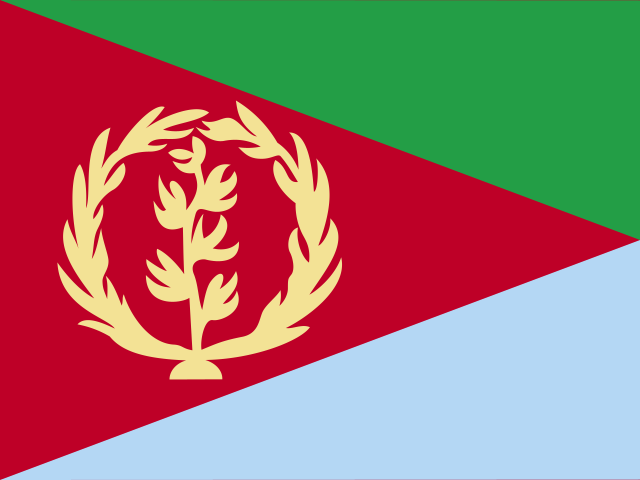
meaning: green stands for the country's agriculture economy, red for the blood shed in the fight for freedom, and blue for the sea's bounty; the shape of the red triangle mimics the country's shape
National symbol(s)
camel
National color(s)
green, red, blue
National coat of arms
National anthem(s)
lyrics/music: SOLOMON Tsehaye Beraki/Isaac Abraham MEHAREZGI and ARON Tekle Tesfatsion
history: adopted 1993, after gaining independence from Ethiopia
National heritage
selected World Heritage Site locales: Asmara: A Modernist African City
Economy22
Economic overview
largely agrarian economy with a significant mining sector; substantial fiscal surplus due to tight controls; high and vulnerable debts; increased Ethiopian trade and shared port usage decreasing prices; financial and economic data integrity challenges
Real GDP (purchasing power parity)
Real GDP (purchasing power parity) 2023: $2.465 billion (2023 est.)
Real GDP (purchasing power parity) 2022: $2.398 billion (2022 est.)
Real GDP growth rate
Real GDP growth rate 2016: 1.9% (2016 est.)
Real GDP growth rate 2015: 2.6% (2015 est.)
Real GDP per capita
Real GDP per capita 2023: $700 (2023 est.)
Real GDP per capita 2022: $700 (2022 est.)
GDP (official exchange rate)
Inflation rate (consumer prices)
Inflation rate (consumer prices) 2021: 6.6% (2021 est.)
Inflation rate (consumer prices) 2020: 5.6% (2020 est.)
Agricultural products
Industries
food processing, beverages, clothing and textiles, light manufacturing, salt, cement
Labor force
Unemployment rate
Unemployment rate 2023: 5.6% (2023 est.)
Unemployment rate 2022: 5.7% (2022 est.)
Youth unemployment rate (ages 15-24)
male: 8.5% (2024 est.)
female: 10.5% (2024 est.)
Budget
expenditures: $549 million (2018 est.)
Public debt
Exports
Exports 2016: $485.4 million (2016 est.)
Exports 2011: $374.898 million (2011 est.)
Exports - partners
Exports - commodities
Imports
Imports 2009: $435.275 million (2009 est.)
Imports - partners
Imports - commodities
Reserves of foreign exchange and gold
Reserves of foreign exchange and gold 2018: $163.034 million (2018 est.)
Reserves of foreign exchange and gold 2017: $143.412 million (2017 est.)
Debt - external
Exchange rates
Currency
Exchange rates 2024
Exchange rates 2023
Exchange rates 2022
Exchange rates 2021
Exchange rates 2020
Energy5
Electricity access
electrification - urban areas: 75.5%
electrification - rural areas: 36%
Electricity
consumption: 388.987 million kWh (2023 est.)
transmission/distribution losses: 51.528 million kWh (2023 est.)
Electricity generation sources
solar: 10.7% of total installed capacity (2023 est.)
wind: 0.2% of total installed capacity (2023 est.)
Petroleum
Energy consumption per capita
Communications6
Telephones - fixed lines
subscriptions per 100 inhabitants: 2 (2022 est.)
Telephones - mobile cellular
subscriptions per 100 inhabitants: 59 (2022 est.)
Broadcast media
government controls broadcast media, with private ownership prohibited; 1 state-owned TV station; 2 state-owned radio networks; purchases of satellite dishes and subscriptions to international broadcast media are permitted (2023)
Internet country code
.er
Internet users
Broadband - fixed subscriptions
subscriptions per 100 inhabitants: (2022 est.) less than 1
Transportation5
Civil aircraft registration country code prefix
E3
Airports
11 (2025)
Railways
narrow gauge: 306 km (2018) 0.950-m gauge
Merchant marine
by type: general cargo 4, oil tanker 1, other 4
Ports
total ports
large
medium
small
very small
ports with oil terminals
key ports
Military & Security6
Military and security forces
Military expenditures
Military Expenditures 2018: 10.2% of GDP (2018 est.)
Military Expenditures 2017: 10.3% of GDP (2017 est.)
Military Expenditures 2016: 10.4% of GDP (2016 est.)
Military Expenditures 2015: 10.6% of GDP (2015 est.)
Military and security service personnel strengths
available information varies widely; estimated 150,000-200,000 active Defense Forces (2025)
Military equipment inventories and acquisitions
the EDF's inventory is comprised primarily of Soviet-era weapons and equipment (2025)
Military service age and obligation
Eritrea mandates military service for all citizens age 18-40; 18-month conscript service obligation, which reportedly includes 4-6 months of military training and 12 months of military or other national service (military service is most common); in practice, military and national service is often extended indefinitely; citizens up to the age of 59 eligible for recall during mobilization (2025)
Military - note
since the country's independence in 1991, the Eritrean military has participated in numerous conflicts, including the Hanish Island Crisis with Yemen (1995), the First Congo War (1996-1997), the Second Sudanese Civil War (1996-1998), the Eritrea-Ethiopia War (1998-2000), the Djiboutian-Eritrean border conflict (2008), and the Tigray conflict in Ethiopia (2020-2022); during the Tigray conflict, the Eritrean Defense Forces were accused of human rights abuses; in recent years, it has provided training support to the military of Somalia (2025)