Faroe Islands
Population
52.9K
Area
1,393 km²
GDP
$3.91B
GDP Per Capita
$70,400
Pop. Density
38/km²
Quick Facts
Currency
krDanish krone(DKK)
Calling Code
+298
Timezone
UTC+00:00
Languages
Danish, Faroese+more
Driving Side
right
Demonym
Faroese
Background
Geography16
Location
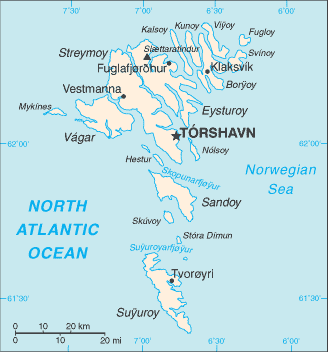
Northern Europe, island group between the Norwegian Sea and the North Atlantic Ocean, about halfway between Iceland and Norway
Geographic coordinates
62 00 N, 7 00 W
Map references
Europe
Area
land: 1,393 sq km
water: 0 sq km (some lakes and streams)
Area - comparative
eight times the size of Washington, D.C.
Land boundaries
Coastline
1,117 km
Maritime claims
continental shelf: 200 nm or agreed boundaries or median line
exclusive fishing zone: 200 nm or agreed boundaries or median line
Climate
mild winters, cool summers; usually overcast; foggy, windy
Terrain
rugged, rocky, some low peaks; cliffs along most of coast
Elevation
lowest point: Atlantic Ocean 0 m
Natural resources
fish, whales, hydropower, possible oil and gas
Land use
agricultural land
agricultural land: arable land
agricultural land: permanent crops
agricultural land: permanent pasture
forest
other
Population distribution
the island of Streymoy is by far the most populous with over 40% of the population; it has approximately twice as many inhabitants as Eysturoy, the second most populous island; seven of the inhabited islands have fewer than 100 people
Natural hazards
strong winds and heavy rains can occur throughout the year
Geography - note
archipelago of 17 inhabited islands, one uninhabited island, and a few uninhabited islets; strategically located along important sea lanes in northeastern Atlantic; precipitous terrain limits habitation to small coastal lowlands
People & Society24
Population
male: 27,400
female: 25,533
Nationality
adjective: Faroese
Ethnic groups
Languages
Religions
Christian 87% (predominantly Evangelical Lutheran), other 0.9%, none 3.7%, unspecified 8.9% (2011 est.)
Age structure
15-64 years: 61.5% (male 17,188/female 15,346)
65 years and over: 18.5% (2024 est.) (male 4,723/female 5,065)
Dependency ratios
youth dependency ratio: 32.6 (2024 est.)
elderly dependency ratio: 30.1 (2024 est.)
potential support ratio: 3.3 (2024 est.)
Median age
male: 36.9 years
female: 36.8 years
Population growth rate
0.62% (2025 est.)
Birth rate
14.76 births/1,000 population (2025 est.)
Death rate
8.58 deaths/1,000 population (2025 est.)
Net migration rate
0 migrant(s)/1,000 population (2025 est.)
Population distribution
the island of Streymoy is by far the most populous with over 40% of the population; it has approximately twice as many inhabitants as Eysturoy, the second most populous island; seven of the inhabited islands have fewer than 100 people
Urbanization
rate of urbanization: 0.89% annual rate of change (2020-25 est.)
Major urban areas - population
21,000 TORSHAVN (capital) (2018)
Sex ratio
0-14 years: 1.07 male(s)/female
15-64 years: 1.12 male(s)/female
65 years and over: 0.93 male(s)/female
total population: 1.07 male(s)/female (2024 est.)
Infant mortality rate
male: 6.3 deaths/1,000 live births
female: 5.1 deaths/1,000 live births
Life expectancy at birth
male: 79.2 years
female: 84.4 years
Total fertility rate
2.26 children born/woman (2025 est.)
Gross reproduction rate
1.09 (2025 est.)
Drinking water source
improved: urban
improved: rural
improved: total
unimproved: urban
unimproved: rural
unimproved: total
Physician density
2.62 physicians/1,000 population (2016)
Currently married women (ages 15-49)
52.3% (2021 est.)
Education expenditure
7.6% of GDP (2019 est.)
Government21
Country name
conventional short form: Faroe Islands
local long form: none
local short form: Foroyar
etymology: the archipelago's name derives from the Old Norse name Faeroyar, meaning "sheep islands;" faer means "sheep," and -oyar means "islands"
Government type
parliamentary democracy (Faroese Parliament); part of the Kingdom of Denmark
Dependency status
part of the Kingdom of Denmark; self-governing overseas administrative division of Denmark since 1948
Capital
geographic coordinates: 62 00 N, 6 46 W
time difference: UTC 0 (5 hours ahead of Washington, DC, during Standard Time)
daylight saving time: +1hr, begins last Sunday in March; ends last Sunday in October
etymology: the name means "Thor's harbor" in Danish
Administrative divisions
Legal system
Constitution
amendment process: see entry for Denmark
Citizenship
see Denmark
Suffrage
18 years of age; universal
Executive branch
chief of state
head of government
cabinet
election/appointment process
most recent election date
expected date of next election
Legislative branch
legislature name
legislative structure
number of seats
electoral system
scope of elections
term in office
most recent election date
parties elected and seats per party
percentage of women in chamber
expected date of next election
Judicial branch
subordinate courts: Court of the First Instance or Tribunal de Première Instance; Court of Administrative Law or Tribunal Administratif; Mixed Commercial Court; Land Court
Political parties
People's Party or A (Folkaflokkurin)
Progress Party or F (Framsokn)
Republic or E (Tjodveldi) (formerly the Republican Party)
Social Democratic Party or JF (Javnadarflokkurin) or JF
Union Party or B (Sambandsflokkurin)
Diplomatic representation in the US
none (self-governing overseas administrative division of Denmark)
Diplomatic representation from the US
International organization participation
Arctic Council, IMO (associate), NC, NIB, UNESCO (associate), UPU
Independence
none (self-governing overseas administrative division of Denmark)
National holiday
Flag
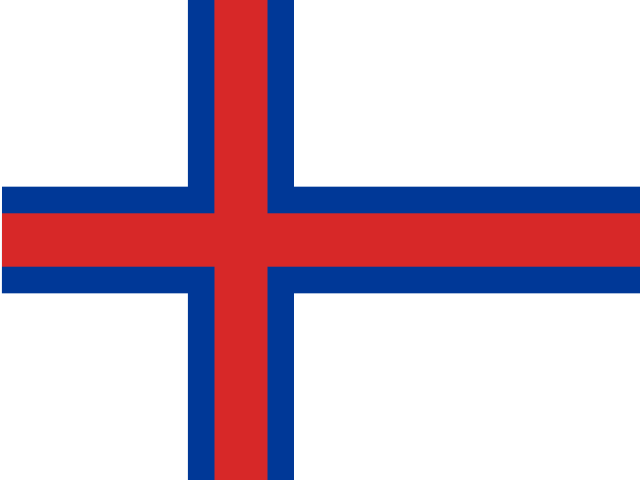
meaning: white represents waves breaking on the shore; red and blue are traditional Faroese colors
history: the flag is referred to as Merkid, meaning "the banner" or "the mark;" a group of students designed it in 1919, although it wasn't officially adopted until 1940
National symbol(s)
ram
National anthem(s)
lyrics/music: Simun av SKAROI/Peter ALBERG
history: adopted 1948; the anthem is also known as "Tu alfagra land mitt" (Thou Fairest Land of Mine); as a self-governing overseas administrative division of Denmark, the Faroe Islands are permitted to have their own national anthem
Economy17
Economic overview
high-income Danish territorial economy; party neither to the EU nor the Schengen Area; associate Nordic Council member; very low unemployment; unique foreign ownership allowance in fishing industry; known salmon exporter; growing IT industries
Real GDP (purchasing power parity)
Real GDP (purchasing power parity) 2022: $3.741 billion (2022 est.)
Real GDP (purchasing power parity) 2021: $3.613 billion (2021 est.)
Real GDP growth rate
Real GDP growth rate 2022: 3.6% (2022 est.)
Real GDP growth rate 2021: 5.5% (2021 est.)
Real GDP per capita
Real GDP per capita 2022: $69,400 (2022 est.)
Real GDP per capita 2021: $67,800 (2021 est.)
GDP (official exchange rate)
GDP - composition, by sector of origin
industry: 19.7% (2023 est.)
services: 52% (2023 est.)
GDP - composition, by end use
household consumption
government consumption
investment in fixed capital
investment in inventories
exports of goods and services
imports of goods and services
Agricultural products
Industries
fishing, fish processing, tourism, small ship repair and refurbishment, handicrafts
Remittances
Remittances 2022: 4.4% of GDP (2022 est.)
Remittances 2021: 4.3% of GDP (2021 est.)
Exports
Exports 2022: $2.219 billion (2022 est.)
Exports 2021: $1.923 billion (2021 est.)
Exports - partners
Russia 26.4%, UK 14.1%, Germany 8.4%, China 7.9%, Spain 6.8%, Denmark 6.2%, US 4.7%, Poland 4.4%, Norway 4.1% (2017)
Exports - commodities
fish and fish products (2021)
Imports
Imports 2022: $2.223 billion (2022 est.)
Imports 2021: $1.906 billion (2021 est.)
Imports - partners
Denmark 33%, China 10.7%, Germany 7.6%, Poland 6.8%, Norway 6.7%, Ireland 5%, Chile 4.3% (2017)
Imports - commodities
goods for household consumption, machinery and transport equipment, fuels, raw materials and semi-manufactures, cars
Exchange rates
Currency
Exchange rates 2024
Exchange rates 2023
Exchange rates 2022
Exchange rates 2021
Exchange rates 2020
Energy5
Electricity access
electrification - urban areas: 99.9%
electrification - rural areas: 100%
Electricity
consumption: 463.285 million kWh (2023 est.)
transmission/distribution losses: 25.115 million kWh (2023 est.)
Electricity generation sources
wind: 18.4% of total installed capacity (2023 est.)
hydroelectricity: 26.8% of total installed capacity (2023 est.)
biomass and waste: 1% of total installed capacity (2023 est.)
Coal
Petroleum
Communications6
Telephones - fixed lines
subscriptions per 100 inhabitants: 28 (2022 est.)
Telephones - mobile cellular
subscriptions per 100 inhabitants: 106 (2022 est.)
Broadcast media
1 publicly owned TV station; the Faroese telecommunications company distributes local and international channels through its digital terrestrial network; publicly owned radio station supplemented by 3 privately owned stations broadcasting over multiple frequencies
Internet country code
.fo
Internet users
Broadband - fixed subscriptions
subscriptions per 100 inhabitants: 35 (2022 est.)
Transportation5
Civil aircraft registration country code prefix
OY-H
Airports
1 (2025)
Heliports
12 (2025)
Merchant marine
by type: container ships 6, general cargo 45, other 40
Ports
total ports
large
medium
small
very small
ports with oil terminals
key ports
Military & Security2
Military and security forces
no regular military forces or conscription
Military - note
Compare Faroe Islands
See how Faroe Islands compares to other countries side by side.
Compare Countries