
Gabon
Gabonese Republic
Population
2.51M
Area
267,667 km²
GDP
$20.87B
GDP Per Capita
$18,900
Pop. Density
9/km²
Quick Facts
Currency
FrCentral African CFA franc(XAF)
Calling Code
+241
Timezone
UTC+01:00
Languages
French+more
Driving Side
right
Demonym
Gabonese
Background
Within a year of independence, the government changed from a parliamentary to a presidential system, and Leon M’BA won the first presidential election in 1961. El Hadj Omar BONGO Ondimba was M’BA’s vice president and assumed the presidency after M’BA’s death in 1967. BONGO went on to dominate the country's political scene for four decades (1967-2009). In 1968, he declared Gabon a single-party state and created the still-dominant Parti Democratique Gabonais (PDG). In the early 1990s, he reintroduced a multiparty system under a new constitution in response to growing political opposition. He was reelected by wide margins in 1995, 1998, 2002, and 2005 against a divided opposition and amidst allegations of fraud. After BONGO's death in 2009, a new election brought his son, Ali BONGO Ondimba, to power, and he was reelected in 2016. He won a third term in the August 2023 election but was overthrown in a military coup a few days later. Gen. Brice OLIGUI Nguema led a military group called the Committee for the Transition and Restoration of Institutions that arrested BONGO, canceled the election results, and dissolved state institutions. In September 2023, OLIGUI was sworn in as transitional president of Gabon.
Historical Trends
GDP (USD)
↑102.3% since 2006Population
↑68.3% since 2006Life Expectancy at Birth
Latest: 68.3 yearsData source: World Bank Open Data
Geography19
Location
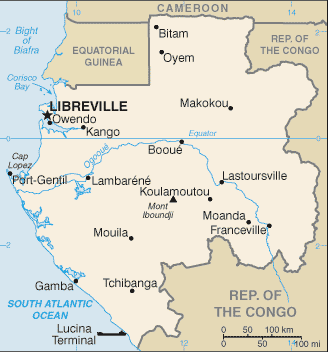
Central Africa, bordering the Atlantic Ocean at the Equator, between Republic of the Congo and Equatorial Guinea
Geographic coordinates
1 00 S, 11 45 E
Map references
Africa
Area
land: 257,667 sq km
water: 10,000 sq km
Area - comparative
slightly smaller than Colorado
Land boundaries
border countries: Cameroon 349 km; Republic of the Congo 2,567 km; Equatorial Guinea 345 km
Coastline
885 km
Maritime claims
contiguous zone: 24 nm
exclusive economic zone: 200 nm
Climate
tropical; always hot, humid
Terrain
narrow coastal plain; hilly interior; savanna in east and south
Elevation
lowest point: Atlantic Ocean 0 m
mean elevation: 377 m
Natural resources
petroleum, natural gas, diamond, niobium, manganese, uranium, gold, timber, iron ore, hydropower
Land use
agricultural land
agricultural land: arable land
agricultural land: permanent crops
agricultural land: permanent pasture
forest
other
Irrigated land
40 sq km (2012)
Major watersheds (area sq km)
Major aquifers
Congo Basin
Population distribution
the relatively small population is spread in pockets throughout the country; the largest urban center is the capital of Libreville, located along the Atlantic coast in the northwest, as shown in this population distribution map
Natural hazards
none
Geography - note
the country has maintained its pristine rain forest and rich biodiversity
People & Society33
Population
male: 1,299,085
female: 1,214,653
Nationality
adjective: Gabonese
Ethnic groups
Fang 23.5%, Shira-Punu'Vii 20.6%, Nzabi-Duma 11.2%, Mbede-Teke 5.6%, Myene 4.4%, Kota-Kele 4.3%, Okande-Tsogho 1.6%, other 12.6%, foreigner 16.2% (2021 est.)
Languages
French (official), Fang, Myene, Nzebi, Bapounou/Eschira, Bandjabi
Religions
Protestant 46.4% (Revival Church 37%, other Protestant 9.4%), Roman Catholic 29.8%, other Christian 4%, Muslim 10.8%, traditional/animist 1.1%, other 0.9%, none 7% (2019-21 est.)
Age structure
15-64 years: 61.1% (male 787,480/female 711,913)
65 years and over: 4.3% (2024 est.) (male 53,410/female 52,049)
Dependency ratios
youth dependency ratio: 55.8 (2025 est.)
elderly dependency ratio: 7.2 (2025 est.)
potential support ratio: 13.9 (2025 est.)
Median age
male: 22.5 years
female: 21.5 years
Population growth rate
2.35% (2025 est.)
Birth rate
25.51 births/1,000 population (2025 est.)
Death rate
5.44 deaths/1,000 population (2025 est.)
Net migration rate
3.42 migrant(s)/1,000 population (2025 est.)
Population distribution
the relatively small population is spread in pockets throughout the country; the largest urban center is the capital of Libreville, located along the Atlantic coast in the northwest, as shown in this population distribution map
Urbanization
rate of urbanization: 2.27% annual rate of change (2020-25 est.)
Major urban areas - population
870,000 LIBREVILLE (capital) (2023)
Sex ratio
0-14 years: 1.02 male(s)/female
15-64 years: 1.11 male(s)/female
65 years and over: 1.03 male(s)/female
total population: 1.07 male(s)/female (2024 est.)
Mother's mean age at first birth
Maternal mortality ratio
233 deaths/100,000 live births (2023 est.)
Infant mortality rate
male: 29.7 deaths/1,000 live births
female: 24 deaths/1,000 live births
Life expectancy at birth
male: 68.6 years
female: 72.1 years
Total fertility rate
3.16 children born/woman (2025 est.)
Gross reproduction rate
1.56 (2025 est.)
Drinking water source
improved: urban
improved: rural
improved: total
unimproved: urban
unimproved: rural
unimproved: total
Health expenditure
Health expenditure (as % of national budget): 9.6% of national budget (2022 est.)
Physician density
0.52 physicians/1,000 population (2022)
Sanitation facility access
improved: urban
improved: rural
improved: total
unimproved: urban
unimproved: rural
unimproved: total
Obesity - adult prevalence rate
15% (2016)
Alcohol consumption per capita
beer: 5.31 liters of pure alcohol (2019 est.)
wine: 0.62 liters of pure alcohol (2019 est.)
spirits: 0.5 liters of pure alcohol (2019 est.)
other alcohols: 0.04 liters of pure alcohol (2019 est.)
Children under the age of 5 years underweight
5.4% (2020 est.)
Currently married women (ages 15-49)
48.5% (2020 est.)
Child marriage
women married by age 18: 13.3% (2021)
men married by age 18: 4.8% (2021)
Education expenditure
Education expenditure (% national budget): 13.6% national budget (2023 est.)
Literacy
male: 90.8% (2021 est.)
female: 87.1% (2021 est.)
Government26
Country name
conventional short form: Gabon
local long form: République Gabonaise
local short form: Gabon
etymology: name originates from the Portuguese word gabão, meaning "cloak," possibly used by early explorers to describe the shape of the Komo River estuary
Government type
presidential republic
Capital
geographic coordinates: 0 23 N, 9 27 E
time difference: UTC+1 (6 hours ahead of Washington, DC, during Standard Time)
etymology: the city was founded in 1849 by freed slaves, and the name means "free town" in French
Administrative divisions
9 provinces; Estuaire, Haut-Ogooue, Moyen-Ogooue, Ngounie, Nyanga, Ogooue-Ivindo, Ogooue-Lolo, Ogooue-Maritime, Woleu-Ntem
Legal system
mixed system of French civil law and customary law
Constitution
amendment process: proposed by the president of the republic, by the Council of Ministers, or by one third of either house of Parliament; passage requires Constitutional Court evaluation, at least two-thirds majority vote of two thirds of the Parliament membership convened in joint session, and approval in a referendum; constitutional articles on Gabon’s democratic form of government cannot be amended
International law organization participation
has not submitted an ICJ jurisdiction declaration; accepts ICCt jurisdiction
Citizenship
citizenship by descent only: at least one parent must be a citizen of Gabon
dual citizenship recognized: no
residency requirement for naturalization: 10 years
Suffrage
18 years of age; universal
Executive branch
chief of state
head of government
cabinet
election/appointment process
most recent election date
election results
2025: Brice OLIGUI Nguema elected president; percent of vote - Brice OLIGUI Nguema (Ind.) 90.35%, Alain Claude Bilie By Nze (EPG) 3.02%, other 6.63%
2016: Ali BONGO Ondimba reelected president; percent of vote - Ali BONGO Ondimba (PDG) 49.8%, Jean PING (UFC) 48.2%, other 2.0%
Legislative branch
legislative structure: bicameral
Legislative branch - lower chamber
chamber name
number of seats
electoral system
scope of elections
term in office
most recent election date
percentage of women in chamber
expected date of next election
Legislative branch - upper chamber
chamber name
number of seats
scope of elections
term in office
most recent election date
percentage of women in chamber
expected date of next election
Judicial branch
judge selection and term of office: appointment and tenure of Supreme, Administrative, Accounting, and State Security courts NA; Constitutional Court judges appointed - 3 by the national president, 3 by the president of the Senate, and 3 by the president of the National Assembly; judges serve single renewable 7-year terms
subordinate courts: Courts of Appeal; county courts; military courts
Political parties
Restoration of Republican Values or RV
The Democrats or LD
Diplomatic representation in the US
chief of mission
chancery
telephone
FAX
email address and website
info@gaboneembassyusa.org
https://gabonembassyusa.org/en/
consulate(s) general
Diplomatic representation from the US
chief of mission
embassy
mailing address
telephone
FAX
email address and website
ACSLibreville@state.gov
https://ga.usembassy.gov/
International organization participation
ACP, AfDB, AU (suspended), BDEAC, CEMAC, FAO, FZ, G-24, G-77, IAEA, IBRD, ICAO, ICCt, ICRM, IDA, IDB, IFAD, IFC, IFRCS, ILO, IMF, IMO, IMSO, Interpol, IOC, IOM, IPU, ISO, ITSO, ITU, ITUC (NGOs), MIGA, MINUSCA, NAM, OIC, OIF, OPCW, UN, UNCTAD, UNESCO, UNIDO, UNWTO, UPU, WCO, WHO, WIPO, WMO, WTO
Independence
17 August 1960 (from France)
National holiday
Independence Day, 17 August (1960)
Flag
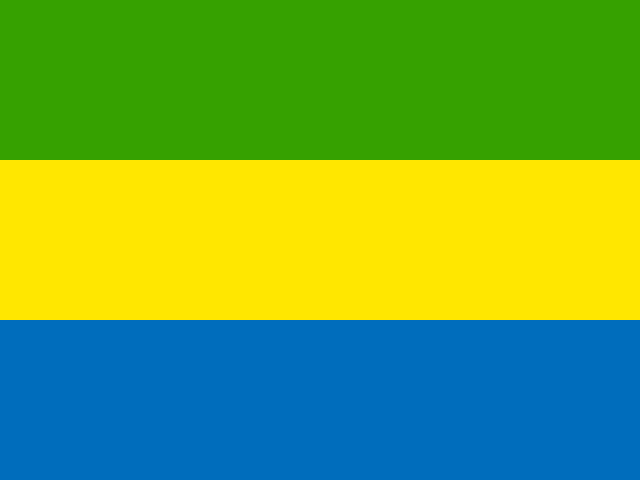
meaning: green stands for the country's forests and natural resources, gold for the equator and the sun, and blue for the sea
National symbol(s)
black panther
National color(s)
green, yellow, blue
National coat of arms
National anthem(s)
lyrics/music: Georges Aleka DAMAS
history: adopted 1960
National heritage
selected World Heritage Site locales: Ecosystem and Relict Cultural Landscape of Lopé-Okanda (m); Ivindo National Park (n)
Economy31
Economic overview
natural-resource-rich, upper-middle-income, Central African economy; significant reliance on oil and mineral exports; highly urbanized population; high levels of poverty and unemployment; uncertainty on institutional and development reform progress following 2023 military coup
Real GDP (purchasing power parity)
Real GDP (purchasing power parity) 2023: $46.472 billion (2023 est.)
Real GDP (purchasing power parity) 2022: $45.363 billion (2022 est.)
Real GDP growth rate
Real GDP growth rate 2023: 2.4% (2023 est.)
Real GDP growth rate 2022: 3% (2022 est.)
Real GDP per capita
Real GDP per capita 2023: $18,700 (2023 est.)
Real GDP per capita 2022: $18,700 (2022 est.)
GDP (official exchange rate)
Inflation rate (consumer prices)
Inflation rate (consumer prices) 2023: 3.6% (2023 est.)
Inflation rate (consumer prices) 2022: 4.2% (2022 est.)
GDP - composition, by sector of origin
industry: 50.9% (2024 est.)
services: 37.5% (2024 est.)
GDP - composition, by end use
household consumption
government consumption
investment in fixed capital
investment in inventories
exports of goods and services
imports of goods and services
Agricultural products
Industries
petroleum extraction and refining; manganese, gold; chemicals, ship repair, food and beverages, textiles, lumbering and plywood, cement
Industrial production growth rate
Labor force
Unemployment rate
Unemployment rate 2023: 20.3% (2023 est.)
Unemployment rate 2022: 20.4% (2022 est.)
Youth unemployment rate (ages 15-24)
male: 31.1% (2024 est.)
female: 42.3% (2024 est.)
Population below poverty line
Gini Index coefficient - distribution of family income
Household income or consumption by percentage share
highest 10%: 27.7% (2017 est.)
Remittances
Remittances 2022: 0.1% of GDP (2022 est.)
Remittances 2021: 0.1% of GDP (2021 est.)
Budget
expenditures: $3.226 billion (2021 est.)
Public debt
Taxes and other revenues
Current account balance
Current account balance 2014: $1.112 billion (2014 est.)
Current account balance 2013: $1.463 billion (2013 est.)
Exports
Exports 2023: $12.869 billion (2023 est.)
Exports 2022: $13.814 billion (2022 est.)
Exports - partners
Exports - commodities
Imports
Imports 2023: $5.38 billion (2023 est.)
Imports 2022: $5.005 billion (2022 est.)
Imports - partners
Imports - commodities
Reserves of foreign exchange and gold
Reserves of foreign exchange and gold 2022: $1.415 billion (2022 est.)
Reserves of foreign exchange and gold 2021: $1.304 billion (2021 est.)
Debt - external
Exchange rates
Currency
Exchange rates 2024
Exchange rates 2023
Exchange rates 2022
Exchange rates 2021
Exchange rates 2020
Energy7
Electricity access
electrification - urban areas: 98.5%
electrification - rural areas: 29%
Electricity
consumption: 3.173 billion kWh (2023 est.)
imports: 584.039 million kWh (2023 est.)
transmission/distribution losses: 604 million kWh (2023 est.)
Electricity generation sources
hydroelectricity: 47.7% of total installed capacity (2023 est.)
biomass and waste: 0.3% of total installed capacity (2023 est.)
Coal
Petroleum
refined petroleum consumption: 14,000 bbl/day (2023 est.)
crude oil estimated reserves: 2 billion barrels (2021 est.)
Natural gas
consumption: 463 million cubic meters (2023 est.)
proven reserves: 25.995 billion cubic meters (2021 est.)
Energy consumption per capita
Communications6
Telephones - fixed lines
subscriptions per 100 inhabitants: 3 (2024 est.)
Telephones - mobile cellular
subscriptions per 100 inhabitants: 125 (2024 est.)
Broadcast media
2 state-run TV stations and 2 state-run radio stations; a few private radio and TV stations; transmissions of at least 2 international broadcasters are accessible; satellite service subscriptions are available
Internet country code
.ga
Internet users
Broadband - fixed subscriptions
subscriptions per 100 inhabitants: 3 (2022 est.)
Transportation5
Civil aircraft registration country code prefix
TR
Airports
42 (2025)
Railways
standard gauge: 649 km (2014) 1.435-m gauge
Merchant marine
by type: bulk carrier 1, general cargo 19, oil tanker 30, other 37
Ports
total ports
large
medium
small
very small
ports with oil terminals
key ports
Military & Security6
Military and security forces
Military expenditures
Military Expenditures 2023: 1.3% of GDP (2023 est.)
Military Expenditures 2022: 1.3% of GDP (2022 est.)
Military Expenditures 2021: 1.7% of GDP (2021 est.)
Military Expenditures 2020: 1.8% of GDP (2020 est.)
Military and security service personnel strengths
approximately 7,000 active-duty Armed Forces including the Republican Guard and Gendarmerie (2025)
Military equipment inventories and acquisitions
the Gabonese military has a mix of older and limited quantities of more modern armaments; suppliers include Brazil, China, France, Germany, Russia/former Soviet Union, South Africa, and Spain (2025)
Military service age and obligation
18-24 years of age for voluntary military service; no conscription (2025)
Military - note
the Gabonese military is a small and lightly armed force that is responsible for both external and internal security; the military may also participate in the economic and social development work of the nation; key defense priorities include securing the country's borders and maritime domain; it has contributed to regional peacekeeping and joint security operations; in August 2023, officers from the Republican Guard seized control of the government and placed the president under arrest (2025)