
Greece
Hellenic Republic
Population
10.42M
Area
131,957 km²
GDP
$257.14B
GDP Per Capita
$37,800
Pop. Density
79/km²
Quick Facts
Background
In 1981, Greece joined the EC (now the EU); it became the 12th member of the European Economic and Monetary Union in 2001. From 2009 until 2019, Greece suffered a severe economic crisis due to nearly a decade of chronic overspending and structural rigidities. Beginning in 2010, Greece entered three bailout agreements -- the first two with the European Commission, the European Central Bank, and the IMF; and the third in 2015 with the European Stability Mechanism -- worth in total about $300 billion. The Greek Government formally exited the third bailout in 2018, and Greece's economy has since improved significantly. In 2022, the country finalized its early repayment to the IMF and graduated on schedule from the EU's enhanced surveillance framework.
Historical Trends
GDP (USD)
↓4.8% since 2006Population
↓5.6% since 2006Life Expectancy at Birth
Latest: 81.5 yearsData source: World Bank Open Data
Geography17
Location
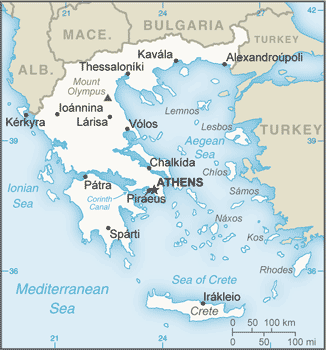
Southern Europe, bordering the Aegean Sea, Ionian Sea, and the Mediterranean Sea, between Albania and Turkey
Geographic coordinates
39 00 N, 22 00 E
Map references
Europe
Area
land: 130,647 sq km
water: 1,310 sq km
Area - comparative
slightly smaller than Alabama
Land boundaries
border countries: Albania 212 km; Bulgaria 472 km; North Macedonia 234 km; Turkey 192 km
Coastline
13,676 km
Maritime claims
continental shelf: 200-m depth or to the depth of exploitation
Climate
temperate; mild, wet winters; hot, dry summers
Terrain
mountainous with ranges extending into the sea as peninsulas or chains of islands
Elevation
lowest point: Mediterranean Sea 0 m
mean elevation: 498 m
Natural resources
lignite, petroleum, iron ore, bauxite, lead, zinc, nickel, magnesite, marble, salt, hydropower potential
Land use
agricultural land
agricultural land: arable land
agricultural land: permanent crops
agricultural land: permanent pasture
forest
other
Irrigated land
12,191 sq km (2021)
Population distribution
one third of the population lives in and around metropolitan Athens; the remainder of the country has moderate population density mixed with sizeable urban clusters
Natural hazards
volcanism: Santorini (367 m) has been deemed a Decade Volcano by the International Association of Volcanology and Chemistry of the Earth's Interior, worthy of study due to its explosive history and close proximity to human populations; Methana and Nisyros in the Aegean are also classified as historically active
Geography - note
strategic location dominating the Aegean Sea and southern approach to Turkish Straits; a peninsular country, with an archipelago of about 2,000 islands
People & Society33
Population
male: 5,105,879
female: 5,318,657
Nationality
adjective: Greek
Ethnic groups
Languages
major-language sample(s):
Το Παγκόσμιο Βιβλίο Δεδομένων, η απαραίτητη πηγή βασικών πληροφοριών. (Greek)
The World Factbook, the indispensable source for basic information.
Religions
Greek Orthodox 81-90%, Muslim 2%, other 3%, none 4-15%, unspecified 1% (2015 est.)
Age structure
15-64 years: 62.6% (male 3,278,906/female 3,267,140)
65 years and over: 23.6% (2024 est.) (male 1,096,825/female 1,377,010)
Dependency ratios
youth dependency ratio: 21.7 (2025 est.)
elderly dependency ratio: 38.4 (2025 est.)
potential support ratio: 2.6 (2025 est.)
Median age
male: 44.6 years
female: 48.3 years
Population growth rate
-0.35% (2025 est.)
Birth rate
7.38 births/1,000 population (2025 est.)
Death rate
11.99 deaths/1,000 population (2025 est.)
Net migration rate
1.1 migrant(s)/1,000 population (2025 est.)
Population distribution
one third of the population lives in and around metropolitan Athens; the remainder of the country has moderate population density mixed with sizeable urban clusters
Urbanization
rate of urbanization: 0.11% annual rate of change (2020-25 est.)
Major urban areas - population
3.154 million ATHENS (capital), 815,000 Thessaloniki (2023)
Sex ratio
0-14 years: 1.06 male(s)/female
15-64 years: 1 male(s)/female
65 years and over: 0.8 male(s)/female
total population: 0.96 male(s)/female (2024 est.)
Mother's mean age at first birth
30.7 years (2020 est.)
Maternal mortality ratio
5 deaths/100,000 live births (2023 est.)
Infant mortality rate
male: 3.8 deaths/1,000 live births
female: 3 deaths/1,000 live births
Life expectancy at birth
male: 79.4 years
female: 84.6 years
Total fertility rate
1.42 children born/woman (2025 est.)
Gross reproduction rate
0.69 (2025 est.)
Drinking water source
improved: urban
improved: rural
improved: total
unimproved: urban
unimproved: rural
unimproved: total
Health expenditure
Health expenditure (as % of national budget): 8.7% of national budget (2022 est.)
Physician density
6.58 physicians/1,000 population (2022)
Hospital bed density
4.2 beds/1,000 population (2019 est.)
Sanitation facility access
improved: urban
improved: rural
improved: total
unimproved: urban
unimproved: rural
unimproved: total
Obesity - adult prevalence rate
24.9% (2016)
Alcohol consumption per capita
beer: 2.13 liters of pure alcohol (2019 est.)
wine: 2.66 liters of pure alcohol (2019 est.)
spirits: 1.45 liters of pure alcohol (2019 est.)
other alcohols: 0.08 liters of pure alcohol (2019 est.)
Tobacco use
male: 30.3% (2025 est.)
female: 24.6% (2025 est.)
Currently married women (ages 15-49)
52.4% (2023 est.)
Education expenditure
Education expenditure (% national budget): 6.4% national budget (2022 est.)
School life expectancy (primary to tertiary education)
male: 21 years (2022 est.)
female: 21 years (2022 est.)
Government24
Country name
conventional long form
conventional short form
local long form
local short form
former
etymology
Government type
parliamentary republic
Capital
geographic coordinates: 37 59 N, 23 44 E
time difference: UTC+2 (7 hours ahead of Washington, DC, during Standard Time)
daylight saving time: +1hr, begins last Sunday in March; ends last Sunday in October
etymology: the origin of the name is uncertain; according to tradition, the city is named after Athena, the Greek goddess of wisdom, but the name is probably pre-Hellenic
Administrative divisions
Legal system
civil legal system based on Roman law
Constitution
amendment process: proposed by at least 50 members of Parliament and agreed by three-fifths majority vote in two separate ballots at least 30 days apart; passage requires absolute majority vote by the next elected Parliament; entry into force finalized through a "special parliamentary resolution"; articles on human rights and freedoms and the form of government cannot be amended
International law organization participation
accepts compulsory ICJ jurisdiction with reservations; accepts ICCt jurisdiction
Citizenship
citizenship by descent only: at least one parent must be a citizen of Greece
dual citizenship recognized: yes
residency requirement for naturalization: 10 years
Suffrage
17 years of age; universal and compulsory
Executive branch
chief of state
head of government
cabinet
election/appointment process
most recent election date
election results
2025: Konstantinos TASOULAS (ND) elected president by Parliament - 160 of 300 votes
2020: Katerina SAKELLAROPOULOU (independent) elected president by Parliament - 261 of 300 votes
expected date of next election
Legislative branch
legislature name
legislative structure
number of seats
electoral system
scope of elections
term in office
most recent election date
parties elected and seats per party
percentage of women in chamber
expected date of next election
Judicial branch
judge selection and term of office: Supreme Court judges appointed by presidential decree on the advice of the Supreme Judicial Council (SJC), which includes the president of the Supreme Court, other judges, and the prosecutor of the Supreme Court; judges appointed for life after a 2-year probationary period; Council of State president appointed by the Greek Cabinet to serve a 4-year term; other judge appointments and tenure NA; Court of Audit president appointed by decree of the president of the republic on the advice of the SJC; court president serves a 4-year term or until age 67; tenure of vice presidents, councilors, and judges NA
subordinate courts: Courts of Appeal and Courts of First Instance (district courts)
Political parties
Communist Party of Greece or KKE
Course of Freedom
Democratic Patriotic Movement-Victory or NIKI
Greek Solution
New Democracy or ND
PASOK - Movement for Change or PASOK-KINAL
Spartans
Diplomatic representation in the US
chief of mission
chancery
telephone
FAX
email address and website
gremb.was@mfa.gr
https://www.mfa.gr/usa/en/the-embassy/
consulate(s) general
consulate(s)
Diplomatic representation from the US
chief of mission
embassy
mailing address
telephone
FAX
email address and website
athensamericancitizenservices@state.gov
https://gr.usembassy.gov/
consulate(s) general
International organization participation
Australia Group, BIS, BSEC, CD, CE, CERN, EAPC, EBRD, ECB, EIB, EMU, ESA, EU, FAO, FATF, IAEA, IBRD, ICAO, ICC (national committees), ICCt, ICRM, IDA, IEA, IFAD, IFC, IFRCS, IGAD (partners), IHO, ILO, IMF, IMO, IMSO, Interpol, IOC, IOM, IPU, ISO, ITSO, ITU, ITUC (NGOs), MIGA, NATO, NEA, NSG, OAS (observer), OECD, OIF, OPCW, OSCE, PCA, Schengen Convention, SELEC, UN, UNCTAD, UNESCO, UNHCR, UNIDO, UNIFIL, UNOOSA, UNWTO, UPU, Wassenaar Arrangement, WCO, WFTU (NGOs), WHO, WIPO, WMO, WTO, ZC
Independence
National holiday
Independence Day, 25 March (1821)
Flag
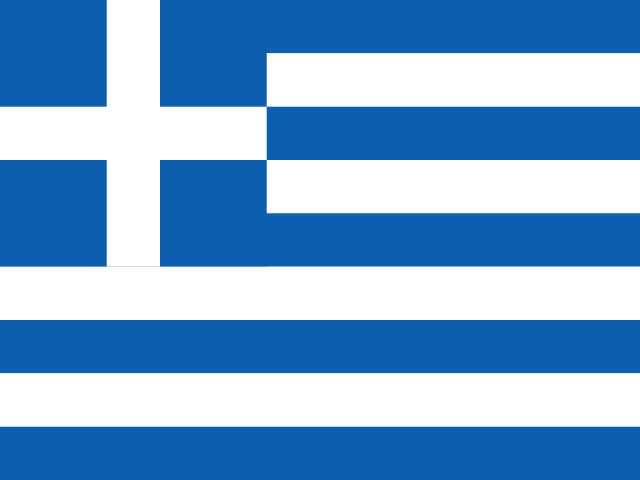
meaning: the cross symbolizes Greek Orthodoxy, the established religion; there is no set meaning for the stripes and colors
National symbol(s)
Greek cross (white cross on a blue field)
National color(s)
blue, white
National coat of arms
National anthem(s)
lyrics/music: Dionysios SOLOMOS/Nikolaos MANTZAROS
history: adopted 1864; the anthem is based on a 158-stanza poem by the same name, which was inspired by the Greek Revolution of 1821 against the Ottomans (only the first two stanzas are used); Cyprus also uses "Hymn to Freedom" as its anthem
National heritage
selected World Heritage Site locales: Acropolis, Athens (c); Archaeological site of Delphi (c); Meteora (m); Medieval City of Rhodes (c); Archaeological site of Olympia (c); Archaeological site of Mycenae and Tiryns (c); Old Town of Corfu (c); Mount Athos (m); Delos (c); Archaeological Site of Philippi (c); Minoan Palatial Centres (c)
Economy31
Economic overview
high-income EU and eurozone economy; growth above euro average, supported by private consumption and EU fund investments; structural reforms strengthening public finances and enhancing resilience within banking system; declining unemployment but low labor productivity and skill shortages
Real GDP (purchasing power parity)
Real GDP (purchasing power parity) 2023: $383.493 billion (2023 est.)
Real GDP (purchasing power parity) 2022: $374.753 billion (2022 est.)
Real GDP growth rate
Real GDP growth rate 2023: 2.3% (2023 est.)
Real GDP growth rate 2022: 5.7% (2022 est.)
Real GDP per capita
Real GDP per capita 2023: $36,900 (2023 est.)
Real GDP per capita 2022: $35,900 (2022 est.)
GDP (official exchange rate)
Inflation rate (consumer prices)
Inflation rate (consumer prices) 2023: 3.5% (2023 est.)
Inflation rate (consumer prices) 2022: 9.6% (2022 est.)
GDP - composition, by sector of origin
industry: 15.4% (2024 est.)
services: 68% (2024 est.)
GDP - composition, by end use
household consumption
government consumption
investment in fixed capital
investment in inventories
exports of goods and services
imports of goods and services
Agricultural products
Industries
tourism, food and tobacco processing, textiles, chemicals, metal products; mining, petroleum
Industrial production growth rate
Labor force
Unemployment rate
Unemployment rate 2023: 11.1% (2023 est.)
Unemployment rate 2022: 12.5% (2022 est.)
Youth unemployment rate (ages 15-24)
male: 23.2% (2024 est.)
female: 26.6% (2024 est.)
Population below poverty line
Gini Index coefficient - distribution of family income
Average household expenditures
on alcohol and tobacco: 4.4% of household expenditures (2023 est.)
Household income or consumption by percentage share
highest 10%: 25.7% (2022 est.)
Remittances
Remittances 2023: 0.2% of GDP (2023 est.)
Remittances 2022: 0.3% of GDP (2022 est.)
Budget
expenditures: $114.497 billion (2023 est.)
Public debt
Taxes and other revenues
Current account balance
Current account balance 2023: -$15.008 billion (2023 est.)
Current account balance 2022: -$22.623 billion (2022 est.)
Exports
Exports 2023: $107.218 billion (2023 est.)
Exports 2022: $106.189 billion (2022 est.)
Exports - partners
Exports - commodities
Imports
Imports 2023: $119.234 billion (2023 est.)
Imports 2022: $127.82 billion (2022 est.)
Imports - partners
Imports - commodities
Reserves of foreign exchange and gold
Reserves of foreign exchange and gold 2023: $13.608 billion (2023 est.)
Reserves of foreign exchange and gold 2022: $12.061 billion (2022 est.)
Exchange rates
Currency
Exchange rates 2024
Exchange rates 2023
Exchange rates 2022
Exchange rates 2021
Exchange rates 2020
Energy7
Electricity access
Electricity
consumption: 46.929 billion kWh (2023 est.)
exports: 3.24 billion kWh (2023 est.)
imports: 8.152 billion kWh (2023 est.)
transmission/distribution losses: 5.346 billion kWh (2023 est.)
Electricity generation sources
solar: 17.5% of total installed capacity (2023 est.)
wind: 23.3% of total installed capacity (2023 est.)
hydroelectricity: 9.8% of total installed capacity (2023 est.)
biomass and waste: 0.6% of total installed capacity (2023 est.)
Coal
consumption: 10.091 million metric tons (2023 est.)
exports: 5 metric tons (2023 est.)
imports: 49,000 metric tons (2023 est.)
proven reserves: 2.876 billion metric tons (2023 est.)
Petroleum
refined petroleum consumption: 308,000 bbl/day (2024 est.)
crude oil estimated reserves: 10 million barrels (2021 est.)
Natural gas
consumption: 3.344 billion cubic meters (2023 est.)
exports: 8.362 billion cubic meters (2023 est.)
imports: 11.619 billion cubic meters (2023 est.)
proven reserves: 991.09 million cubic meters (2021 est.)
Energy consumption per capita
Communications6
Telephones - fixed lines
subscriptions per 100 inhabitants: 47 (2024 est.)
Telephones - mobile cellular
subscriptions per 100 inhabitants: 114 (2024 est.)
Broadcast media
broadcast media dominated by the private sector; roughly 150 private TV channels, about 10 of which broadcast nationwide; 1 state-owned terrestrial TV channel with national coverage; 3 privately owned satellite channels; multi-channel satellite and cable TV services available; over 1,500 radio stations, all privately owned; state-owned broadcaster has 2 national radio stations
Internet country code
.gr
Internet users
Broadband - fixed subscriptions
subscriptions per 100 inhabitants: 44 (2023 est.)
Transportation6
Civil aircraft registration country code prefix
SX
Airports
82 (2025)
Heliports
59 (2025)
Railways
Merchant marine
by type: bulk carrier 132, container ship 4, general cargo 79, oil tanker 299, other 701
Ports
total ports
large
medium
small
very small
ports with oil terminals
key ports
Military & Security7
Military and security forces
note 2: the National Guard was established in 1982 as an official part of the Army to help protect Greece and provide reinforcements and support to the Army in peacetime and in times of mobilization and war
Military expenditures
Military Expenditures 2024: 2.7% of GDP (2024 est.)
Military Expenditures 2023: 2.8% of GDP (2023 est.)
Military Expenditures 2022: 3.9% of GDP (2022 est.)
Military Expenditures 2021: 3.7% of GDP (2021 est.)
Military and security service personnel strengths
approximately 112,000 active-duty military personnel (2025)
Military equipment inventories and acquisitions
Military service age and obligation
note 2: as of 2025, women comprised about 17% of the military's full-time personnel
Military deployments
Military - note
Greece’s NATO membership is a key component of its security; it became a NATO member in 1952 and occupies a strategic location in the Eastern Mediterranean on NATO’s southern flank; Greece is host to several NATO facilities, including the Deployable Corps Greece (NDC-GR) headquarters in Thessaloniki, the Combined Air Operations Center in Larissa, the Multinational Peace Support Operations Training Center in Kilkis, the Multinational Sealift Coordination Center in Athens, and the Naval Base, Maritime Interdiction Operational Training Centre, and NATO Missile Firing Installation at Souda, Crete (2025)
Transnational Issues1
Refugees and internally displaced persons
stateless persons: 3,743 (2024 est.)