
Guinea-Bissau
Republic of Guinea-Bissau
Population
2.13M
Area
36,125 km²
GDP
$2.12B
GDP Per Capita
$2,700
Pop. Density
59/km²
Quick Facts
Currency
FrWest African CFA franc(XOF)
Calling Code
+245
Timezone
UTC
Languages
Portuguese, Upper Guinea Creole+more
Driving Side
right
Demonym
Guinea-Bissauan
Background
For much of its history, Guinea-Bissau was under the control of the Mali Empire and the Kaabu Kingdom. In the 16th century, Portugal began establishing trading posts along Guinea-Bissau’s shoreline. Initially, the Portuguese were restricted to the coastline and islands. However, the slave and gold trades were lucrative to local African leaders, and the Portuguese were slowly able to expand their power and influence inland. Starting in the 18th century, the Mali Empire and Kingdom of Kaabu slowly disintegrated into smaller local entities. By the 19th century, Portugal had fully incorporated Guinea-Bissau into its empire.
Since gaining independence in 1974, Guinea-Bissau has experienced considerable political and military upheaval. In 1980, a military coup established General Joao Bernardo 'Nino' VIEIRA as president. VIEIRA's regime suppressed political opposition and purged political rivals. Several coup attempts through the 1980s and early 1990s failed to unseat him, but a military mutiny and civil war in 1999 led to VIEIRA's ouster. In 2000, a transitional government turned over power to opposition leader Kumba YALA. In 2003, a bloodless military coup overthrew YALA and installed businessman Henrique ROSA as interim president. In 2005, VIEIRA was reelected, pledging to pursue economic development and national reconciliation; he was assassinated in 2009. Malam Bacai SANHA was then elected president, but he passed away in 2012 from a long-term illness. A military coup blocked the second round of the election to replace him, but after mediation from the Economic Community of Western African States, a civilian transitional government assumed power. In 2014, Jose Mario VAZ was elected president in a free and fair election, and in 2019, he became the first president in Guinea-Bissau’s history to complete a full term. Umaro Sissoco EMBALO was elected president in 2019, but he did not take office until 2020 because of a prolonged challenge to the election results.
Historical Trends
GDP (USD)
↑249.5% since 2006Population
↑55.5% since 2006Life Expectancy at Birth
Latest: 64.1 yearsData source: World Bank Open Data
Geography18
Location
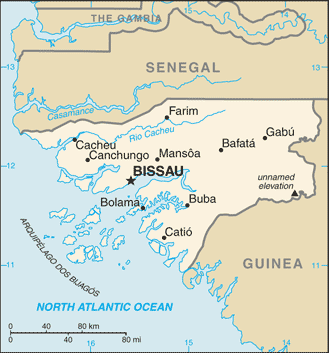
Western Africa, bordering the North Atlantic Ocean, between Guinea and Senegal
Geographic coordinates
12 00 N, 15 00 W
Map references
Africa
Area
land: 28,120 sq km
water: 8,005 sq km
Area - comparative
slightly less than three times the size of Connecticut
Land boundaries
border countries: Guinea 421 km; Senegal 341 km
Coastline
350 km
Maritime claims
exclusive economic zone: 200 nm
Climate
tropical; generally hot and humid; monsoonal-type rainy season (June to November) with southwesterly winds; dry season (December to May) with northeasterly harmattan winds
Terrain
mostly low-lying coastal plain with a deeply indented estuarine coastline rising to savanna in east; numerous off-shore islands including the Arquipelago Dos Bijagos consisting of 18 main islands and many small islets
Elevation
lowest point: Atlantic Ocean 0 m
mean elevation: 70 m
Natural resources
fish, timber, phosphates, bauxite, clay, granite, limestone, unexploited deposits of petroleum
Land use
agricultural land
agricultural land: arable land
agricultural land: permanent crops
agricultural land: permanent pasture
forest
other
Irrigated land
250 sq km (2012)
Major aquifers
Senegalo-Mauritanian Basin
Population distribution
approximately one fifth of the population lives in the capital city of Bissau along the Atlantic coast; the remainder is distributed among the eight mainly rural regions, as shown in this population distribution map
Natural hazards
hot, dry, dusty harmattan haze may reduce visibility during dry season; brush fires
Geography - note
this small country is swampy along its western coast and is low-lying inland
People & Society33
Population
male: 1,042,910
female: 1,089,415
Nationality
adjective: Bissau-Guinean
Ethnic groups
Balanta 30%, Fulani 30%, Manjaco 14%, Mandinga 13%, Papel 7%, unspecified smaller ethnic groups 6% (2015 est.)
Languages
Portuguese-based Creole, Portuguese (official; largely used as a second or third language), Pular (a Fula language), Mandingo
Religions
Muslim 46.1%, folk religions 30.6%, Christian 18.9%, other or unaffiliated 4.4% (2020 est.)
Age structure
15-64 years: 54.6% (male 561,868/female 602,280)
65 years and over: 3.1% (2024 est.) (male 27,529/female 38,621)
Dependency ratios
youth dependency ratio: 77.5 (2024 est.)
elderly dependency ratio: 5.7 (2024 est.)
potential support ratio: 17.6 (2024 est.)
Median age
male: 17.8 years
female: 18.9 years
Population growth rate
2.55% (2025 est.)
Birth rate
35.82 births/1,000 population (2025 est.)
Death rate
6.99 deaths/1,000 population (2025 est.)
Net migration rate
-3.36 migrant(s)/1,000 population (2025 est.)
Population distribution
approximately one fifth of the population lives in the capital city of Bissau along the Atlantic coast; the remainder is distributed among the eight mainly rural regions, as shown in this population distribution map
Urbanization
rate of urbanization: 3.22% annual rate of change (2020-25 est.)
Major urban areas - population
664,000 BISSAU (capital) (2023)
Sex ratio
0-14 years: 1.01 male(s)/female
15-64 years: 0.93 male(s)/female
65 years and over: 0.71 male(s)/female
total population: 0.96 male(s)/female (2024 est.)
Maternal mortality ratio
505 deaths/100,000 live births (2023 est.)
Infant mortality rate
male: 52 deaths/1,000 live births
female: 40.6 deaths/1,000 live births
Life expectancy at birth
male: 62.2 years
female: 66.8 years
Total fertility rate
4.59 children born/woman (2025 est.)
Gross reproduction rate
2.26 (2025 est.)
Drinking water source
improved: urban
improved: rural
improved: total
unimproved: urban
unimproved: rural
unimproved: total
Health expenditure
Health expenditure (as % of national budget): 5.2% of national budget (2022 est.)
Physician density
0.25 physicians/1,000 population (2022)
Sanitation facility access
improved: urban
improved: rural
improved: total
unimproved: urban
unimproved: rural
unimproved: total
Obesity - adult prevalence rate
9.5% (2016)
Alcohol consumption per capita
beer: 0.41 liters of pure alcohol (2019 est.)
wine: 0.98 liters of pure alcohol (2019 est.)
spirits: 0.54 liters of pure alcohol (2019 est.)
other alcohols: 1.28 liters of pure alcohol (2019 est.)
Tobacco use
male: 13.2% (2025 est.)
female: 0.5% (2025 est.)
Children under the age of 5 years underweight
18.8% (2019 est.)
Currently married women (ages 15-49)
59% (2019 est.)
Child marriage
women married by age 18: 25.7% (2019)
men married by age 18: 2.2% (2019)
Education expenditure
2.7% of GDP (2020 est.)
Literacy
male: 77.3% (2022 est.)
female: 52.2% (2022 est.)
Government23
Country name
conventional long form
conventional short form
local long form
local short form
former
etymology
Government type
semi-presidential republic
Capital
geographic coordinates: 11 51 N, 15 35 W
time difference: UTC 0 (5 hours ahead of Washington, DC, during Standard Time)
etymology: the name is derived from the local Bijuga people and is used to distinguish the country from neighboring Guinea
Administrative divisions
Legal system
mixed system of civil law, which incorporated Portuguese law at independence; influenced by Economic Community of West African States (ECOWAS), West African Economic and Monetary Union (UEMOA), African Francophone Public Law, and customary law
Constitution
amendment process: proposed by the National People’s Assembly if supported by at least one third of its members, by the Council of State (a presidential consultant body), or by the government; passage requires approval by at least two-thirds majority vote of the Assembly; constitutional articles on the republican and secular form of government and national sovereignty cannot be amended
International law organization participation
accepts compulsory ICJ jurisdiction; non-party state to the ICCt
Citizenship
citizenship by descent only: yes
dual citizenship recognized: no
residency requirement for naturalization: 5 years
Suffrage
18 years of age; universal
Executive branch
chief of state
head of government
cabinet
election/appointment process
most recent election date
election results
2025: Umaro Sissoco EMBALO (Madem G15) and Fernando DIAS da Costa (PRS) both claimed victory in first round; a coup prevented the release of election results after ballots were destroyed
2019: Umaro Sissoco EMBALO elected president in second round; percent of vote in first round - Domingos Simoes PEREIRA (PAIGC) 40.1%, Umaro Sissoco EMBALO (Madem G15) 27.7%, Nuno Gomez NABIAM (APU-PDGB) 13.2%, Jose Mario VAZ (independent) 12.4%, other 6.6%; percent of vote in second round - Umaro Sissoco EMBALO 53.6%, Domingos Simoes PEREIRA 46.5% (2019)
expected date of next election
Legislative branch
legislature name
legislative structure
number of seats
electoral system
scope of elections
term in office
most recent election date
parties elected and seats per party
percentage of women in chamber
expected date of next election
Judicial branch
judge selection and term of office: judges nominated by the Higher Council of the Magistrate, a major government organ responsible for judge appointments, dismissals, and judiciary discipline; judges appointed by the president for life
subordinate courts: Appeals Court; regional (first instance) courts; military court
Political parties
Democratic Convergence Party or PCD
Movement for Democratic Alternation Group of 15 or MADEM-G15
National People’s Assembly – Democratic Party of Guinea Bissau or APU-PDGB
New Democracy Party or PND
Party for Social Renewal or PRS
Republican Party for Independence and Development or PRID
Union for Change or UM
Diplomatic representation in the US
chancery: 918 16th Street, NW (Mezzanine Suite)
Washington DC 20006
telephone: [1] (202) 872-4222
FAX: [1] (202) 872-4226
Diplomatic representation from the US
mailing address: 2080 Bissau Place, Washington DC 20521-2080
email address and website:
dakarACS@state.gov
https://gw.usmission.gov/
International organization participation
ACP, AfDB, AOSIS, AU, CPLP, ECOWAS, FAO, FZ, G-77, IBRD, ICAO, ICRM, IDA, IDB, IFAD, IFC, IFRCS, ILO, IMF, IMO, Interpol, IOC, IOM, IPU, ITSO, ITU, ITUC (NGOs), MIGA, MINUSMA, NAM, OIC, OIF, OPCW, UN, UNCTAD, UNESCO, UNIDO, UNWTO, UPU, WADB (regional), WAEMU, WCO, WFTU (NGOs), WHO, WIPO, WMO, WTO
Independence
24 September 1973 (declared); 10 September 1974 (from Portugal)
National holiday
Independence Day, 24 September (1973)
Flag
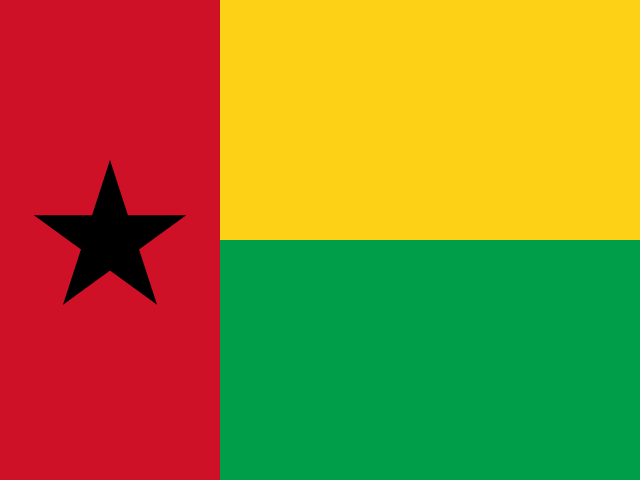
meaning: yellow stands for the sun, green for hope, red for blood shed during the struggle for independence; the black star stands for African unity
history: uses the colors of the Pan-African movement; the Ghanaian flag heavily influenced the design
National symbol(s)
black star
National color(s)
red, yellow, green, black
National anthem(s)
lyrics/music: Amilcar Lopes CABRAL/XIAO He
history: adopted 1974; a delegation from Portuguese Guinea visited China in 1963 and heard music by XIAO He; Amilcar Lopes CABRAL, the leader of Guinea-Bissau's independence movement, asked the composer to create a piece that would inspire his people to fight for independence
National heritage
selected World Heritage Site locales: Coastal and Marine Ecosystems of the Bijagós Archipelago – Omatí Minhô (n)
Economy30
Economic overview
extremely poor West African economy; ethnically diverse labor force; increasing government expenditures; slight inflation due to food supply disruptions; major cashew exporter; systemic banking instabilities and corruption; vulnerable to oil price shocks
Real GDP (purchasing power parity)
Real GDP (purchasing power parity) 2023: $5.64 billion (2023 est.)
Real GDP (purchasing power parity) 2022: $5.399 billion (2022 est.)
Real GDP growth rate
Real GDP growth rate 2023: 4.5% (2023 est.)
Real GDP growth rate 2022: 5.6% (2022 est.)
Real GDP per capita
Real GDP per capita 2023: $2,600 (2023 est.)
Real GDP per capita 2022: $2,600 (2022 est.)
GDP (official exchange rate)
Inflation rate (consumer prices)
Inflation rate (consumer prices) 2023: 7.1% (2023 est.)
Inflation rate (consumer prices) 2022: 9.4% (2022 est.)
GDP - composition, by sector of origin
industry: 16.6% (2024 est.)
services: 42.1% (2024 est.)
GDP - composition, by end use
household consumption
government consumption
investment in fixed capital
investment in inventories
exports of goods and services
imports of goods and services
Agricultural products
Industries
agricultural products processing, beer, soft drinks
Industrial production growth rate
Labor force
Unemployment rate
Unemployment rate 2023: 2.7% (2023 est.)
Unemployment rate 2022: 2.7% (2022 est.)
Youth unemployment rate (ages 15-24)
male: 3.4% (2024 est.)
female: 2% (2024 est.)
Population below poverty line
Gini Index coefficient - distribution of family income
Household income or consumption by percentage share
highest 10%: 26.1% (2021 est.)
Remittances
Remittances 2022: 10.3% of GDP (2022 est.)
Remittances 2021: 11% of GDP (2021 est.)
Budget
expenditures: $450.953 million (2023 est.)
Public debt
Taxes and other revenues
Current account balance
Current account balance 2022: -$146.64 million (2022 est.)
Current account balance 2021: -$14.128 million (2021 est.)
Exports
Exports 2022: $280.065 million (2022 est.)
Exports 2021: $334.904 million (2021 est.)
Exports - partners
Exports - commodities
Imports
Imports 2022: $577.899 million (2022 est.)
Imports 2021: $518.162 million (2021 est.)
Imports - partners
Imports - commodities
Debt - external
Exchange rates
Currency
Exchange rates 2024
Exchange rates 2023
Exchange rates 2022
Exchange rates 2021
Exchange rates 2020
Energy6
Electricity access
electrification - urban areas: 61%
electrification - rural areas: 15.8%
Electricity
consumption: 79.8 million kWh (2023 est.)
transmission/distribution losses: 6 million kWh (2023 est.)
Electricity generation sources
solar: 3.5% of total installed capacity (2023 est.)
Coal
Petroleum
Energy consumption per capita
Communications6
Telephones - fixed lines
subscriptions per 100 inhabitants: (2022 est.) less than 1
Telephones - mobile cellular
subscriptions per 100 inhabitants: 126 (2022 est.)
Broadcast media
1 state-owned TV station, Televisao da Guine-Bissau (TGB) and a second station, Radio e Televisao de Portugal (RTP) Africa, operated by Portuguese public broadcaster (RTP); 1 state-owned radio station, several private radio stations, and some community radio stations; multiple international broadcasters are available (2019)
Internet country code
.gw
Internet users
Broadband - fixed subscriptions
subscriptions per 100 inhabitants: (2023 est.) less than 1
Transportation4
Civil aircraft registration country code prefix
J5
Airports
7 (2025)
Merchant marine
by type: bulk carrier 3, general cargo 12, other 5
Ports
total ports
large
medium
small
very small
ports with oil terminals
key ports
Military & Security6
Military and security forces
Ministry of Internal Administration: National Guard (a gendarmerie force), Public Order Police, Border Police, Rapid Intervention Police, Maritime Police (2025)
Military expenditures
Military Expenditures 2023: 1.2% of GDP (2023 est.)
Military Expenditures 2022: 1.4% of GDP (2022 est.)
Military Expenditures 2021: 1.5% of GDP (2021 est.)
Military Expenditures 2020: 1.5% of GDP (2020 est.)
Military and security service personnel strengths
estimated 4,000 active FARP (2025)
Military equipment inventories and acquisitions
the FARP is outfitted mostly with Soviet-era weapons and equipment (2025)
Military service age and obligation
18-25 years of age for selective compulsory military service for men and women (Air Force service is voluntary) (2025)
Military - note
Transnational Issues1
Refugees and internally displaced persons
Compare Guinea-Bissau
See how Guinea-Bissau compares to other countries side by side.
Compare Countries