
Iceland
Population
364.0K
Area
103,000 km²
GDP
$33.46B
GDP Per Capita
$65,600
Pop. Density
4/km²
Quick Facts
Currency
krIcelandic króna(ISK)
Calling Code
+354
Timezone
UTC
Languages
Icelandic+more
Driving Side
right
Demonym
Icelander
Background
Historical Trends
GDP (USD)
↑88.2% since 2006Population
↑27.2% since 2006Life Expectancy at Birth
Latest: 82.6 yearsData source: World Bank Open Data
Geography17
Location
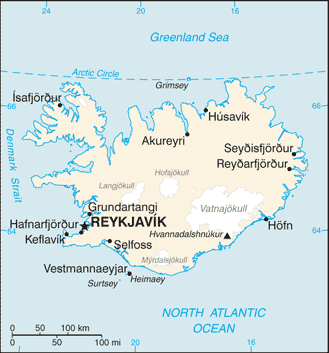
Northern Europe, island between the Greenland Sea and the North Atlantic Ocean, northwest of the United Kingdom
Geographic coordinates
65 00 N, 18 00 W
Map references
Arctic Region
Area
land: 100,250 sq km
water: 2,750 sq km
Area - comparative
slightly smaller than Pennsylvania; about the same size as Kentucky
Land boundaries
Coastline
4,970 km
Maritime claims
exclusive economic zone: 200 nm
continental shelf: 200 nm or to the edge of the continental margin
Climate
temperate; moderated by North Atlantic Current; mild, windy winters; damp, cool summers
Terrain
mostly plateau interspersed with mountain peaks, icefields; coast deeply indented by bays and fiords
Elevation
lowest point: Atlantic Ocean 0 m
mean elevation: 557 m
Natural resources
fish, hydropower, geothermal power, diatomite
Land use
agricultural land
agricultural land: arable land
agricultural land: permanent crops
agricultural land: permanent pasture
forest
other
Irrigated land
0.5 sq km (2022)
Population distribution
Iceland is almost entirely urban, with half of the population located in and around the capital of Reykjavik; smaller clusters are primarily found along the coast in the north and west
Natural hazards
volcanism: Iceland is situated on top of a hotspot and experiences severe volcanic activity; Eyjafjallajokull (1,666 m) erupted in 2010, sending ash high into the atmosphere and seriously disrupting European air traffic; scientists continue to monitor nearby Katla (1,512 m), which has a high probability of eruption; Grimsvoetn and Hekla are Iceland's most active volcanoes; other historically active volcanoes include Askja, Bardarbunga, Brennisteinsfjoll, Esjufjoll, Hengill, Krafla, Krisuvik, Kverkfjoll, Oraefajokull, Reykjanes, Torfajokull, and Vestmannaeyjar
Geography - note
strategic location between Greenland and Europe; westernmost European country; Reykjavik is the northernmost national capital in the world; more land covered by glaciers than in all of continental Europe
People & Society33
Population
male: 182,268
female: 181,768
Nationality
adjective: Icelandic
Ethnic groups
Languages
Icelandic, English, Polish, Nordic languages, German
Religions
Evangelical Lutheran Church of Iceland (official) 58.6% Roman Catholic 3.8%, Independent Congregation of Reykjavik 2.6%, Independent Congregation of Hafnarfjordur 1.9%, pagan worship 1.5%, Icelandic Ethical Humanist Association 1.4%, other (includes Zuist and Pentecostal) or unspecified 18.7%, none 7.7% (2024 est.)
Age structure
15-64 years: 63.2% (male 116,210/female 113,810)
65 years and over: 17.1% (2024 est.) (male 29,366/female 32,719)
Dependency ratios
youth dependency ratio: 31.3 (2024 est.)
elderly dependency ratio: 27 (2024 est.)
potential support ratio: 3.7 (2024 est.)
Median age
male: 37.4 years
female: 38.6 years
Population growth rate
0.82% (2025 est.)
Birth rate
12.47 births/1,000 population (2025 est.)
Death rate
6.62 deaths/1,000 population (2025 est.)
Net migration rate
2.3 migrant(s)/1,000 population (2025 est.)
Population distribution
Iceland is almost entirely urban, with half of the population located in and around the capital of Reykjavik; smaller clusters are primarily found along the coast in the north and west
Urbanization
rate of urbanization: 0.74% annual rate of change (2020-25 est.)
Major urban areas - population
216,000 REYKJAVIK (capital) (2018)
Sex ratio
0-14 years: 1.04 male(s)/female
15-64 years: 1.02 male(s)/female
65 years and over: 0.9 male(s)/female
total population: 1 male(s)/female (2024 est.)
Mother's mean age at first birth
28.7 years (2020 est.)
Maternal mortality ratio
3 deaths/100,000 live births (2023 est.)
Infant mortality rate
male: 1.8 deaths/1,000 live births
female: 1.4 deaths/1,000 live births
Life expectancy at birth
male: 81.8 years
female: 86.3 years
Total fertility rate
1.93 children born/woman (2025 est.)
Gross reproduction rate
0.94 (2025 est.)
Drinking water source
improved: urban
improved: rural
improved: total
unimproved: urban
unimproved: rural
unimproved: total
Health expenditure
Health expenditure (as % of national budget): 16.5% of national budget (2022 est.)
Physician density
4.37 physicians/1,000 population (2023)
Hospital bed density
2.8 beds/1,000 population (2020 est.)
Sanitation facility access
improved: urban
improved: rural
improved: total
unimproved: urban
unimproved: rural
unimproved: total
Obesity - adult prevalence rate
21.9% (2016)
Alcohol consumption per capita
beer: 4.39 liters of pure alcohol (2019 est.)
wine: 2.11 liters of pure alcohol (2019 est.)
spirits: 1.22 liters of pure alcohol (2019 est.)
other alcohols: 0 liters of pure alcohol (2019 est.)
Tobacco use
male: 7.9% (2025 est.)
female: 8% (2025 est.)
Currently married women (ages 15-49)
48.5% (2023 est.)
Education expenditure
Education expenditure (% national budget): 15.7% national budget (2022 est.)
School life expectancy (primary to tertiary education)
male: 18 years (2022 est.)
female: 20 years (2022 est.)
Government24
Country name
conventional short form: Iceland
local long form: none
local short form: Island
etymology: Floki VILGERDARSON, an early Norse explorer of the island in the 10th century, applied the name "Land of Ice," from the local words ís (ice) and land (land)
Government type
unitary parliamentary republic
Capital
geographic coordinates: 64 09 N, 21 57 W
time difference: UTC 0 (5 hours ahead of Washington, DC, during Standard Time)
etymology: the name means "smoky bay" in Icelandic and refers to the steam from the hot springs in the area
Administrative divisions
Legal system
civil law system influenced by the Danish model
Constitution
amendment process: proposed by the Althingi; passage requires approval by the Althingi and by the next elected Althingi, and confirmation by the president of the republic; proposed amendments to Article 62 of the constitution – that the Evangelical Lutheran Church shall be the state church of Iceland – also require passage by referendum
International law organization participation
has not submitted an ICJ jurisdiction declaration; accepts ICCt jurisdiction
Citizenship
citizenship by descent only: at least one parent must be a citizen of Iceland
dual citizenship recognized: yes
residency requirement for naturalization: 3 to 7 years
Suffrage
18 years of age; universal
Executive branch
chief of state
head of government
cabinet
election/appointment process
most recent election date
election results
2024: Halla TOMASDOTTIR elected president; percent of vote - Halla TOMASDOTTIR (independent) 34.1%, Katrin JAKOBSDOTTIR (Left-Green Movement) 25.2%, Halla Hrund LOGADOTTIR (independent) 15.7%, Jon GNARR (Social Democratic Alliance) 10.1%, Baldur PORHALLSSON (independent) 8.4%, other 6.5%
2020: Gudni Thorlacius JOHANNESSON reelected president; percent of vote - Gudni Thorlacius JOHANNESSON (independent) 92.2%, Gudmundur Franklin JONSSON (independent) 7.8%
expected date of next election
Legislative branch
legislature name
legislative structure
number of seats
electoral system
scope of elections
term in office
most recent election date
parties elected and seats per party
percentage of women in chamber
expected date of next election
Judicial branch
judge selection and term of office: judges proposed by Ministry of Interior selection committee and appointed by the president for an indefinite period
subordinate courts: Appellate Court or Landsrettur; 8 district courts; Labor Court
Political parties
Independence Party or D
Liberal Reform Party or C
People's Party or F
Progressive Party or B
Social Democratic Alliance or S
Diplomatic representation in the US
chancery: House of Sweden, 2900 K Street NW, #509, Washington, DC 20007
telephone: [1] (202) 265-6653
FAX: [1] (202) 265-6656
email address and website:
washington@mfa.is
https://www.government.is/diplomatic-missions/embassy-of-iceland-in-washington-d.c/
Diplomatic representation from the US
chief of mission
embassy
mailing address
telephone
FAX
email address and website
ReykjavikConsular@state.gov
https://is.usembassy.gov/
International organization participation
Arctic Council, Australia Group, BIS, CBSS, CD, CE, EAPC, EBRD, EFTA, FAO, FATF, IAEA, IBRD, ICAO, ICC (national committees), ICCt, ICRM, IDA, IFAD, IFC, IFRCS, IHO, ILO, IMF, IMO, IMSO, Interpol, IOC, IOM, IPU, ISO, ITSO, ITU, ITUC (NGOs), MIGA, NATO, NC, NEA, NIB, NSG, OAS (observer), OECD, OPCW, OSCE, PCA, Schengen Convention, UN, UNCTAD, UNESCO, UPU, WCO, WHO, WIPO, WMO, WTO
Independence
1 December 1918 (became a sovereign state under the Danish Crown); 17 June 1944 (from Denmark; birthday of Jon SIGURDSSON, leader of Iceland's 19th-century independence movement)
National holiday
Independence Day, 17 June (1944)
Flag
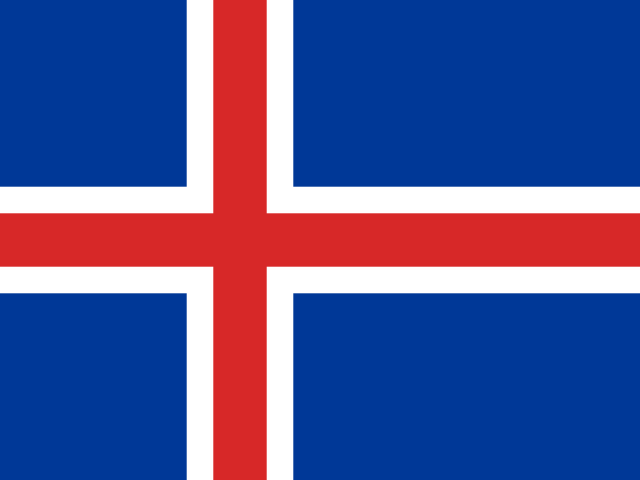
meaning: red stands for the island's volcanic fires, white for the snow and ice fields, and blue for the ocean
National symbol(s)
gyrfalcon
National color(s)
blue, white, red
National coat of arms
Iceland’s coat of arms is derived from a 13th-century folktale about four guardians who protect the four corners of the nation; the bull protects the northwest, the eagle the northeast, the dragon the southeast, and the rock-giant the southwest; the shield displays the national flag, with red standing for Iceland’s volcanic fires, white for its snow and ice fields, and blue for the ocean
National anthem(s)
lyrics/music: Matthias JOCHUMSSON/Sveinbjorn SVEINBJORNSSON
history: adopted 1918
National heritage
selected World Heritage Site locales: Thingvellir National Park (c); Surtsey (n); Vatnajökull National Park - Dynamic Nature of Fire and Ice (n)
Economy30
Economic overview
high-income North Atlantic island economy; not an EU member but market integration via European Economic Area (EEA); dominant tourism, fishing, and aluminum industries vulnerable to demand swings and disruption from volcanic activity; inflation remains above target rate; barriers to foreign business access and economic diversification
Real GDP (purchasing power parity)
Real GDP (purchasing power parity) 2023: $26.424 billion (2023 est.)
Real GDP (purchasing power parity) 2022: $25.012 billion (2022 est.)
Real GDP growth rate
Real GDP growth rate 2023: 5.6% (2023 est.)
Real GDP growth rate 2022: 9% (2022 est.)
Real GDP per capita
Real GDP per capita 2023: $67,200 (2023 est.)
Real GDP per capita 2022: $65,500 (2022 est.)
GDP (official exchange rate)
Inflation rate (consumer prices)
Inflation rate (consumer prices) 2023: 8.7% (2023 est.)
Inflation rate (consumer prices) 2022: 8.3% (2022 est.)
GDP - composition, by sector of origin
industry: 19.4% (2024 est.)
services: 65.5% (2024 est.)
GDP - composition, by end use
household consumption
government consumption
investment in fixed capital
investment in inventories
exports of goods and services
imports of goods and services
Agricultural products
Industries
tourism, fish processing; aluminum smelting; geothermal power, hydropower; medical/pharmaceutical products
Industrial production growth rate
Labor force
Unemployment rate
Unemployment rate 2023: 3.6% (2023 est.)
Unemployment rate 2022: 3.8% (2022 est.)
Youth unemployment rate (ages 15-24)
male: 8.3% (2024 est.)
female: 7% (2024 est.)
Population below poverty line
Gini Index coefficient - distribution of family income
Household income or consumption by percentage share
highest 10%: 21.7% (2018 est.)
Remittances
Remittances 2023: 0.7% of GDP (2023 est.)
Remittances 2022: 0.7% of GDP (2022 est.)
Budget
expenditures: $10.364 billion (2023 est.)
Public debt
Taxes and other revenues
Current account balance
Current account balance 2023: $290.603 million (2023 est.)
Current account balance 2022: -$698.165 million (2022 est.)
Exports
Exports 2023: $13.702 billion (2023 est.)
Exports 2022: $13.114 billion (2022 est.)
Exports - partners
Exports - commodities
Imports
Imports 2023: $13.63 billion (2023 est.)
Imports 2022: $13.237 billion (2022 est.)
Imports - partners
Imports - commodities
Reserves of foreign exchange and gold
Reserves of foreign exchange and gold 2023: $5.809 billion (2023 est.)
Reserves of foreign exchange and gold 2022: $5.887 billion (2022 est.)
Exchange rates
Currency
Exchange rates 2024
Exchange rates 2023
Exchange rates 2022
Exchange rates 2021
Exchange rates 2020
Energy5
Electricity access
Electricity
consumption: 19.584 billion kWh (2023 est.)
transmission/distribution losses: 543 million kWh (2023 est.)
Electricity generation sources
geothermal: 29.9% of total installed capacity (2023 est.)
Coal
exports: 81 metric tons (2023 est.)
imports: 106,000 metric tons (2023 est.)
Petroleum
Communications6
Telephones - fixed lines
subscriptions per 100 inhabitants: 21 (2023 est.)
Telephones - mobile cellular
subscriptions per 100 inhabitants: 123 (2022 est.)
Broadcast media
state-owned public TV broadcaster (RUV) operates 21 TV channels nationally; every household is required to have RUV, which doubles as the emergency broadcast network; 3 privately owned TV stations; 100% of households have multi-channel services though digital and/or fiber-optic connections; RUV operates 3 national and 4 regional radio stations; 1 privately owned radio conglomerate, Syn (4 stations), broadcasts nationwide; over 20 regional radio stations (2019)
Internet country code
.is
Internet users
Broadband - fixed subscriptions
subscriptions per 100 inhabitants: 37 (2023 est.)
Transportation5
Civil aircraft registration country code prefix
TF
Airports
82 (2025)
Heliports
1 (2025)
Merchant marine
by type: general cargo 5, oil tanker 2, other 32
Ports
total ports
large
medium
small
very small
size unknown
ports with oil terminals
key ports
Military & Security2
Military and security forces
Military - note
Iceland also cooperates with the militaries of other regional countries through the Nordic Defense Cooperation (Denmark, Finland, Iceland, Norway, and Sweden) and the Joint Expeditionary Force (Denmark, Estonia, Finland, Iceland, Latvia, Lithuania, the Netherlands, Norway, Sweden and the UK); in 1951, Iceland and the US concluded an agreement to make arrangements regarding the defense of Iceland and for the use of facilities in Iceland to that end (2025)
Transnational Issues1
Refugees and internally displaced persons
IDPs: 3,700 (2024 est.)
stateless persons: 31 (2024 est.)