
Italy
Italian Republic
Population
60.92M
Area
301,340 km²
GDP
$2.37T
GDP Per Capita
$53,100
Pop. Density
202/km²
Quick Facts
Currency
€euro(EUR)
Calling Code
+39
Timezone
UTC+01:00
Languages
Italian, Catalan+more
Driving Side
right
Demonym
Italian
Background
Italy became a nation-state in 1861 when the regional states of the peninsula, along with Sardinia and Sicily, were united under King Victor EMMANUEL II. An era of parliamentary government came to a close in the early 1920s when Benito MUSSOLINI established a Fascist dictatorship. His alliance with Nazi Germany led to Italy's defeat in World War II. A democratic republic replaced the monarchy in 1946, and economic revival followed. Italy is a charter member of NATO, as well as the European Economic Community (EEC) and its successors, the EC and the EU. It has been at the forefront of European economic and political unification, joining the Economic and Monetary Union in 1999. Persistent problems include sluggish economic growth, high youth and female unemployment, organized crime, corruption, and economic disparities between southern Italy and the more prosperous north.
Historical Trends
GDP (USD)
↑21.6% since 2006Population
↑0.9% since 2006Life Expectancy at Birth
Latest: 83.7 yearsData source: World Bank Open Data
Geography18
Location
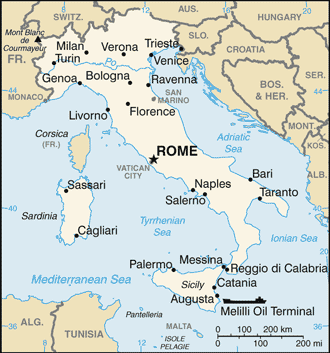
Southern Europe, a peninsula extending into the central Mediterranean Sea, northeast of Tunisia
Geographic coordinates
42 50 N, 12 50 E
Map references
Europe
Area
land: 294,140 sq km
water: 7,200 sq km
Area - comparative
almost twice the size of Georgia; slightly larger than Arizona
Land boundaries
border countries: Austria 404 km; France 476 km; Holy See (Vatican City) 3.4 km; San Marino 37 km; Slovenia 218 km; Switzerland 698 km
Coastline
7,600 km
Maritime claims
continental shelf: 200-m depth or to the depth of exploitation
Climate
predominantly Mediterranean; alpine in far north; hot, dry in south
Terrain
mostly rugged and mountainous; some plains, coastal lowlands
Elevation
lowest point: Mediterranean Sea 0 m
mean elevation: 538 m
Natural resources
coal, antimony, mercury, zinc, potash, marble, barite, asbestos, pumice, fluorspar, feldspar, pyrite (sulfur), natural gas and crude oil reserves, fish, arable land
Land use
agricultural land
agricultural land: arable land
agricultural land: permanent crops
agricultural land: permanent pasture
forest
other
Irrigated land
24,460 sq km (2021)
Major watersheds (area sq km)
Population distribution
a fairly even population distribution exists throughout most of the country, with coastal areas, the Po River Valley, and urban centers (particularly Milan, Rome, and Naples) attracting larger and denser populations
Natural hazards
volcanism: significant volcanic activity; Etna (3,330 m) is Europe's most active volcano, and its flank eruptions pose a threat to nearby Sicilian villages; Etna, along with the famous Vesuvius, have both been deemed Decade Volcanoes by the International Association of Volcanology and Chemistry of the Earth's Interior, worthy of study due to their explosive history and close proximity to human populations; Stromboli, on its namesake island, has also been continuously active with moderate volcanic activity; other historically active volcanoes include Campi Flegrei, Ischia, Larderello, Pantelleria, Vulcano, and Vulsini
Geography - note
strategic location dominating central Mediterranean, as well as southern sea and air approaches to Western Europe
People & Society34
Population
male: 29,383,949
female: 31,540,902
Nationality
adjective: Italian
Ethnic groups
Italian (includes small clusters of German-, French-, and Slovene-Italians in the north, Albanian-Italians, Croat-Italians, and Greek-Italians in the south)
Languages
major-language sample(s):
L'Almanacco dei fatti del mondo, l'indispensabile fonte per le informazioni di base. (Italian)
The World Factbook, the indispensable source for basic information.
Religions
Christian 80.8% (overwhelmingly Roman Catholic with very small groups of Jehovah's Witnesses and Protestants), Muslim 4.9%, unaffiliated 13.4%, other 0.9% (2020 est.)
Age structure
15-64 years: 64.5% (male 19,378,160/female 19,958,137)
65 years and over: 23.6% (2024 est.) (male 6,336,738/female 8,060,995)
Dependency ratios
youth dependency ratio: 18.1 (2025 est.)
elderly dependency ratio: 37.2 (2025 est.)
potential support ratio: 2.7 (2025 est.)
Median age
male: 47.4 years
female: 49.4 years
Population growth rate
-0.05% (2025 est.)
Birth rate
7.13 births/1,000 population (2025 est.)
Death rate
11.2 deaths/1,000 population (2025 est.)
Net migration rate
3.55 migrant(s)/1,000 population (2025 est.)
Population distribution
a fairly even population distribution exists throughout most of the country, with coastal areas, the Po River Valley, and urban centers (particularly Milan, Rome, and Naples) attracting larger and denser populations
Urbanization
rate of urbanization: 0.27% annual rate of change (2020-25 est.)
Major urban areas - population
4.316 million ROME (capital), 3.155 million Milan, 2.179 million Naples, 1.802 million Turin, 913,000 Bergamo, 850,000 Palermo (2023)
Sex ratio
0-14 years: 1.05 male(s)/female
15-64 years: 0.97 male(s)/female
65 years and over: 0.79 male(s)/female
total population: 0.93 male(s)/female (2024 est.)
Mother's mean age at first birth
31.4 years (2020 est.)
Maternal mortality ratio
6 deaths/100,000 live births (2023 est.)
Infant mortality rate
male: 3.2 deaths/1,000 live births
female: 2.9 deaths/1,000 live births
Life expectancy at birth
male: 80.7 years
female: 85.5 years
Total fertility rate
1.27 children born/woman (2025 est.)
Gross reproduction rate
0.62 (2025 est.)
Drinking water source
unimproved: total: total: 0.1% of population (2022 est.)
Health expenditure
Health expenditure (as % of national budget): 11.8% of national budget (2022 est.)
Physician density
4.19 physicians/1,000 population (2022)
Hospital bed density
3.2 beds/1,000 population (2020 est.)
Sanitation facility access
improved: urban
improved: rural
improved: total
unimproved: urban
unimproved: rural
unimproved: total
Obesity - adult prevalence rate
19.9% (2016)
Alcohol consumption per capita
beer: 1.99 liters of pure alcohol (2019 est.)
wine: 4.83 liters of pure alcohol (2019 est.)
spirits: 0.83 liters of pure alcohol (2019 est.)
other alcohols: 0 liters of pure alcohol (2019 est.)
Tobacco use
male: 23.2% (2025 est.)
female: 16.6% (2025 est.)
Currently married women (ages 15-49)
51.8% (2023 est.)
Education expenditure
Education expenditure (% national budget): 7.4% national budget (2022 est.)
Literacy
male: 99.5% (2019 est.)
female: 99.2% (2019 est.)
School life expectancy (primary to tertiary education)
male: 16 years (2023 est.)
female: 17 years (2023 est.)
Government26
Country name
conventional long form
conventional short form
local long form
local short form
former
etymology
Government type
parliamentary republic
Capital
geographic coordinates: 41 54 N, 12 29 E
time difference: UTC+1 (6 hours ahead of Washington, DC, during Standard Time)
daylight saving time: +1hr, begins last Sunday in March; ends last Sunday in October
etymology: by tradition, named after Romulus, one of the legendary founders of the city, but the name Romulus may instead derive from the city's name; the name Rome may come from an Etruscan name for the Tiber River, which was Roma or Ruma
Administrative divisions
regions: Abruzzo, Basilicata, Calabria, Campania, Emilia-Romagna, Lazio (Latium), Liguria, Lombardia, Marche, Molise, Piemonte (Piedmont), Puglia (Apulia), Toscana (Tuscany), Umbria, Veneto
autonomous regions: Friuli Venezia Giulia, Sardegna (Sardinia), Sicilia (Sicily), Trentino-Alto Adige (Trentino-South Tyrol) or Trentino-Suedtirol (German), Valle d'Aosta (Aosta Valley) or Vallée d'Aoste (French)
Legal system
civil law system; Constitutional Court reviews legislation under certain conditions
Constitution
amendment process: proposed by both houses of Parliament; passage requires two successive debates and approval by absolute majority of each house on the second vote; a referendum is only required when requested by one fifth of the members of either house, by voter petition, or by 5 Regional Councils (elected legislative assemblies of the 15 first-level administrative regions and 5 autonomous regions of Italy); referendum not required if an amendment has been approved by a two-thirds majority in each house in the second vote
International law organization participation
accepts compulsory ICJ jurisdiction with reservations; accepts ICCt jurisdiction
Citizenship
citizenship by descent only: at least one parent must be a citizen of Italy
dual citizenship recognized: yes
residency requirement for naturalization: 4 years for EU nationals, 5 years for refugees and specified exceptions, 10 years for all others
Suffrage
18 years of age; universal except in senatorial elections, where minimum age is 25
Executive branch
chief of state
head of government
cabinet
election/appointment process
most recent election date
election results
2022: Sergio MATTARELLA (independent) reelected president; electoral college vote count in eighth round - 759 out of 1,009 (505 vote threshold)
2015: Sergio MATTARELLA (independent) elected president; electoral college vote count in fourth round - 665 out of 995 (505 vote threshold)
expected date of next election
Legislative branch
legislative structure: bicameral
Legislative branch - lower chamber
chamber name
number of seats
electoral system
scope of elections
term in office
most recent election date
parties elected and seats per party
percentage of women in chamber
expected date of next election
Legislative branch - upper chamber
chamber name
number of seats
electoral system
scope of elections
term in office
most recent election date
parties elected and seats per party
percentage of women in chamber
expected date of next election
Judicial branch
judge selection and term of office: Supreme Court judges appointed by the High Council of the Judiciary, headed by the president of the republic; judges may serve for life; Constitutional Court judges - 5 appointed by the president, 5 elected by Parliament, 5 elected by select higher courts; judges serve up to 9 years
subordinate courts: various lower civil and criminal courts (primary and secondary tribunals and courts of appeal)
Political parties
Associative Movement of Italians Abroad or MAIE
Brothers of Italy or FdI
Democratic Party or PD
Five Star Movement or M5S
Forza Italia or FI
Free and Equal (Liberi e Uguali) or LeU
Greens and Left Alliance or AVS
League or Lega
More Europe or +EU
South calls North or ScN
South Tyrolean Peoples Party or SVP
Us Moderates or NM
other minor parties
Diplomatic representation in the US
chief of mission
chancery
telephone
FAX
email address and website
washington.ambasciata@esteri.it
https://ambwashingtondc.esteri.it/ambasciata_washington/en/
consulate(s) general
consulate(s)
Diplomatic representation from the US
chief of mission
embassy
mailing address
telephone
FAX
email address and website
uscitizenrome@state.gov
https://it.usembassy.gov/
consulate(s) general
International organization participation
ADB (nonregional member), AfDB (nonregional member), Arctic Council (observer), Australia Group, BIS, BSEC (observer), CBSS (observer), CD, CDB, CE, CEI, CERN, EAPC, EBRD, ECB, EIB, EITI (implementing country), EMU, ESA, EU, FAO, FATF, G-7, G-8, G-10, G-20, IADB, IAEA, IBRD, ICAO, ICC (national committees), ICCt, ICRM, IDA, IEA, IFAD, IFC, IFRCS, IGAD (partners), IHO, ILO, IMF, IMO, IMSO, Interpol, IOC, IOM, IPU, ISO, ITSO, ITU, ITUC (NGOs), LAIA (observer), MIGA, MINURSO, NATO, NEA, NSG, OAS (observer), OECD, OPCW, OSCE, Pacific Alliance (observer), Paris Club, PCA, PIF (partner), Schengen Convention, SELEC (observer), SICA (observer), UN, UNCTAD, UNESCO, UNHCR, UNIDO, UNIFIL, Union Latina, UNMOGIP, UNOOSA, UNRWA, UNTSO, UNWTO, UPU, Wassenaar Arrangement, WCO, WHO, WIPO, WMO, WTO, ZC
Independence
National holiday
Republic Day, 2 June (1946)
Flag
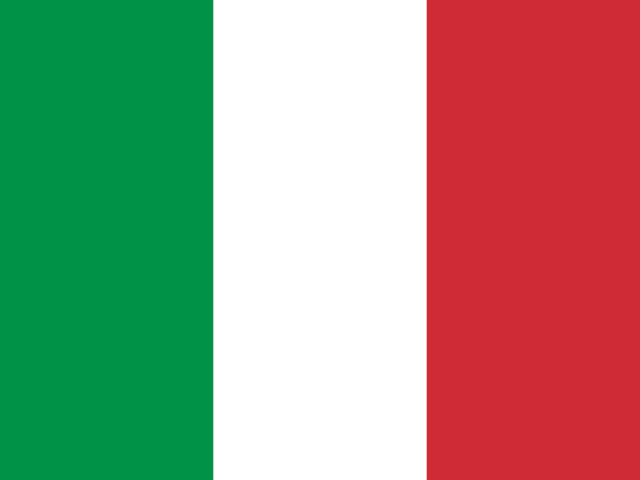
meaning: colors are those of Milan (red and white) combined with the green uniform color of the Milanese civic guard
history: design inspired by the French flag that Napoleon brought to Italy in 1797
National symbol(s)
five-pointed white star (Stella d'Italia)
National color(s)
red, white, green
National coat of arms
National anthem(s)
lyrics/music: Goffredo MAMELI/Michele NOVARO
history: adopted 2005; the anthem, originally written in 1847, is also known as "L'Inno di Mameli" (Mameli's Hymn), and "Fratelli d'Italia" (Brothers of Italy)
National heritage
selected World Heritage Site locales: Historic Center of Rome (c); Archaeological Areas of Pompeii, Herculaneum, and Torre Annunziata (c); Venice and its Lagoon (c); Historic Center of Florence (c); Piazza del Duomo, Pisa (c); Historic Centre of Naples (c); Portovenere, Cinque Terre, and the Islands (Palmaria, Tino and Tinetto)(c); Mount Etna (n); Cultural landscape of the Benedictine settlements in medieval Italy (c); Church and Dominican Convent of Santa Maria delle Grazie with “The Last Supper” by Leonardo da Vinci (c); City of Vicenza and the Palladian Villas of the Veneto (c); Crespi d'Adda (c); Early Christian Monuments of Ravenna (c); Historic Centre of the City of Pienza (c); Cathedral, Torre Civica and Piazza Grande, Modena (c); Costiera Amalfitana (c); Villa Romana del Casale (c); Archaeological Area and the Patriarchal Basilica of Aquileia (c); Cilento and Vallo di Diano National Park with the Archeological Sites of Paestum and Velia, and the Certosa di Padula (c); Historic Centre of Urbino (c); Villa Adriana (Tivoli) (c); Assisi, the Basilica of San Francesco and Other Franciscan Sites (c); City of Verona (c); Isole Eolie (Aeolian Islands) (n); Etruscan Necropolises of Cerveteri and Tarquinia (c); Val d'Orcia (c); Mantua and Sabbioneta (c); The Dolomites (n); Prehistoric Pile Dwellings around the Alps (c); Medici Villas and Gardens in Tuscany (c); Venetian Works of Defence between the 16th and 17th Centuries: Stato da Terra – Western Stato da Mar (c); Padua’s fourteenth-century fresco cycles (c); The Porticoes of Bologna (c); Evaporitic Karst and Caves of Northern Apennines (n); Via Appia: Regina Viarum (c); Funerary Tradition in the Prehistory of Sardinia – The domus de janas (c)
Economy31
Economic overview
high-income, core EU economy; strong services, manufacturing, and tourism sectors; modest growth supported by net exports, low inflation, and public investments via EU funds; tight labor market with aging workforce and shortages in specialized skills; high public debt levels
Real GDP (purchasing power parity)
Real GDP (purchasing power parity) 2023: $3.11 trillion (2023 est.)
Real GDP (purchasing power parity) 2022: $3.088 trillion (2022 est.)
Real GDP growth rate
Real GDP growth rate 2023: 0.7% (2023 est.)
Real GDP growth rate 2022: 4.8% (2022 est.)
Real GDP per capita
Real GDP per capita 2023: $52,700 (2023 est.)
Real GDP per capita 2022: $52,300 (2022 est.)
GDP (official exchange rate)
Inflation rate (consumer prices)
Inflation rate (consumer prices) 2023: 5.6% (2023 est.)
Inflation rate (consumer prices) 2022: 8.2% (2022 est.)
GDP - composition, by sector of origin
industry: 21.7% (2024 est.)
services: 65.6% (2024 est.)
GDP - composition, by end use
household consumption
government consumption
investment in fixed capital
investment in inventories
exports of goods and services
imports of goods and services
Agricultural products
Industries
tourism, machinery, iron and steel, chemicals, food processing, textiles, motor vehicles, clothing, footwear, ceramics
Industrial production growth rate
Labor force
Unemployment rate
Unemployment rate 2023: 7.7% (2023 est.)
Unemployment rate 2022: 8.1% (2022 est.)
Youth unemployment rate (ages 15-24)
male: 19.9% (2024 est.)
female: 24.8% (2024 est.)
Population below poverty line
Gini Index coefficient - distribution of family income
Average household expenditures
on alcohol and tobacco: 3.8% of household expenditures (2023 est.)
Household income or consumption by percentage share
highest 10%: 25.3% (2022 est.)
Remittances
Remittances 2023: 0.5% of GDP (2023 est.)
Remittances 2022: 0.5% of GDP (2022 est.)
Budget
expenditures: $1.104 trillion (2023 est.)
Public debt
Taxes and other revenues
Current account balance
Current account balance 2023: $3.261 billion (2023 est.)
Current account balance 2022: -$36.325 billion (2022 est.)
Exports
Exports 2023: $774.311 billion (2023 est.)
Exports 2022: $737.083 billion (2022 est.)
Exports - partners
Exports - commodities
Imports
Imports 2023: $739.646 billion (2023 est.)
Imports 2022: $775.518 billion (2022 est.)
Imports - partners
Imports - commodities
Reserves of foreign exchange and gold
Reserves of foreign exchange and gold 2023: $247.396 billion (2023 est.)
Reserves of foreign exchange and gold 2022: $224.581 billion (2022 est.)
Exchange rates
Currency
Exchange rates 2024
Exchange rates 2023
Exchange rates 2022
Exchange rates 2021
Exchange rates 2020
Energy8
Electricity access
Electricity
consumption: 290.664 billion kWh (2023 est.)
exports: 3.32 billion kWh (2023 est.)
imports: 54.572 billion kWh (2023 est.)
transmission/distribution losses: 17.62 billion kWh (2023 est.)
Electricity generation sources
fossil fuels
solar
wind
hydroelectricity
geothermal
biomass and waste
Nuclear energy
Coal
consumption: 12.424 million metric tons (2023 est.)
exports: 304,000 metric tons (2023 est.)
imports: 12.069 million metric tons (2023 est.)
proven reserves: 609.999 million metric tons (2023 est.)
Petroleum
refined petroleum consumption: 1.245 million bbl/day (2024 est.)
crude oil estimated reserves: 497.934 million barrels (2021 est.)
Natural gas
consumption: 61.906 billion cubic meters (2023 est.)
exports: 2.609 billion cubic meters (2023 est.)
imports: 61.851 billion cubic meters (2023 est.)
proven reserves: 45.76 billion cubic meters (2021 est.)
Energy consumption per capita
Communications6
Telephones - fixed lines
subscriptions per 100 inhabitants: 34 (2023 est.)
Telephones - mobile cellular
subscriptions per 100 inhabitants: 133 (2024 est.)
Broadcast media
Internet country code
.it
Internet users
Broadband - fixed subscriptions
subscriptions per 100 inhabitants: 34 (2023 est.)
Transportation6
Civil aircraft registration country code prefix
I
Airports
655 (2025)
Heliports
163 (2025)
Railways
Merchant marine
by type: bulk carrier 17, container ship 6, general cargo 109, oil tanker 95, other 1,049
Ports
total ports
large
medium
small
very small
size unknown
ports with oil terminals
key ports
Military & Security7
Military and security forces
note 2: the Financial Guard (Guardia di Finanza) under the Ministry of Economy and Finance is a force with military status and nationwide remit for financial crime investigations, including narcotics trafficking, smuggling, and illegal immigration
Military expenditures
Military Expenditures 2024: 1.5% of GDP (2024 est.)
Military Expenditures 2023: 1.5% of GDP (2023 est.)
Military Expenditures 2022: 1.5% of GDP (2022 est.)
Military Expenditures 2021: 1.5% of GDP (2021 est.)
Military and security service personnel strengths
approximately 170,000 active-duty military personnel; approximately 105,000 Carabinieri (2025)
Military equipment inventories and acquisitions
the military's inventory includes a mix of domestically manufactured, imported, and jointly produced weapons systems; imports come mostly from Europe and the US; the Italian defense industry is capable of producing equipment across all the military domains with particular strengths in aircraft, armored vehicles, and naval vessels; it also participates in joint development and production of advanced weapons systems with other European countries and the US (2025)
Military service age and obligation
Military deployments
Military - note
Italy has been an active member of NATO since its founding in 1948, and the Alliance is a cornerstone of Rome’s national security strategy; it is one of NATO’s leading contributors of military forces and participates in such Alliance missions as Air Policing in the Baltics, the Enhanced Forward Presence in Eastern Europe, and maritime patrols in the Mediterranean and beyond; it hosts NATO’s Joint Force Command in Naples and a NATO Rapid Deployable Corps headquarters in Milan
Italy is also active in European/EU defense cooperation and integration, including hosting the headquarters for the EU’s Mediterranean naval operations force in Rome; in addition, Italy has close defense ties with the US and hosts several US military air, army, and naval bases and facilities (2025)
Transnational Issues1
Refugees and internally displaced persons
stateless persons: 3,000 (2024 est.)