Kazakhstan
Republic of Kazakhstan
Population
20.43M
Area
2,724,900 km²
GDP
$288.41B
GDP Per Capita
$35,900
Pop. Density
7/km²
Quick Facts
Currency
₸Kazakhstani tenge(KZT)
Calling Code
+76
Primary Timezone
UTC+05:00
Languages
Kazakh, Russian+more
Driving Side
right
Demonym
Kazakhstani
Background
Ethnic Kazakhs derive from a mix of Turkic nomadic tribes that migrated to the region in the 15th century. The Russian Empire conquered the Kazakh steppe in the 18th and 19th centuries, and Kazakhstan became a Soviet Republic in 1925. Forced agricultural collectivization led to repression and starvation, resulting in more than a million deaths in the early 1930s. During the 1950s and 1960s, the agricultural "Virgin Lands" program generated an influx of settlers -- mostly ethnic Russians, but also other nationalities -- and by the time of Kazakhstan’s independence in 1991, ethnic Kazakhs were a minority. However, non-Muslim ethnic minorities departed Kazakhstan in large numbers from the mid-1990s through the mid-2000s, and a national program has repatriated about a million ethnic Kazakhs (from Uzbekistan, Tajikistan, Mongolia, and the Xinjiang region of China) to Kazakhstan. As a result of this shift, the ethnic Kazakh share of the population now exceeds two-thirds.
Kazakhstan's economy is the largest in Central Asia, mainly due to the country's vast natural resources. Current issues include diversifying the economy, attracting foreign direct investment, enhancing Kazakhstan's economic competitiveness, and strengthening economic relations with neighboring states and foreign powers.
Historical Trends
GDP (USD)
↑259.8% since 2006Population
↑27.9% since 2006Life Expectancy at Birth
Latest: 74.4 yearsData source: World Bank Open Data
Geography20
Location
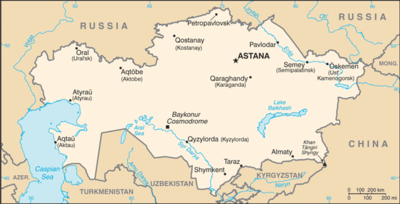
Central Asia, northwest of China; a small portion west of the Ural (Oral) River in easternmost Europe
Geographic coordinates
48 00 N, 68 00 E
Map references
Asia
Area
land: 2,699,700 sq km
water: 25,200 sq km
Area - comparative
slightly less than four times the size of Texas
Land boundaries
border countries: China 1,765 km; Kyrgyzstan 1,212 km; Russia 7,644 km; Turkmenistan 413 km; Uzbekistan 2,330 km
Coastline
Maritime claims
none (landlocked)
Climate
continental, cold winters and hot summers, arid and semiarid
Terrain
vast flat steppe extending from the Volga in the west to the Altai Mountains in the east and from the plains of western Siberia in the north to oases and deserts of Central Asia in the south
Elevation
note - the northern most 7,000 meter peak in the World
lowest point: Qauyndy Oyysy -132 m
mean elevation: 387 m
Natural resources
major deposits of petroleum, natural gas, coal, iron ore, manganese, chrome ore, nickel, cobalt, copper, molybdenum, lead, zinc, bauxite, gold, uranium
Land use
agricultural land
agricultural land: arable land
agricultural land: permanent crops
agricultural land: permanent pasture
forest
other
Irrigated land
17,794 sq km (2022)
Major lakes (area sq km)
salt water lake(s): Caspian Sea (shared with Iran, Azerbaijan, Turkmenistan, and Russia) - 374,000 sq km; Aral Sea (north) - 3,300 sq km; Ozero Alakol - 2,650 sq km; Ozero Teniz 1,590 sq km; Ozero Seletytenzi - 780 sq km; Ozero Sasykkol - 740 sq km
Major rivers (by length in km)
note: [s] after country name indicates river source; [m] after country name indicates river mouth
Major watersheds (area sq km)
Population distribution
most of the country displays a low population density, particularly the interior; population clusters appear in urban agglomerations in the far northern and southern portions of the country
Natural hazards
earthquakes in the south; mudslides around Almaty
Geography - note
People & Society34
Population
male: 9,902,303
female: 10,530,359
Nationality
adjective: Kazakhstani
Ethnic groups
Kazakh 71%, Russian 14.9%, Uzbek 3.3%, Ukrainian 1.9%, Uyghurs 1.5%, German 1.1%, Tatar 1.1%, other 4.9%, unspecified 0.3% (2023 est.)
Languages
major-language sample(s):
Әлемдік деректер кітабы, негізгі ақпараттың таптырмайтын көзі. (Kazakh)
Книга фактов о мире – незаменимый источник базовой информации. (Russian)
The World Factbook, the indispensable source for basic information.
Religions
Muslim 69.3%, Christian 17.2% (Orthodox 17%, other 0.2%), Buddhism 0.1%, other 0.1%, non-believers 2.3%, unspecified 11% (2021 est.)
Age structure
15-64 years: 62.8% (male 6,233,881/female 6,486,019)
65 years and over: 9.6% (2024 est.) (male 700,091/female 1,244,043)
Dependency ratios
youth dependency ratio: 43.6 (2025 est.)
elderly dependency ratio: 15.8 (2025 est.)
potential support ratio: 6.3 (2025 est.)
Median age
male: 30 years
female: 33.8 years
Population growth rate
0.83% (2025 est.)
Birth rate
16.83 births/1,000 population (2025 est.)
Death rate
8.1 deaths/1,000 population (2025 est.)
Net migration rate
-0.4 migrant(s)/1,000 population (2025 est.)
Population distribution
most of the country displays a low population density, particularly the interior; population clusters appear in urban agglomerations in the far northern and southern portions of the country
Urbanization
rate of urbanization: 1.19% annual rate of change (2020-25 est.)
Major urban areas - population
1.987 million Almaty, 1.291 million NUR-SULTAN (capital), 1.155 million Shimkent (2023)
Sex ratio
0-14 years: 1.06 male(s)/female
15-64 years: 0.96 male(s)/female
65 years and over: 0.56 male(s)/female
total population: 0.94 male(s)/female (2024 est.)
Mother's mean age at first birth
28.9 years (2019 est.)
Maternal mortality ratio
10 deaths/100,000 live births (2023 est.)
Infant mortality rate
male: 8.9 deaths/1,000 live births
female: 7 deaths/1,000 live births
Life expectancy at birth
male: 69 years
female: 77.9 years
Total fertility rate
2.57 children born/woman (2025 est.)
Gross reproduction rate
1.24 (2025 est.)
Drinking water source
unimproved: urban: urban: 2% of population (2022 est.)
Health expenditure
Health expenditure (as % of national budget): 10.6% of national budget (2022 est.)
Physician density
3.75 physicians/1,000 population (2023)
Hospital bed density
6.7 beds/1,000 population (2020 est.)
Sanitation facility access
improved: urban
improved: rural
improved: total
unimproved: urban
unimproved: rural
unimproved: total
Obesity - adult prevalence rate
21% (2016)
Alcohol consumption per capita
beer: 2.52 liters of pure alcohol (2019 est.)
wine: 0.16 liters of pure alcohol (2019 est.)
spirits: 1.05 liters of pure alcohol (2019 est.)
other alcohols: 0 liters of pure alcohol (2019 est.)
Tobacco use
male: 35.7% (2025 est.)
female: 6.3% (2025 est.)
Currently married women (ages 15-49)
63.8% (2021 est.)
Child marriage
women married by age 18: 7% (2015)
Education expenditure
Education expenditure (% national budget): 22% national budget (2024 est.)
School life expectancy (primary to tertiary education)
male: 14 years (2024 est.)
female: 14 years (2024 est.)
Government26
Country name
conventional long form
conventional short form
local long form
local short form
former
etymology
Government type
presidential republic
Capital
geographic coordinates: 51 10 N, 71 25 E
time difference: UTC+5 (10 hours ahead of Washington, DC, during Standard Time)
time zone note: On 1 March 2024, Kazakhstan moved from using two time zones to one
etymology: the name means "capital city" in Kazakh
Administrative divisions
note 2: in 1995, the Kazakh and Russian governments agreed that Russia would lease for 20 years an area of 6,000 sq km (2,317 sq mi) around the Baikonur space launch facilities and the city of Bayqongyr (Baikonur, formerly Leninsk); in 2004, the lease was extended to 2050
Legal system
civil law system influenced by Roman-Germanic law and by the theory and practice of the Russian Federation
Constitution
amendment process: introduced by a referendum initiated by the president of the republic, on the recommendation of Parliament, or by the government; the president has the option of submitting draft amendments to Parliament or directly to a referendum; passage of amendments by Parliament requires four-fifths majority vote of both houses and the signature of the president; passage by referendum requires absolute majority vote by more than one half of the voters in at least two thirds of the oblasts, major cities, and the capital, followed by the signature of the president
International law organization participation
has not submitted an ICJ jurisdiction declaration; non-party state to the ICCt
Citizenship
citizenship by descent only: at least one parent must be a citizen of Kazakhstan
dual citizenship recognized: no
residency requirement for naturalization: 5 years
Suffrage
18 years of age; universal
Executive branch
chief of state
head of government
cabinet
election/appointment process
most recent election date
election results
2024: Olzhas BEKTENOV elected as prime minister; 69-0 in parliament
2022: Kasym-Zhomart TOKAYEV reelected president; percent of vote - Kassym-Jomart TOKAYEV (Amanat) 81.3%, Zhiguli DAYRABAEV (Auyl) 3.4%, Qaraqat or Karakat ÄBDEN (KÄQŪA) 2.6%, Meyram KAZHYKEN (Amanat) 2.5%, Nurlan AUYESBAYEV (NSDP) 2.2%, Saltanat TURSYNBEKOVA (QA-DJ) 2.1%, other 5.8%
2019: Kasym-Zhomart TOKAYEV elected president; percent of vote - Kasym-Zhomart TOKAYEV (Amanat) 71%, Amirzhan KOSANOV (Ult Tagdyry) 16.2%, Daniya YESPAYEVA (Ak Zhol) 5.1%, other 7.7%
expected date of next election
Legislative branch
legislative structure: bicameral
Legislative branch - lower chamber
chamber name
number of seats
electoral system
scope of elections
term in office
most recent election date
parties elected and seats per party
percentage of women in chamber
expected date of next election
Legislative branch - upper chamber
chamber name
number of seats
scope of elections
term in office
most recent election date
percentage of women in chamber
expected date of next election
Judicial branch
judge selection and term of office: Supreme Court judges proposed by the president of the republic on recommendation of the Supreme Judicial Council and confirmed by the Senate; judges normally serve until age 65 but can be extended to age 70; Constitutional Council - the president of the republic, the Senate chairperson, and the Mazhilis chairperson each appoints 2 members for a 6-year term; chairperson of the Constitutional Council appointed by the president for a 6-year term
subordinate courts: regional and local courts
Political parties
Amanat formerly Nur Otan
Auyl People's Democratic Patriotic Party or Auyl
Green Party of Kazakhstan orBaytaq
Nationwide Social Democratic Party or NSDP
People's Party of Kazakhstan or PPK
Respublica
Diplomatic representation in the US
chief of mission
chancery
telephone
FAX
email address and website
washington@mfa.kz
https://www.gov.kz/memleket/entities/mfa-washington?lang=en
consulate(s) general
Diplomatic representation from the US
chief of mission
embassy
mailing address
telephone
FAX
email address and website
USAKZ@state.gov
https://kz.usembassy.gov/
consulate(s) general
International organization participation
ADB, CICA, CIS, CSTO, EAEU, EAPC, EBRD, ECO, EITI (compliant country), FAO, GCTU, IAEA, IBRD, ICAO, ICC (NGOs), ICRM, IDA, IDB, IFAD, IFC, IFRCS, ILO, IMF, IMO, Interpol, IOC, IOM, IPU, ISO, ITSO, ITU, MIGA, MINURSO, NAM (observer), NSG, OAS (observer), OIC, OPCW, OSCE, PFP, SCO, UN, UNCTAD, UNESCO, UNHRC, UNIDO, UNOOSA, UN Security Council (temporary), UNWTO, UPU, WCO, WFTU (NGOs), WHO, WIPO, WMO, WTO, ZC
Independence
16 December 1991 (from the Soviet Union)
National holiday
Independence Day, 16 December (1991)
Flag
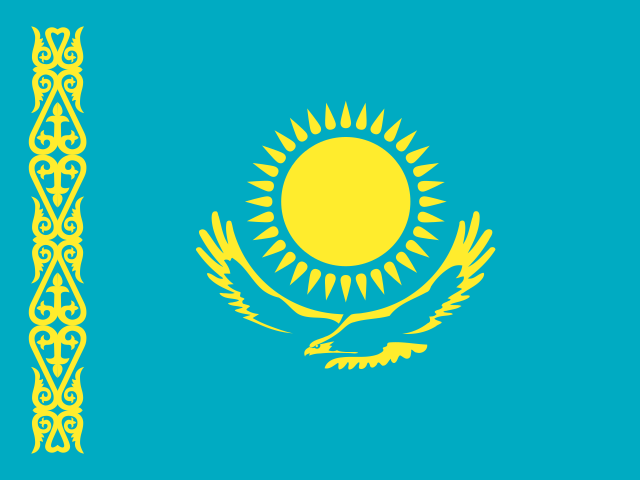
meaning: the blue color has religious significance for the Turkic peoples and symbolizes cultural and ethnic unity, as well as sky and water; the sun stands for wealth and plenitude, with rays shaped like grain; the eagle has appeared on Kazakh tribal flags for centuries and represents freedom, power, and the flight to the future
National symbol(s)
golden eagle
National color(s)
blue, yellow
National coat of arms
National anthem(s)
lyrics/music: Zhumeken NAZHIMEDENOV and Nursultan NAZARBAYEV/Shamshi KALDAYAKOV
history: adopted 2006; President Nursultan NAZARBAYEV played a role in revising the lyrics
National heritage
selected World Heritage Site locales: Mausoleum of Khoja Ahmed Yasawi (c); Petroglyphs at Tanbaly (c); Saryarka - Steppe and Lakes of Northern Kazakhstan (n); Silk Roads: the Chang'an-Tianshan Corridor (c); Western Tien-Shan (n); Cold Winter Deserts of Turan (n)
Economy32
Economic overview
upper-middle-income Central Asian economy; robust growth due to rising oil production, expansion in manufacturing and services, rising domestic demand, and infrastructure investments; however, rapid growth contributing to high inflation rate; declining unemployment and poverty rates
Real GDP (purchasing power parity)
Real GDP (purchasing power parity) 2023: $705.52 billion (2023 est.)
Real GDP (purchasing power parity) 2022: $671.285 billion (2022 est.)
Real GDP growth rate
Real GDP growth rate 2023: 5.1% (2023 est.)
Real GDP growth rate 2022: 3.2% (2022 est.)
Real GDP per capita
Real GDP per capita 2023: $34,700 (2023 est.)
Real GDP per capita 2022: $33,500 (2022 est.)
GDP (official exchange rate)
Inflation rate (consumer prices)
Inflation rate (consumer prices) 2023: 14.7% (2023 est.)
Inflation rate (consumer prices) 2022: 15% (2022 est.)
GDP - composition, by sector of origin
industry: 31.4% (2024 est.)
services: 58.2% (2024 est.)
GDP - composition, by end use
household consumption
government consumption
investment in fixed capital
investment in inventories
exports of goods and services
imports of goods and services
Agricultural products
Industries
oil, coal, iron ore, manganese, chromite, lead, zinc, copper, titanium, bauxite, gold, silver, phosphates, sulfur, uranium, iron and steel; tractors and other agricultural machinery, electric motors, construction materials
Industrial production growth rate
Labor force
Unemployment rate
Unemployment rate 2023: 4.9% (2023 est.)
Unemployment rate 2022: 4.9% (2022 est.)
Youth unemployment rate (ages 15-24)
male: 3% (2024 est.)
female: 4.8% (2024 est.)
Population below poverty line
Gini Index coefficient - distribution of family income
Average household expenditures
on alcohol and tobacco: 2.2% of household expenditures (2023 est.)
Household income or consumption by percentage share
highest 10%: 24.8% (2021 est.)
Remittances
Remittances 2023: 0.1% of GDP (2023 est.)
Remittances 2022: 0.2% of GDP (2022 est.)
Budget
expenditures: $47.247 billion (2023 est.)
Public debt
Taxes and other revenues
Current account balance
Current account balance 2023: -$9.448 billion (2023 est.)
Current account balance 2022: $6.436 billion (2022 est.)
Exports
Exports 2023: $90.926 billion (2023 est.)
Exports 2022: $93.822 billion (2022 est.)
Exports - partners
Exports - commodities
Imports
Imports 2023: $72.723 billion (2023 est.)
Imports 2022: $60.439 billion (2022 est.)
Imports - partners
Imports - commodities
Reserves of foreign exchange and gold
Reserves of foreign exchange and gold 2023: $35.965 billion (2023 est.)
Reserves of foreign exchange and gold 2022: $35.076 billion (2022 est.)
Debt - external
Exchange rates
Currency
Exchange rates 2024
Exchange rates 2023
Exchange rates 2022
Exchange rates 2021
Exchange rates 2020
Energy8
Electricity access
Electricity
consumption: 106.201 billion kWh (2023 est.)
exports: 2.243 billion kWh (2023 est.)
imports: 3.694 billion kWh (2023 est.)
transmission/distribution losses: 9.439 billion kWh (2023 est.)
Electricity generation sources
solar: 1.9% of total installed capacity (2023 est.)
wind: 2.1% of total installed capacity (2023 est.)
hydroelectricity: 8.2% of total installed capacity (2023 est.)
Nuclear energy
Coal
consumption: 86.349 million metric tons (2023 est.)
exports: 34.043 million metric tons (2023 est.)
imports: 114,000 metric tons (2023 est.)
proven reserves: 25.605 billion metric tons (2023 est.)
Petroleum
refined petroleum consumption: 386,000 bbl/day (2023 est.)
crude oil estimated reserves: 30 billion barrels (2021 est.)
Natural gas
consumption: 22.223 billion cubic meters (2023 est.)
exports: 7.071 billion cubic meters (2023 est.)
imports: 408.952 million cubic meters (2023 est.)
proven reserves: 2.407 trillion cubic meters (2021 est.)
Energy consumption per capita
Communications6
Telephones - fixed lines
subscriptions per 100 inhabitants: 13 (2023 est.)
Telephones - mobile cellular
subscriptions per 100 inhabitants: 127 (2024 est.)
Broadcast media
the state owns nearly all radio and TV transmission facilities and operates national TV and radio networks; there are 96 TV channels, and 4 state-run radio stations; some former state-owned media outlets have been privatized; households with satellite dishes have access to foreign media; small number of commercial radio stations; all media outlets have to register with the government (2018)
Internet country code
.kz
Internet users
Broadband - fixed subscriptions
subscriptions per 100 inhabitants: 18 (2023 est.)
Transportation5
Civil aircraft registration country code prefix
UP
Airports
132 (2025)
Heliports
32 (2025)
Railways
broad gauge: 16,636 km (2021) 1.520-m gauge (4,237 km electrified)
Merchant marine
by type: general cargo 3, oil tanker 7, other 112
Military & Security6
Military and security forces
Ministry of Internal Affairs: National Police, National Guard
Committee for National Security (KNB): Border Guard Service (2025)
Military expenditures
Military Expenditures 2023: 1% of GDP (2023 est.)
Military Expenditures 2022: 0.9% of GDP (2022 est.)
Military Expenditures 2021: 1% of GDP (2021 est.)
Military Expenditures 2020: 1.1% of GDP (2020 est.)
Military and security service personnel strengths
available information varies widely; estimated 50,000 active Armed Forces; estimated 30,000 National Guard (2025)
Military equipment inventories and acquisitions
Military service age and obligation
men 18-27 are subject to conscription for 12-24 months; conscripts may be assigned to the Armed Forces, the National Guard, the Border Service, the State Security Service, or the Ministry of Emergency Situations; women may volunteer (2025)
Military - note
Kazakhstan has been a member of the Collective Security Treaty Organization (CSTO) since 1994 and has obligated troops to CSTO's rapid reaction force; it also has had a relationship with NATO since 1992 focused on democratic, institutional, and defense reforms (2025)
Transnational Issues1
Refugees and internally displaced persons
IDPs: 0 (2024 est.)
stateless persons: 7,865 (2024 est.)