

Kuwait
State of Kuwait
Population
3.17M
Area
17,818 km²
GDP
$160.23B
GDP Per Capita
$45,400
Pop. Density
178/km²
Quick Facts
Currency
د.كKuwaiti dinar(KWD)
Calling Code
+965
Timezone
UTC+03:00
Languages
Arabic+more
Driving Side
right
Demonym
Kuwaiti
Background
Kuwait has been ruled by the AL-SABAH dynasty since the 18th century. The threat of Ottoman invasion in 1899 prompted Amir Mubarak AL-SABAH to seek protection from Britain, ceding foreign and defense responsibility to Britain until 1961, when the country attained its independence. Iraq attacked and overran Kuwait in 1990. After several weeks of aerial bombardment, a US-led UN coalition began a ground assault in 1991 that liberated Kuwait in four days. In 1992, the Amir reconstituted the parliament that he had dissolved in 1986. Amid the 2010-11 uprisings and protests across the Arab world, stateless Arabs known as Bidoon staged small protests demanding citizenship, jobs, and other benefits available to Kuwaiti nationals. Other demographic groups, notably Islamists and Kuwaitis from tribal backgrounds, soon joined the growing protest movements, which culminated with the resignation of the prime minister amid allegations of corruption. Demonstrations renewed in 2012 in response to a decree amending the electoral law that lessened the voting power of the tribal blocs.
An opposition coalition of Sunni Islamists, tribal populists, and some liberals largely boycotted legislative elections in 2012 and 2013, which ushered in a legislature more amenable to the government's agenda. Faced with the prospect of painful subsidy cuts, oppositionists and independents actively participated in the 2016 election, winning nearly half the seats, but the opposition became increasingly factionalized. Between 2006 and his death in 2020, the Amir dissolved the National Assembly on seven occasions and shuffled the cabinet over a dozen times, usually citing political stagnation and gridlock between the legislature and the government.
The current Amir, who assumed his role in 2020, launched a "National Dialogue" in 2021 meant to resolve political gridlock. As part of this initiative, the Amir pardoned several opposition figures who had been living in exile, and they returned to Kuwait. Legislative challenges remain, and the cabinet has been reshuffled six times since 2020.
Historical Trends
GDP (USD)
↑57.8% since 2006Population
↑107.1% since 2006Life Expectancy at Birth
Latest: 83.2 yearsData source: World Bank Open Data
Geography19
Location
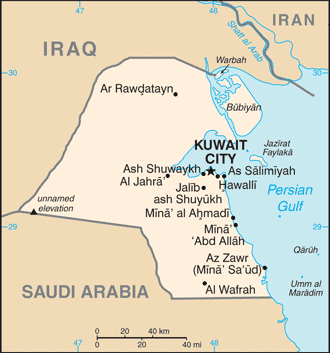
Middle East, bordering the Persian Gulf, between Iraq and Saudi Arabia
Geographic coordinates
29 30 N, 45 45 E
Map references
Middle East
Area
land: 17,818 sq km
water: 0 sq km
Area - comparative
slightly smaller than New Jersey
Land boundaries
border countries: Iraq 254 km; Saudi Arabia 221 km
Coastline
499 km
Maritime claims
Climate
dry desert; intensely hot summers; short, cool winters
Terrain
flat to slightly undulating desert plain
Elevation
lowest point: Persian Gulf 0 m
mean elevation: 108 m
Natural resources
petroleum, fish, shrimp, natural gas
Land use
agricultural land
agricultural land: arable land
agricultural land: permanent crops
agricultural land: permanent pasture
forest
other
Irrigated land
100 sq km (2015)
Major watersheds (area sq km)
Major aquifers
Arabian Aquifer System
Population distribution
densest settlement is along the Persian Gulf, particularly in Kuwait City and on Bubiyan Island; significant population threads extend south and west along highways that radiate from the capital, particularly in the southern half of the country
Natural hazards
sudden cloudbursts are common from October to April and bring heavy rain, which can damage roads and houses; sandstorms and dust storms occur throughout the year but are most common between March and August
Geography - note
strategic location at head of Persian Gulf
People & Society33
Population
male: 1,827,274
female: 1,345,237
Nationality
adjective: Kuwaiti
Ethnic groups
Kuwaiti 30.4%, other Arab 27.4%, Asian 40.3%, African 1%, other 0.9% (includes European, North American, South American, and Australian) (2018 est.)
Languages
major-language sample(s):
كتاب حقائق العالم، المصدر الذي لا يمكن الاستغناء عنه للمعلومات الأساسية (Arabic)
The World Factbook, the indispensable source for basic information.
Religions
Age structure
15-64 years: 73.4% (male 1,386,349/female 917,465)
65 years and over: 3.6% (2024 est.) (male 47,778/female 64,158)
Dependency ratios
youth dependency ratio: 30.9 (2025 est.)
elderly dependency ratio: 5.1 (2025 est.)
potential support ratio: 19.7 (2025 est.)
Median age
male: 31.1 years
female: 28.9 years
Population growth rate
1.07% (2025 est.)
Birth rate
17.36 births/1,000 population (2025 est.)
Death rate
2.3 deaths/1,000 population (2025 est.)
Net migration rate
-4.39 migrant(s)/1,000 population (2025 est.)
Population distribution
densest settlement is along the Persian Gulf, particularly in Kuwait City and on Bubiyan Island; significant population threads extend south and west along highways that radiate from the capital, particularly in the southern half of the country
Urbanization
rate of urbanization: 1.35% annual rate of change (2020-25 est.)
Major urban areas - population
3.298 million KUWAIT (capital) (2023)
Sex ratio
0-14 years: 1.09 male(s)/female
15-64 years: 1.51 male(s)/female
65 years and over: 0.74 male(s)/female
total population: 1.36 male(s)/female (2024 est.)
Maternal mortality ratio
8 deaths/100,000 live births (2023 est.)
Infant mortality rate
male: 7.4 deaths/1,000 live births
female: 6.9 deaths/1,000 live births
Life expectancy at birth
male: 78.1 years
female: 81.1 years
Total fertility rate
2.19 children born/woman (2025 est.)
Gross reproduction rate
1.07 (2025 est.)
Drinking water source
improved: total: total: 100% of population (2022 est.)
unimproved: urban: urban: 0% of population (2022 est.)
unimproved: total: total: 0% of population (2022 est.)
Health expenditure
Health expenditure (as % of national budget): 9.4% of national budget (2022 est.)
Physician density
2.27 physicians/1,000 population (2020)
Hospital bed density
2.4 beds/1,000 population (2020 est.)
Sanitation facility access
improved: total: total: 100% of population (2022 est.)
unimproved: urban: urban: 0% of population (2022 est.)
unimproved: total: total: 0% of population (2022 est.)
Obesity - adult prevalence rate
37.9% (2016)
Alcohol consumption per capita
beer: 0 liters of pure alcohol (2019 est.)
wine: 0 liters of pure alcohol (2019 est.)
spirits: 0 liters of pure alcohol (2019 est.)
other alcohols: 0 liters of pure alcohol (2019 est.)
Tobacco use
male: 34.9% (2025 est.)
female: 1.9% (2025 est.)
Children under the age of 5 years underweight
2.8% (2023 est.)
Education expenditure
Education expenditure (% national budget): 13.8% national budget (2025 est.)
Literacy
male: 97.1% (2020 est.)
female: 95.3% (2020 est.)
School life expectancy (primary to tertiary education)
male: 13 years (2015 est.)
female: 16 years (2015 est.)
Government22
Country name
conventional short form: Kuwait
local long form: Dawlat al Kuwayt
local short form: Al Kuwayt
etymology: the name derives from the capital city, which comes from the Arabic al-kuwayt, itself a diminutive of the Hindustani term kut, meaning a fortress-like house
Government type
constitutional monarchy (emirate)
Capital
geographic coordinates: 29 22 N, 47 58 E
time difference: UTC+3 (8 hours ahead of Washington, DC, during Standard Time)
etymology: the name comes from the Arabic al-kuwayt, a diminutive of the Hindustani term kut, meaning a fortress-like house
Administrative divisions
Legal system
mixed system consisting of English common law, French civil law, and Islamic sharia law
Constitution
amendment process: proposed by the amir or supported by at least one third of the National Assembly; passage requires two-thirds consent of the Assembly membership and promulgation by the amir; constitutional articles on the initiation, approval, and promulgation of general legislation cannot be amended
International law organization participation
has not submitted an ICJ jurisdiction declaration; non-party state to the ICCt
Citizenship
citizenship by descent only: at least one parent must be a citizen of Kuwait
dual citizenship recognized: no
residency requirement for naturalization: not specified
Suffrage
21 years of age and at least 20-year citizenship
Executive branch
head of government: Prime Minister AHMAD ABDULLAH Al-Ahmad al Sabah (since 15 May 2024)
cabinet: Council of Ministers appointed by the prime minister, approved by the amir
election/appointment process: amir chosen from within the ruling family, confirmed by the National Assembly; prime minister appointed by the amir
Legislative branch
Judicial branch
judge selection and term of office: all Kuwaiti judges appointed by the Amir on recommendation of the Supreme Judicial Council, a consultative body comprised of Kuwaiti judges and Ministry of Justice officials
subordinate courts: High Court of Appeal; Court of First Instance; Summary Court
Political parties
none; the government does not recognize any political parties or allow their formation, although no formal law bans political parties
Diplomatic representation in the US
chief of mission
chancery
telephone
FAX
email address and website
info@kuwaitembassy.us
https://www.kuwaitembassy.us/
consulate(s) general
Diplomatic representation from the US
chief of mission
embassy
mailing address
telephone
FAX
email address and website
KuwaitACS@state.gov
https://kw.usembassy.gov/
International organization participation
ABEDA, AfDB (nonregional member), AFESD, AMF, BDEAC, CAEU, CD, FAO, G-77, GCC, IAEA, IBRD, ICAO, ICC (national committees), ICRM, IDA, IDB, IFAD, IFC, IFRCS, IHO, ILO, IMF, IMO, IMSO, Interpol, IOC, IPU, ISO, ITSO, ITU, ITUC (NGOs), LAS, MIGA, NAM, OAPEC, OIC, OPCW, OPEC, Paris Club (associate), PCA, UN, UNCTAD, UNESCO, UNHRC, UNIDO, UNOOSA, UNRWA, UN Security Council (temporary), UNWTO, UPU, WCO, WFTU (NGOs), WHO, WIPO, WMO, WTO
Independence
19 June 1961 (from the UK)
National holiday
National Day, 25 February (1950)
Flag
meaning: green stands for fertile fields, white for purity, red for blood on Kuwaiti swords, and black for defeating the enemy
history: colors and design are based on the Arab Revolt flag of World War I
National symbol(s)
golden falcon
National color(s)
green, white, red, black
National anthem(s)
lyrics/music: Ahmad MUSHARI al-Adwani/Ibrahim Nasir al-SOULA
history: adopted 1978; the anthem is only used on formal occasions
Economy27
Economic overview
small, high-income, oil-based Middle East economy; renewable energy proponent; regional finance and investment leader; maintains oldest sovereign wealth fund; emerging space and tourism industries; mid-way through 25-year development program
Real GDP (purchasing power parity)
Real GDP (purchasing power parity) 2023: $231.884 billion (2023 est.)
Real GDP (purchasing power parity) 2022: $235.815 billion (2022 est.)
Real GDP growth rate
Real GDP growth rate 2023: -1.7% (2023 est.)
Real GDP growth rate 2022: 6.8% (2022 est.)
Real GDP per capita
Real GDP per capita 2023: $47,800 (2023 est.)
Real GDP per capita 2022: $51,400 (2022 est.)
GDP (official exchange rate)
Inflation rate (consumer prices)
Inflation rate (consumer prices) 2023: 3.6% (2023 est.)
Inflation rate (consumer prices) 2022: 4% (2022 est.)
GDP - composition, by sector of origin
industry: 57.1% (2024 est.)
services: 55.9% (2024 est.)
GDP - composition, by end use
household consumption
government consumption
investment in fixed capital
investment in inventories
exports of goods and services
imports of goods and services
Agricultural products
Industries
petroleum, petrochemicals, cement, shipbuilding and repair, water desalination, food processing, construction materials
Industrial production growth rate
Labor force
Unemployment rate
Unemployment rate 2023: 2.2% (2023 est.)
Unemployment rate 2022: 2.2% (2022 est.)
Youth unemployment rate (ages 15-24)
male: 9.3% (2024 est.)
female: 28.9% (2024 est.)
Average household expenditures
on alcohol and tobacco: 0.2% of household expenditures (2023 est.)
Remittances
Remittances 2023: 0% of GDP (2023 est.)
Remittances 2022: 0% of GDP (2022 est.)
Budget
expenditures: $59.584 billion (2015 est.)
Public debt
Current account balance
Current account balance 2023: $51.396 billion (2023 est.)
Current account balance 2022: $63.078 billion (2022 est.)
Exports
Exports 2023: $95.476 billion (2023 est.)
Exports 2022: $110.923 billion (2022 est.)
Exports - partners
Exports - commodities
Imports
Imports 2023: $63.43 billion (2023 est.)
Imports 2022: $55.909 billion (2022 est.)
Imports - partners
Imports - commodities
Reserves of foreign exchange and gold
Reserves of foreign exchange and gold 2023: $52.619 billion (2023 est.)
Reserves of foreign exchange and gold 2022: $52.462 billion (2022 est.)
Exchange rates
Currency
Exchange rates 2024
Exchange rates 2023
Exchange rates 2022
Exchange rates 2021
Exchange rates 2020
Energy7
Electricity access
Electricity
consumption: 78.047 billion kWh (2023 est.)
transmission/distribution losses: 7.516 billion kWh (2023 est.)
Electricity generation sources
solar: 0.2% of total installed capacity (2023 est.)
wind: 2% of total installed capacity (2023 est.)
Coal
exports: 11 metric tons (2023 est.)
imports: 152,000 metric tons (2023 est.)
Petroleum
refined petroleum consumption: 430,000 bbl/day (2023 est.)
crude oil estimated reserves: 101.5 billion barrels (2021 est.)
Natural gas
consumption: 26.296 billion cubic meters (2023 est.)
imports: 8.433 billion cubic meters (2023 est.)
proven reserves: 1.784 trillion cubic meters (2021 est.)
Energy consumption per capita
Communications6
Telephones - fixed lines
subscriptions per 100 inhabitants: 12 (2023 est.)
Telephones - mobile cellular
subscriptions per 100 inhabitants: 168 (2023 est.)
Broadcast media
state-owned TV broadcaster operates 4 networks and a satellite channel; several private TV broadcasters; satellite TV available, and pan-Arab TV stations are especially popular; state-owned Radio Kuwait broadcasts on a number of channels in Arabic and English; first private radio station in 2005; transmissions of at least 2 international radio broadcasters are available (2019)
Internet country code
.kw
Internet users
Broadband - fixed subscriptions
subscriptions per 100 inhabitants: 1 (2023 est.)
Transportation5
Civil aircraft registration country code prefix
9K
Airports
6 (2025)
Heliports
20 (2025)
Merchant marine
by type: general cargo 15, oil tanker 28, other 133
Ports
total ports
large
medium
small
very small
ports with oil terminals
key ports
Military & Security6
Military and security forces
Ministry of Interior: Kuwait Police, State Security, Kuwait Coast Guard (2025)
note 2: the National Guard reports directly to the prime minister and the amir and possesses an independent command structure, equipment inventory, and logistics corps separate from the Ministry of Defense, the regular armed services, and the Ministry of Interior; it is responsible for protecting critical infrastructure and providing support for the Ministries of Interior and Defense as required
Military expenditures
Military Expenditures 2023: 4.8% of GDP (2023 est.)
Military Expenditures 2022: 4.5% of GDP (2022 est.)
Military Expenditures 2021: 6.5% of GDP (2021 est.)
Military Expenditures 2020: 6.3% of GDP (2020 est.)
Military and security service personnel strengths
approximately 17,000 active Kuwait Armed Forces; approximately 7,000 National Guard (2025)
Military equipment inventories and acquisitions
the military's inventory consists of armaments from Western Europe, Russia, and particularly the US (2025)
Military service age and obligation
Military - note
Kuwait's key security partner since the 1991 Gulf War has been the US; the US maintains thousands of military personnel as well as logistics and training facilities in Kuwait as part of mutual cooperation agreements signed in 1991 and 2013; the KAF conducts bilateral exercises with the US military and would look to US assistance in the event of an external attack; Kuwait has Major Non-NATO Ally status with the US, a designation under US law that provides foreign partners with certain benefits in the areas of defense trade and security cooperation (2025)
Transnational Issues1
Refugees and internally displaced persons
stateless persons: 92,000 (2024 est.)