Libya
State of Libya
Population
7.36M
Area
1,759,540 km²
GDP
$46.64B
GDP Per Capita
$12,300
Pop. Density
4/km²
Quick Facts
Currency
ل.دLibyan dinar(LYD)
Calling Code
+218
Timezone
UTC+01:00
Languages
Arabic+more
Driving Side
right
Demonym
Libyan
Background
Berbers have inhabited central north Africa since ancient times, but Phoenicians, Greeks, Carthaginians, Persians, Egyptians, Romans, and Vandals have all settled and ruled the region. In the 7th century, Islam spread through the area. In the mid-16th century, Ottoman rule began; the Italians supplanted the Ottoman Turks in the area around Tripoli in 1911 and held it until 1943, when they were defeated in World War II. Libya then came under UN administration and achieved independence in 1951. Col. Muammar al-QADHAFI assumed leadership with a military coup in 1969 and began to espouse a political system that combined socialism and Islam. During the 1970s, QADHAFI used oil revenues to promote his ideology outside Libya, supporting subversive and terrorist activities that included the downing of two airliners -- one over Scotland and another in Northern Africa -- and a discotheque bombing in Berlin. UN sanctions in 1992 isolated QADHAFI politically and economically; the sanctions were lifted in 2003 when Libya accepted responsibility for the bombings and agreed to claimant compensation. QADHAFI also agreed to end Libya's program to develop weapons of mass destruction, and he made significant strides in normalizing relations with Western nations.
Unrest that began in several Middle Eastern and North African countries in 2010 erupted in Libyan cities in 2011. QADHAFI's brutal crackdown on protesters spawned an eight-month civil war that saw the emergence of a National Transitional Council (NTC), UN authorization of air and naval intervention by the international community, and the toppling of the QADHAFI regime. In 2012, the NTC handed power to an elected parliament, the General National Congress (GNC), which was replaced two years later with the House of Representatives (HoR). In 2015, the UN brokered the Libyan Political Agreement (LPA) among a broad array of political parties and social groups, establishing an interim executive body. However, hardliners continued to oppose and hamper the LPA implementation, leaving Libya with eastern and western-based rival governments. In 2018, the international community supported a recalibrated plan that aimed to break the political deadlock with a National Conference in 2019. These plans, however, were derailed when the eastern-based, self-described Libyan National Army (LNA) launched an offensive to seize Tripoli. The LNA offensive collapsed in 2020, and a subsequent UN-sponsored cease-fire helped formalize the pause in fighting between rival camps.
In 2021, the UN-facilitated Libyan Political Dialogue Forum selected a new prime minister for an interim government -- the Government of National Unity (GNU) -- and a new presidential council charged with preparing for elections and uniting the country’s state institutions. The HoR approved the GNU and its cabinet the same year, providing Libya with its first unified government since 2014, but the parliament then postponed the planned presidential election to an undetermined date in the future. In 2022, the HoR voted to replace GNU interim Prime Minister, Abdul Hamid DUBAYBAH, with another government led by Fathi BASHAGHA. GNU allegations of an illegitimate HoR vote allowed DUBAYBAH to remain in office and rebuff BASHAGHA's attempts to seat his government in Tripoli. In 2023, the HoR voted to replace BASHAGHA with Osma HAMAD. Special Representative of the UN Security-General for Libya, Abdoulaye BATHILY, is leading international efforts to persuade key Libyan political actors to resolve the core issues impeding elections.
Historical Trends
GDP (USD)
↓19.3% since 2006Population
↑23.4% since 2006Life Expectancy at Birth
Latest: 69.3 yearsData source: World Bank Open Data
Geography19
Location
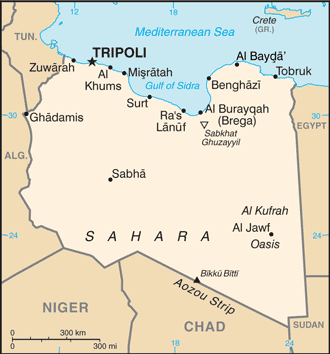
Northern Africa, bordering the Mediterranean Sea, between Egypt, Tunisia, and Algeria
Geographic coordinates
25 00 N, 17 00 E
Map references
Africa
Area
land: 1,759,540 sq km
water: 0 sq km
Area - comparative
about 2.5 times the size of Texas; slightly larger than Alaska
Land boundaries
border countries: Algeria 989 km; Chad 1,050 km; Egypt 1,115 km; Niger 342 km; Sudan 382 km; Tunisia 461 km
Coastline
1,770 km
Maritime claims
exclusive fishing zone: 62 nm
Climate
Mediterranean along coast; dry, extreme desert interior
Terrain
mostly barren, flat to undulating plains, plateaus, depressions
Elevation
lowest point: Sabkhat Ghuzayyil -47 m
mean elevation: 423 m
Natural resources
petroleum, natural gas, gypsum
Land use
agricultural land
agricultural land: arable land
agricultural land: permanent crops
agricultural land: permanent pasture
forest
other
Irrigated land
4,700 sq km (2012)
Major watersheds (area sq km)
Major aquifers
Nubian Aquifer System, North Western Sahara Aquifer System, Murzuk-Djado Basin
Population distribution
over 90% of the population lives along the Mediterranean coast in and between Tripoli to the west and Al Bayda to the east; the interior remains vastly underpopulated due to the Sahara and its lack of surface water, as shown in this population distribution map
Natural hazards
hot, dry, dust-laden ghibli is a southern wind lasting one to four days in spring and fall; dust storms, sandstorms
Geography - note
note 2: the volcano Waw an Namus lies in south central Libya in the middle of the Sahara; the caldera is an oasis -- the name means "oasis of mosquitoes" -- containing several small lakes that host many species of insects and birds
People & Society29
Population
male: 3,747,364
female: 3,613,899
Nationality
adjective: Libyan
Ethnic groups
Amazigh and Arab 97%, other 3% (includes Egyptian, Greek, Indian, Italian, Maltese, Pakistani, Tunisian, and Turkish)
Languages
major-language sample(s):
كتاب حقائق العالم، المصدر الذي لا يمكن الاستغناء عنه للمعلومات الأساسية (Arabic)
The World Factbook, the indispensable source for basic information.
Religions
Age structure
15-64 years: 63.2% (male 2,385,152/female 2,263,780)
65 years and over: 4.6% (2024 est.) (male 151,125/female 184,471)
Dependency ratios
youth dependency ratio: 51.1 (2024 est.)
elderly dependency ratio: 7.2 (2024 est.)
potential support ratio: 13.9 (2024 est.)
Median age
male: 26.3 years
female: 26.2 years
Population growth rate
1.35% (2025 est.)
Birth rate
19.83 births/1,000 population (2025 est.)
Death rate
3.48 deaths/1,000 population (2025 est.)
Net migration rate
-2.89 migrant(s)/1,000 population (2025 est.)
Population distribution
over 90% of the population lives along the Mediterranean coast in and between Tripoli to the west and Al Bayda to the east; the interior remains vastly underpopulated due to the Sahara and its lack of surface water, as shown in this population distribution map
Urbanization
rate of urbanization: 1.45% annual rate of change (2020-25 est.)
Major urban areas - population
1.183 million TRIPOLI (capital), 984,000 Misratah, 859,000 Benghazi (2023)
Sex ratio
0-14 years: 1.04 male(s)/female
15-64 years: 1.05 male(s)/female
65 years and over: 0.82 male(s)/female
total population: 1.04 male(s)/female (2024 est.)
Maternal mortality ratio
59 deaths/100,000 live births (2023 est.)
Infant mortality rate
male: 12.1 deaths/1,000 live births
female: 9.3 deaths/1,000 live births
Life expectancy at birth
male: 75.5 years
female: 80 years
Total fertility rate
2.96 children born/woman (2025 est.)
Gross reproduction rate
1.44 (2025 est.)
Drinking water source
unimproved: total: total: 0.1% of population (2022 est.)
Health expenditure
5.1% of national budget (2022 est.)
Physician density
2.04 physicians/1,000 population (2017)
Hospital bed density
3.2 beds/1,000 population (2021 est.)
Sanitation facility access
unimproved: total: total: 0.7% of population (2022 est.)
Obesity - adult prevalence rate
32.5% (2016)
Alcohol consumption per capita
beer: 0 liters of pure alcohol (2019 est.)
wine: 0.01 liters of pure alcohol (2019 est.)
spirits: 0 liters of pure alcohol (2019 est.)
other alcohols: 0 liters of pure alcohol (2019 est.)
Children under the age of 5 years underweight
4.3% (2022 est.)
Government22
Country name
conventional short form: Libya
local long form: Dawlat Libiya
local short form: Libiya
etymology: the name probably derives from the Libu, a North African tribe first mentioned in texts from the 13th century B.C.; the ancient Greeks and Romans used the name for the entire North African coast west of Egypt
Government type
in transition
Capital
geographic coordinates: 32 53 N, 13 10 E
time difference: UTC+2 (7 hours ahead of Washington, DC, during Standard Time)
etymology: the name derives from the Greek words tri and polis, meaning "three cities;" the modern-day city was founded in the 14th century to replace the three ancient cities of Pallantium, Tegea, and Mantineia
Administrative divisions
Legal system
Libya's post-revolution system is in flux and driven by state and non-state entities
Constitution
International law organization participation
has not submitted an ICJ jurisdiction declaration; non-party state to the ICCt
Citizenship
citizenship by descent only: at least one parent or grandparent must be a citizen of Libya
dual citizenship recognized: no
residency requirement for naturalization: varies from 3 to 5 years
Suffrage
18 years of age, universal
Executive branch
head of government: GNU Interim Prime Minister Abd-al-Hamid DUBAYBAH (since 5 February 2021)
election/appointment process: first direct presidential election was not held as planned
most recent election date: scheduled for 24 December 2021 but not held
expected date of next election: no new date has been set for elections
Legislative branch
legislative structure
chamber name
number of seats
electoral system
scope of elections
most recent election date
percentage of women in chamber
expected date of next election
Judicial branch
Diplomatic representation in the US
chancery: 1460 Dahlia Street NW, Washington, DC 20012
telephone: [1] (202) 944-9601
FAX: [1] (202) 944-9606
email address and website:
info@embassyoflibyadc.com
https://www.embassyoflibyadc.org/
Diplomatic representation from the US
embassy: US Embassy Tripoli operations suspended in 2014
mailing address: 8850 Tripoli Place, Washington, DC 20521-8850
telephone: [216] 71-107-000
email address and website:
Webmaster_Libya@state.gov
https://ly.usembassy.gov/
International organization participation
ABEDA, AfDB, AFESD, AMF, AMU, AU, BDEAC, CAEU, COMESA, FAO, G-77, IAEA, IBRD, ICAO, ICC (NGOs), ICRM, IDA, IDB, IFAD, IFC, IFRCS, ILO, IMF, IMO, IMSO, Interpol, IOC, IOM, IPU, ISO, ITSO, ITU, LAS, LCBC, MIGA, NAM, OAPEC, OIC, OPCW, OPEC, PCA, UN, UNCTAD, UNESCO, UNHRC, UNIDO, UNOOSA, UNSMIL, UNWTO, UPU, WCO, WFTU (NGOs), WHO, WIPO, WMO, WTO (observer)
Independence
24 December 1951 (from UN trusteeship)
National holiday
Liberation Day, 23 October (2011)
Flag
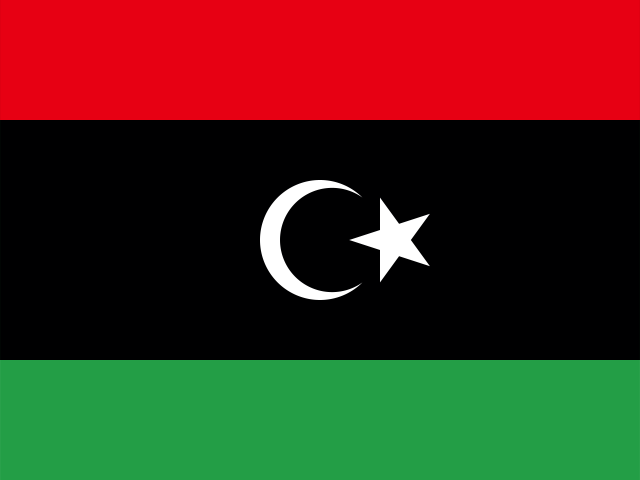
meaning: the colors represent the three major regions of the country: red stands for Fezzan, black for Cyrenaica, and green for Tripolitania; the crescent and star represent Islam
history: the National Transitional Council reintroduced this flag design from the former Kingdom of Libya (1951-69) in 2011 to replace the all-green banner of the QADHAFI regime
National symbol(s)
star and crescent, hawk
National color(s)
red, black, green
National anthem(s)
lyrics/music: Al Bashir AL AREBI/Mohamad Abdel WAHAB
history: adopted 1951, but replaced in 1969 when QADHAFI came to power; readopted 2011 with some modification to the lyrics; also known as "Ya Beladi" (O My Country)
National heritage
selected World Heritage Site locales: Archaeological Site of Cyrene; Archaeological Site of Leptis Magna, Archaeological Site of Sabratha; Rock-Art Sites of Tadrart Acacus; Old Town of Ghadamès
Economy26
Economic overview
upper middle-income, fossil fuel-based North African economy; 31% economic contraction due to COVID-19 and 2020 oil blockade; reduced government spending; central bank had to devalue currency; public wages are over 60% of expenditures
Real GDP (purchasing power parity)
Real GDP (purchasing power parity) 2023: $91.161 billion (2023 est.)
Real GDP (purchasing power parity) 2022: $82.756 billion (2022 est.)
Real GDP growth rate
Real GDP growth rate 2023: 10.2% (2023 est.)
Real GDP growth rate 2022: -8.3% (2022 est.)
Real GDP per capita
Real GDP per capita 2023: $12,500 (2023 est.)
Real GDP per capita 2022: $11,500 (2022 est.)
GDP (official exchange rate)
Inflation rate (consumer prices)
Inflation rate (consumer prices) 2023: 2.4% (2023 est.)
Inflation rate (consumer prices) 2022: 4.5% (2022 est.)
GDP - composition, by sector of origin
industry: 68.3% (2024 est.)
services: 34.3% (2024 est.)
GDP - composition, by end use
household consumption
government consumption
investment in fixed capital
investment in inventories
exports of goods and services
imports of goods and services
Agricultural products
Industries
petroleum, petrochemicals, aluminum, iron and steel, food processing, textiles, handicrafts, cement
Industrial production growth rate
Labor force
Unemployment rate
Unemployment rate 2023: 18.8% (2023 est.)
Unemployment rate 2022: 19.3% (2022 est.)
Youth unemployment rate (ages 15-24)
male: 41.5% (2024 est.)
female: 68.8% (2024 est.)
Remittances
Remittances 2022: 0% of GDP (2022 est.)
Remittances 2021: 0% of GDP (2021 est.)
Budget
expenditures: $37.475 billion (2019 est.)
Public debt
Current account balance
Current account balance 2022: $9.607 billion (2022 est.)
Current account balance 2021: $5.675 billion (2021 est.)
Exports
Exports 2022: $39.831 billion (2022 est.)
Exports 2021: $32.38 billion (2021 est.)
Exports - partners
Exports - commodities
Imports
Imports 2022: $27.872 billion (2022 est.)
Imports 2021: $25.406 billion (2021 est.)
Imports - partners
Imports - commodities
Reserves of foreign exchange and gold
Reserves of foreign exchange and gold 2023: $92.427 billion (2023 est.)
Reserves of foreign exchange and gold 2022: $86.683 billion (2022 est.)
Exchange rates
Currency
Exchange rates 2024
Exchange rates 2023
Exchange rates 2022
Exchange rates 2021
Exchange rates 2020
Energy7
Electricity access
electrification - urban areas: 100%
Electricity
consumption: 28.826 billion kWh (2023 est.)
imports: 800 million kWh (2023 est.)
transmission/distribution losses: 7.081 billion kWh (2023 est.)
Electricity generation sources
Coal
Petroleum
refined petroleum consumption: 207,000 bbl/day (2023 est.)
crude oil estimated reserves: 48.363 billion barrels (2021 est.)
Natural gas
consumption: 8.633 billion cubic meters (2023 est.)
exports: 2.527 billion cubic meters (2023 est.)
proven reserves: 1.505 trillion cubic meters (2021 est.)
Energy consumption per capita
Communications6
Telephones - fixed lines
subscriptions per 100 inhabitants: 17 (2022 est.)
Telephones - mobile cellular
subscriptions per 100 inhabitants: 205 (2022 est.)
Broadcast media
state-funded and private TV stations; some provinces operate local TV stations; pan-Arab satellite TV stations are available; state-funded radio (2019)
Internet country code
.ly
Internet users
Broadband - fixed subscriptions
subscriptions per 100 inhabitants: 5 (2022 est.)
Transportation4
Civil aircraft registration country code prefix
5A
Airports
75 (2025)
Merchant marine
by type: general cargo 2, oil tanker 13, other 81
Ports
total ports
large
medium
small
very small
ports with oil terminals
key ports
Military & Security6
Military and security forces
Military expenditures
not available
Military and security service personnel strengths
estimates not available
Military equipment inventories and acquisitions
Military service age and obligation
not available
Military - note
the western-based forces aligned with the GNU and the eastern-based LNA forces are separated by a fortified line of control just west of the coastal city of Sirte; Turkey has provided support to the GNU forces, including military trainers, ammunition, weapons, and aerial drones; Russia, the United Arab Emirates, and Egypt have been the main supporters of the LNA (2025)
Transnational Issues2
Refugees and internally displaced persons
IDPs: 139,305 (2024 est.)