Mozambique
Republic of Mozambique
Population
34.21M
Area
799,380 km²
GDP
$22.42B
GDP Per Capita
$1,500
Pop. Density
43/km²
Quick Facts
Currency
MTMozambican metical(MZN)
Calling Code
+258
Timezone
UTC+02:00
Languages
Portuguese+more
Driving Side
left
Demonym
Mozambican
Background
In the first half of the second millennium A.D., northern Mozambican port towns were frequented by traders from Somalia, Ethiopia, Egypt, Arabia, Persia, and India. The Portuguese were able to wrest much of the coastal trade from Arab Muslims in the centuries after 1500, and they set up their own colonies. Portugal did not relinquish Mozambique until 1975. Large-scale emigration, economic dependence on South Africa, a severe drought, and a prolonged civil war hindered the country's development until the mid-1990s.
The ruling Front for the Liberation of Mozambique (FRELIMO) party formally abandoned Marxism in 1989, and a new constitution the following year provided for multiparty elections and a free-market economy. A UN-negotiated peace agreement between FRELIMO and rebel Mozambique National Resistance (RENAMO) forces ended the fighting in 1992. In 2004, Mozambique underwent a delicate transition as Joaquim CHISSANO stepped down after 18 years in office. His elected successor, Armando GUEBUZA, served two terms and then passed executive power to Filipe NYUSI in 2015. RENAMO’s residual armed forces intermittently engaged in a low-level insurgency after 2012, but a 2016 cease-fire eventually led to the two sides signing a comprehensive peace deal in 2019.
Since 2017, violent extremists -- who an official ISIS media outlet recognized as ISIS's network in Mozambique for the first time in 2019 -- have been conducting attacks against civilians and security services in the northern province of Cabo Delgado. In 2021, Rwanda and the Southern African Development Community deployed forces to support Mozambique’s efforts to counter the extremist group.
Historical Trends
GDP (USD)
↑139.2% since 2006Population
↑66.6% since 2006Life Expectancy at Birth
Latest: 63.6 yearsData source: World Bank Open Data
Geography20
Location
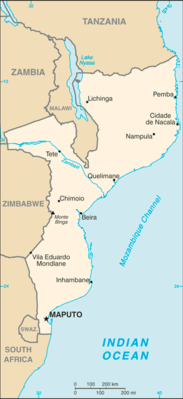
Southeastern Africa, bordering the Mozambique Channel, between South Africa and Tanzania
Geographic coordinates
18 15 S, 35 00 E
Map references
Africa
Area
land: 786,380 sq km
water: 13,000 sq km
Area - comparative
slightly more than five times the size of Georgia; slightly less than twice the size of California
Land boundaries
border countries: Malawi 1498 km; South Africa 496 km; Eswatini 108 km; Tanzania 840 km; Zambia 439 km; Zimbabwe 1,402 km
Coastline
2,470 km
Maritime claims
exclusive economic zone: 200 nm
Climate
tropical to subtropical
Terrain
mostly coastal lowlands, uplands in center, high plateaus in northwest, mountains in west
Elevation
lowest point: Indian Ocean 0 m
mean elevation: 345 m
Natural resources
coal, titanium, natural gas, hydropower, tantalum, graphite
Land use
agricultural land
agricultural land: arable land
agricultural land: permanent crops
agricultural land: permanent pasture
forest
other
Irrigated land
1,180 sq km (2012)
Major lakes (area sq km)
Major rivers (by length in km)
note: [s] after country name indicates river source; [m] after country name indicates river mouth
Major watersheds (area sq km)
Population distribution
three large population clusters are found along the southern coast between Maputo and Inhambane, in the central area between Beira and Chimoio along the Zambezi River, and in and around the northern cities of Nampula, Cidade de Nacala, and Pemba; the northwest and southwest are the least populated areas, as shown in this population distribution map
Natural hazards
severe droughts; devastating cyclones and floods in central and southern provinces
Geography - note
the Zambezi River flows through the north-central and most fertile part of the country
People & Society36
Population
male: 16,880,529
female: 17,325,615
Nationality
adjective: Mozambican
Ethnic groups
African 99% (Makhuwa, Tsonga, Lomwe, Sena, and others), Mestizo 0.8%, other (includes European, Indian, Pakistani, Chinese) 0.2% (2017 est.)
Languages
Makhuwa 26.1%, Portuguese (official) 16.6%, Tsonga 8.6%, Nyanja 8.1, Sena 7.1%, Lomwe 7.1%, Chuwabo 4.7%, Ndau 3.8%, Tswa 3.8%, other Mozambican languages 11.8%, other 0.5%, unspecified 1.8% (2017 est.)
Religions
Catholic 27.3%, Islam 19.1%, Pentecostal 16.7%, Saio/Zione 16.3%, no religion 13.5%, other 4.3%, Anglican 1.7%, unknown 1.2% (2017 est.)
Age structure
15-64 years: 52.4% (male 8,428,457/female 9,061,065)
65 years and over: 2.9% (2024 est.) (male 473,030/female 490,143)
Dependency ratios
youth dependency ratio: 83.7 (2025 est.)
elderly dependency ratio: 5.5 (2025 est.)
potential support ratio: 18.3 (2025 est.)
Median age
male: 16.7 years
female: 17.9 years
Population growth rate
2.53% (2025 est.)
Birth rate
36.07 births/1,000 population (2025 est.)
Death rate
9.34 deaths/1,000 population (2025 est.)
Net migration rate
-1.46 migrant(s)/1,000 population (2025 est.)
Population distribution
three large population clusters are found along the southern coast between Maputo and Inhambane, in the central area between Beira and Chimoio along the Zambezi River, and in and around the northern cities of Nampula, Cidade de Nacala, and Pemba; the northwest and southwest are the least populated areas, as shown in this population distribution map
Urbanization
rate of urbanization: 4.24% annual rate of change (2020-25 est.)
Major urban areas - population
1.852 million Matola, 1.163 million MAPUTO (capital), 969,000 Nampula (2023)
Sex ratio
0-14 years: 1.03 male(s)/female
15-64 years: 0.93 male(s)/female
65 years and over: 0.97 male(s)/female
total population: 0.97 male(s)/female (2024 est.)
Mother's mean age at first birth
Maternal mortality ratio
82 deaths/100,000 live births (2023 est.)
Infant mortality rate
male: 60.1 deaths/1,000 live births
female: 56.2 deaths/1,000 live births
Life expectancy at birth
male: 57.1 years
female: 59.6 years
Total fertility rate
4.58 children born/woman (2025 est.)
Gross reproduction rate
2.26 (2025 est.)
Drinking water source
improved: urban
improved: rural
improved: total
unimproved: urban
unimproved: rural
unimproved: total
Health expenditure
Health expenditure (as % of national budget): 8% of national budget (2022 est.)
Physician density
0.18 physicians/1,000 population (2022)
Hospital bed density
0.7 beds/1,000 population (2021 est.)
Sanitation facility access
improved: urban
improved: rural
improved: total
unimproved: urban
unimproved: rural
unimproved: total
Obesity - adult prevalence rate
7.2% (2016)
Alcohol consumption per capita
beer: 1.03 liters of pure alcohol (2019 est.)
wine: 0.22 liters of pure alcohol (2019 est.)
spirits: 0.21 liters of pure alcohol (2019 est.)
other alcohols: 0 liters of pure alcohol (2019 est.)
Tobacco use
male: 23% (2020 est.)
female: 5.6% (2020 est.)
Children under the age of 5 years underweight
15.4% (2022 est.)
Currently married women (ages 15-49)
64.8% (2023 est.)
Child marriage
women married by age 18: 52.9% (2015)
men married by age 18: 9.7% (2015)
Education expenditure
Education expenditure (% national budget): 20.4% national budget (2021 est.)
Literacy
male: 74.1% (2022 est.)
female: 50.9% (2022 est.)
School life expectancy (primary to tertiary education)
male: 11 years (2017 est.)
female: 10 years (2017 est.)
Government23
Country name
conventional long form
conventional short form
local long form
local short form
former
etymology
Government type
presidential republic
Capital
geographic coordinates: 25 57 S, 32 35 E
time difference: UTC+2 (7 hours ahead of Washington, DC, during Standard Time)
etymology: named after the Maputo River, which drains into Maputo Bay south of the city; the river is said to be named after the son of Muagobe, a local chief in the 18th century
Administrative divisions
Legal system
mixed system of Portuguese civil law and customary law
Constitution
amendment process: proposed by the president of the republic or supported by at least one third of the Assembly of the Republic membership; passage of amendments affecting constitutional provisions, including the independence and sovereignty of the state, the republican form of government, basic rights and freedoms, and universal suffrage, requires at least a two-thirds majority vote by the Assembly and approval in a referendum; referenda not required for passage of other amendments
International law organization participation
has not submitted an ICJ jurisdiction declaration; non-party state to the ICCt
Citizenship
citizenship by descent only: at least one parent must be a citizen of Mozambique
dual citizenship recognized: no
residency requirement for naturalization: 5 years
Suffrage
18 years of age; universal
Executive branch
chief of state
head of government
cabinet
election/appointment process
most recent election date
election results
2024: Daniel CHAPO elected president in first round; percent of vote - Daniel CHAPO (FRELIMO) 65.2%, Venâncio MONDLANE (PODEMOS) 24.2%, Ossufo MOMADE (RENAMO) 6.6%
expected date of next election
Legislative branch
legislature name
legislative structure
number of seats
electoral system
scope of elections
term in office
most recent election date
parties elected and seats per party
percentage of women in chamber
expected date of next election
Judicial branch
judge selection and term of office: Supreme Court president appointed by the president of the republic; vice president appointed by the president in consultation with the Higher Council of the Judiciary (CSMJ) and ratified by the Assembly of the Republic; other judges elected by the Assembly; judges serve 5-year renewable terms; Constitutional Council judges appointed - 1 by the president, 5 by the Assembly, and 1 by the CSMJ; judges serve 5-year nonrenewable terms
subordinate courts: Administrative Court (capital city only); provincial courts or Tribunais Judicias de Provincia; District Courts or Tribunais Judicias de Districto; customs courts; maritime courts; courts marshal; labor courts; community courts
Political parties
Liberation Front of Mozambique (Frente de Liberatacao de Mocambique) or FRELIMO
Mozambican National Resistance (Resistencia Nacional Mocambicana) or RENAMO
Diplomatic representation in the US
chancery: 1525 New Hampshire Avenue NW, Washington, DC 20036
telephone: [1] (202) 293-7147
FAX: [1] (202) 835-0245
email address and website:
washington.dc@embamoc.gov.mz
https://usa.embamoc.gov.mz/
Diplomatic representation from the US
embassy: Avenida Marginal 5467, Maputo
mailing address: 2330 Maputo Place, Washington DC 20521-2330
telephone: [258] (84) 095-8000
email address and website:
MaputaConsular@state.gov
https://mz.usembassy.gov/
International organization participation
Independence
25 June 1975 (from Portugal)
National holiday
Independence Day, 25 June (1975)
Flag
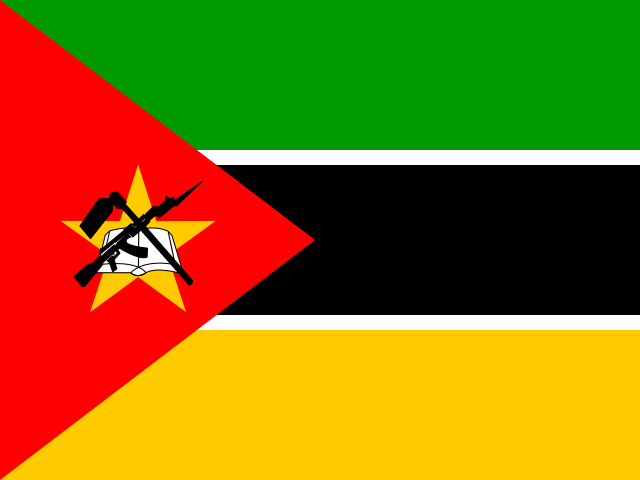
meaning: green stands for the riches of the land, white for peace, black for the African continent, yellow for the country's minerals, and red for the fight for independence; the rifle stands for defense and vigilance, the hoe for agriculture, the open book for the importance of education, and the star for Marxism and internationalism
National symbol(s)
rifle, hoe, and book
National color(s)
green, black, yellow, white, red
National anthem(s)
lyrics/music: Salomão J. MANHICA/unkown
history: adopted 2002; the new anthem reflects the new multi-party political system
National heritage
selected World Heritage Site locales: Island of Mozambique
Economy31
Economic overview
low-income East African economy; subsistence farming dominates labor force; return to growth led by agriculture and extractive industries; Islamist insurgency threatens natural gas projects in north; ongoing foreign debt restructuring and resolution under IMF Highly Indebted Poor Countries (HIPC) initiative
Real GDP (purchasing power parity)
Real GDP (purchasing power parity) 2023: $50.844 billion (2023 est.)
Real GDP (purchasing power parity) 2022: $48.222 billion (2022 est.)
Real GDP growth rate
Real GDP growth rate 2023: 5.4% (2023 est.)
Real GDP growth rate 2022: 4.4% (2022 est.)
Real GDP per capita
Real GDP per capita 2023: $1,500 (2023 est.)
Real GDP per capita 2022: $1,500 (2022 est.)
GDP (official exchange rate)
Inflation rate (consumer prices)
Inflation rate (consumer prices) 2023: 7.1% (2023 est.)
Inflation rate (consumer prices) 2022: 10.3% (2022 est.)
GDP - composition, by sector of origin
industry: 24.6% (2024 est.)
services: 38.4% (2024 est.)
GDP - composition, by end use
household consumption
government consumption
investment in fixed capital
investment in inventories
exports of goods and services
imports of goods and services
Agricultural products
Industries
aluminum, petroleum products, chemicals (fertilizer, soap, paints), textiles, cement, glass, asbestos, tobacco, food, beverages
Industrial production growth rate
Labor force
Unemployment rate
Unemployment rate 2023: 3.6% (2023 est.)
Unemployment rate 2022: 3.6% (2022 est.)
Youth unemployment rate (ages 15-24)
male: 7.5% (2024 est.)
female: 7.2% (2024 est.)
Population below poverty line
Gini Index coefficient - distribution of family income
Household income or consumption by percentage share
highest 10%: 41.1% (2019 est.)
Remittances
Remittances 2023: 1.2% of GDP (2023 est.)
Remittances 2022: 0.9% of GDP (2022 est.)
Budget
expenditures: $7.223 billion (2024 est.)
Public debt
Taxes and other revenues
Current account balance
Current account balance 2023: -$2.207 billion (2023 est.)
Current account balance 2022: -$6.367 billion (2022 est.)
Exports
Exports 2023: $9.405 billion (2023 est.)
Exports 2022: $9.409 billion (2022 est.)
Exports - partners
Exports - commodities
Imports
Imports 2023: $11.18 billion (2023 est.)
Imports 2022: $15.932 billion (2022 est.)
Imports - partners
Imports - commodities
Reserves of foreign exchange and gold
Reserves of foreign exchange and gold 2023: $3.637 billion (2023 est.)
Reserves of foreign exchange and gold 2022: $2.939 billion (2022 est.)
Debt - external
Exchange rates
Currency
Exchange rates 2024
Exchange rates 2023
Exchange rates 2022
Exchange rates 2021
Exchange rates 2020
Energy7
Electricity access
electrification - urban areas: 79.4%
electrification - rural areas: 5%
Electricity
consumption: 12.983 billion kWh (2023 est.)
exports: 11.483 billion kWh (2023 est.)
imports: 8.287 billion kWh (2023 est.)
transmission/distribution losses: 3.38 billion kWh (2023 est.)
Electricity generation sources
solar: 0.4% of total installed capacity (2023 est.)
hydroelectricity: 82.7% of total installed capacity (2023 est.)
biomass and waste: 0.6% of total installed capacity (2023 est.)
Coal
consumption: 13,000 metric tons (2023 est.)
exports: 10.658 million metric tons (2023 est.)
imports: 900 metric tons (2023 est.)
proven reserves: 1.792 billion metric tons (2023 est.)
Petroleum
Natural gas
consumption: 1.625 billion cubic meters (2023 est.)
exports: 7.09 billion cubic meters (2023 est.)
proven reserves: 2.832 trillion cubic meters (2021 est.)
Energy consumption per capita
Communications6
Telephones - fixed lines
subscriptions per 100 inhabitants: (2022 est.) less than 1
Telephones - mobile cellular
subscriptions per 100 inhabitants: 50 (2024 est.)
Broadcast media
1 state-run TV station supplemented by a private TV station; Portuguese state TV's African service, RTP Africa, and Brazilian-owned TV Miramar are available; state-run radio provides nearly 100% territorial coverage and broadcasts in multiple languages; a number of privately owned and community-operated stations; transmissions of multiple international broadcasters are available (2019)
Internet country code
.mz
Internet users
Broadband - fixed subscriptions
subscriptions per 100 inhabitants: (2022 est.) less than 1
Transportation5
Civil aircraft registration country code prefix
C9
Airports
92 (2025)
Railways
narrow gauge: 4,787 km (2014) 1.067-m gauge
Merchant marine
by type: general cargo 9, other 27
Ports
total ports
large
medium
small
very small
ports with oil terminals
key ports
Military & Security6
Military and security forces
Ministry of Interior: Mozambique National Police (PRM; includes the Rapid Intervention Unit, UIR), the National Criminal Investigation Service (SERNIC), Border Security Force; other security forces include the Presidential Guard and the Force for the Protection of High-Level Individuals (2025)
note 2: the PRM, SERNIC, and the UIR are responsible for law enforcement and internal security; the Border Security Force is responsible for protecting the country’s international borders and for carrying out police duties within 24 miles of borders
note 3: in 2023, the Mozambique Government legalized local militias that have been assisting security forces operating in Cabo Delgado against Islamic militants since 2020; this Local Force is comprised of ex-combatants and other civilians and receives training, uniforms, weapons, and logistical support from the FADM
Military expenditures
Military Expenditures 2023: 2% of GDP (2023 est.)
Military Expenditures 2022: 2% of GDP (2022 est.)
Military Expenditures 2021: 2% of GDP (2021 est.)
Military Expenditures 2020: 1.5% of GDP (2020 est.)
Military and security service personnel strengths
estimated 12,000 active FADM (2025)
Military equipment inventories and acquisitions
the FADM's inventory consists primarily of Soviet-era armaments, although in recent years it has received some secondhand equipment from a number of countries, including India, South Africa, and the UAE, mostly as donations (2025)
Military service age and obligation
registration for military service is mandatory for all men and women at 18 years of age; 18-35 years of age for selective compulsory military service; 18 years of age for voluntary service for men and women; initial 60-month service obligation (2025)
Military - note
Transnational Issues1
Refugees and internally displaced persons
IDPs: 718,154 (2024 est.)