
Namibia
Republic of Namibia
Population
2.85M
Area
824,292 km²
GDP
$13.37B
GDP Per Capita
$10,300
Pop. Density
3/km²
Quick Facts
Currency
$Namibian dollar(NAD)
Calling Code
+264
Timezone
UTC+01:00
Languages
Afrikaans, German, English +6+more
Driving Side
left
Demonym
Namibian
Background
Historical Trends
GDP (USD)
↑67.1% since 2006Population
↑52.1% since 2006Life Expectancy at Birth
Latest: 67.4 yearsData source: World Bank Open Data
Geography20
Location
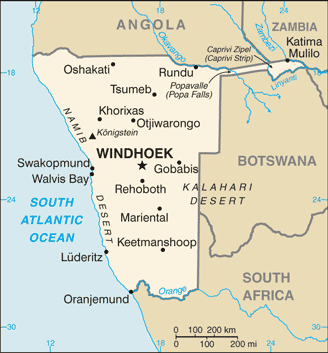
Southern Africa, bordering the South Atlantic Ocean, between Angola and South Africa
Geographic coordinates
22 00 S, 17 00 E
Map references
Africa
Area
land: 823,290 sq km
water: 1,002 sq km
Area - comparative
almost seven times the size of Pennsylvania; slightly more than half the size of Alaska
Land boundaries
border countries: Angola 1,427 km; Botswana 1,544 km; South Africa 1,005 km; Zambia 244 km
Coastline
1,572 km
Maritime claims
contiguous zone: 24 nm
exclusive economic zone: 200 nm
Climate
desert; hot, dry; rainfall sparse and erratic
Terrain
mostly high plateau; Namib Desert along coast; Kalahari Desert in east
Elevation
lowest point: Atlantic Ocean 0 m
mean elevation: 1,141 m
Natural resources
Land use
agricultural land
agricultural land: arable land
agricultural land: permanent crops
agricultural land: permanent pasture
forest
other
Irrigated land
80 sq km (2012)
Major rivers (by length in km)
note: [s] after country name indicates river source; [m] after country name indicates river mouth
Major watersheds (area sq km)
Indian Ocean drainage: Zambezi (1,332,412 sq km)
Internal (endorheic basin) drainage: Okavango Basin (863,866 sq km)
Major aquifers
Lower Kalahari-Stampriet Basin, Upper Kalahari-Cuvelai-Upper Zambezi Basin
Population distribution
population density is very low, with the largest clusters found in the extreme north-central area along the border with Angola, as shown in this population distribution map
Natural hazards
prolonged periods of drought
Geography - note
the Namib Desert, after which the country is named, is considered to be the oldest desert in the world; some 14% of the land is protected, including virtually the entire Namib Desert coastal strip
People & Society32
Population
male: 1,402,136
female: 1,450,641
Nationality
adjective: Namibian
Ethnic groups
Ovambo 50%, Kavangos 9%, Herero 7%, Damara 7%, mixed European and African ancestry 6.5%, European 6%, Nama 5%, Caprivian 4%, San 3%, Baster 2%, Tswana 0.5%
Languages
Religions
Christian 97.5%, other 0.6% (includes Muslim, Baha'i, Jewish, Buddhist), unaffiliated 1.9% (2020 est.)
Age structure
15-64 years: 62% (male 846,810/female 890,099)
65 years and over: 3.9% (2024 est.) (male 47,686/female 62,969)
Dependency ratios
youth dependency ratio: 54 (2025 est.)
elderly dependency ratio: 6.5 (2025 est.)
potential support ratio: 15.5 (2025 est.)
Median age
male: 22.1 years
female: 23.5 years
Population growth rate
1.76% (2025 est.)
Birth rate
23.93 births/1,000 population (2025 est.)
Death rate
6.36 deaths/1,000 population (2025 est.)
Net migration rate
0 migrant(s)/1,000 population (2025 est.)
Population distribution
population density is very low, with the largest clusters found in the extreme north-central area along the border with Angola, as shown in this population distribution map
Urbanization
rate of urbanization: 3.64% annual rate of change (2020-25 est.)
Major urban areas - population
477,000 WINDHOEK (capital) (2023)
Sex ratio
0-14 years: 1.02 male(s)/female
15-64 years: 0.95 male(s)/female
65 years and over: 0.76 male(s)/female
total population: 0.97 male(s)/female (2024 est.)
Mother's mean age at first birth
Maternal mortality ratio
139 deaths/100,000 live births (2023 est.)
Infant mortality rate
male: 31 deaths/1,000 live births
female: 24.7 deaths/1,000 live births
Life expectancy at birth
male: 64.2 years
female: 67.6 years
Total fertility rate
2.85 children born/woman (2025 est.)
Gross reproduction rate
1.4 (2025 est.)
Drinking water source
improved: urban
improved: rural
improved: total
unimproved: urban
unimproved: rural
unimproved: total
Health expenditure
Health expenditure (as % of national budget): 11.7% of national budget (2022 est.)
Physician density
0.55 physicians/1,000 population (2022)
Sanitation facility access
improved: urban
improved: rural
improved: total
unimproved: urban
unimproved: rural
unimproved: total
Obesity - adult prevalence rate
17.2% (2016)
Alcohol consumption per capita
beer: 1.37 liters of pure alcohol (2019 est.)
wine: 0.16 liters of pure alcohol (2019 est.)
spirits: 0.53 liters of pure alcohol (2019 est.)
other alcohols: 0.32 liters of pure alcohol (2019 est.)
Tobacco use
male: 20.5% (2025 est.)
female: 3.9% (2025 est.)
Currently married women (ages 15-49)
33.7% (2018 est.)
Education expenditure
Education expenditure (% national budget): 24.6% national budget (2025 est.)
Literacy
male: 87.9% (2023 est.)
female: 87.4% (2023 est.)
Government25
Country name
conventional long form
conventional short form
local long form
local short form
former
etymology
Government type
presidential republic
Capital
geographic coordinates: 22 34 S, 17 05 E
time difference: UTC+2 (7 hours ahead of Washington, DC, during Standard Time)
etymology: the name is an Afrikaans word meaning "windy corner;" a local Khoikhoin chief first used the name in the 19th century and may have derived it from the name of his childhood South African village of Winterhoek
Administrative divisions
Legal system
mixed system of uncodified civil law based on Roman-Dutch law and customary law
Constitution
amendment process: passage requires majority vote of the National Assembly membership and of the National Council of Parliament and assent of the president of the republic; if the National Council fails to pass an amendment, the president can call for a referendum; passage by referendum requires two-thirds majority of votes cast; amendments that detract from or repeal constitutional articles on fundamental rights and freedoms cannot be amended, and the requisite majorities needed by Parliament to amend the constitution cannot be changed
International law organization participation
has not submitted an ICJ jurisdiction declaration; accepts ICCt jurisdiction
Citizenship
citizenship by descent only: at least one parent must be a citizen of Namibia
dual citizenship recognized: no
residency requirement for naturalization: 5 years
Suffrage
18 years of age; universal
Executive branch
chief of state
head of government
cabinet
election/appointment process
most recent election date
election results
2024: Netumbo NANDI-NDAITWAH elected president in the first round; percent of vote -Netumbo NANDI-NDAITWAH (SWAPO) 57%, Panduleni ITULA (IPC) 26%, McHenry VENAANI (PDM) 5.10%, Bernadus SWARTBOOI (LPM) 4.72%, Job AMUPANDA (AR) 1.80%, Hendrik GAOBEAB (UDF) 1.16%; other 3.31%
2019: Hage GEINGOB reelected president in the first round; percent of vote - Hage GEINGOB (SWAPO) 56.3%, Panduleni ITULA (independent) 29.4%, McHenry VENAANI (PDM) 5.3%, other .9%
expected date of next election
Legislative branch
legislative structure: bicameral
Legislative branch - lower chamber
chamber name
number of seats
electoral system
scope of elections
term in office
most recent election date
parties elected and seats per party
percentage of women in chamber
expected date of next election
Legislative branch - upper chamber
chamber name
number of seats
electoral system
term in office
most recent election date
percentage of women in chamber
expected date of next election
Judicial branch
judge selection and term of office: judges appointed by the president of Namibia on the recommendation of the Judicial Service Commission; judges serve until age 65, but terms can be extended by the president until age 70
subordinate courts: High Court; Electoral Court, Labor Court; regional and district magistrates' courts; community courts
Political parties
Christian Democratic Voice or CDV
Landless People's Movement or LPM
National Unity Democratic Organization or NUDO
Namibian Economic Freedom Fighters or NEFF
Popular Democratic Movement or PDM (formerly Democratic Turnhalle Alliance or DTA)
Rally for Democracy and Progress or RDP
Republican Party or RP
South West Africa National Union or SWANU
South West Africa People's Organization or SWAPO
United Democratic Front or UDF
United People's Movement or UPM
Diplomatic representation in the US
chancery: 1605 New Hampshire Avenue NW, Washington, DC 20009
telephone: [1] (202) 986-0540
FAX: [1] (202) 986-0443
email address and website:
info@namibiaembassyusa.org
https://namibiaembassyusa.org/
Diplomatic representation from the US
chief of mission
embassy
mailing address
telephone
FAX
email address and website
ConsularWindhoek@state.gov
https://na.usembassy.gov/
International organization participation
ACP, AfDB, AU, C, CD, CPLP (associate observer), FAO, G-77, IAEA, IBRD, ICAO, ICCt, ICRM, IDA, IFAD, IFC, IFRCS, ILO, IMF, IMO, Interpol, IOC, IOM, IPU, ISO, ITSO, ITU, ITUC (NGOs), MIGA, NAM, OPCW, SACU, SADC, UN, UNAMID, UNCTAD, UNESCO, UNHCR, UNHRC, UNIDO, UNISFA, UNMIL, UNMISS, UNOCI, UNWTO, UPU, WCO, WHO, WIPO, WMO, WTO
Independence
21 March 1990 (from South African mandate)
National holiday
Independence Day, 21 March (1990)
Flag
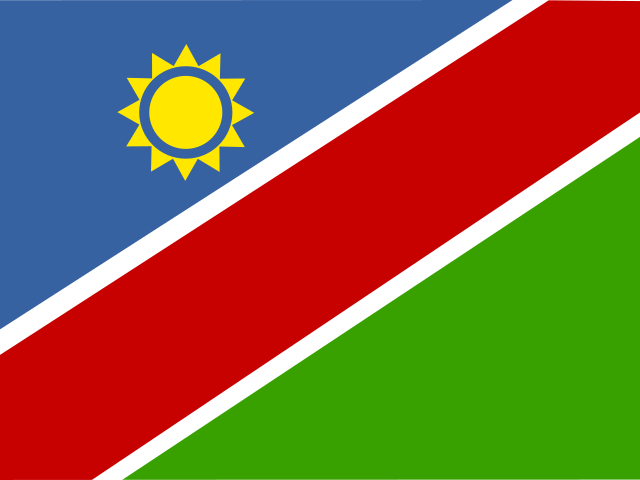
meaning: red stands for the heroism of the people and their determination to build a future of equal opportunity; white stands for peace, unity, tranquility, and harmony; blue stands for the sky and the Atlantic Ocean, the sun for power and existence, and green for vegetation and agricultural resources
National symbol(s)
oryx (antelope)
National color(s)
blue, red, green, white, yellow
National anthem(s)
lyrics/music: Axali DOESEB
history: adopted 1991
National heritage
selected World Heritage Site locales: Twyfelfontein or /Ui-//aes (c); Namib Sand Sea (n)
Economy30
Economic overview
upper middle-income, export-driven Sub-Saharan economy; natural resource rich; Walvis Bay port expansion for trade; high potential for renewable power generation and energy independence; major nature-based tourist locale; natural resource rich; shortage of skilled labor
Real GDP (purchasing power parity)
Real GDP (purchasing power parity) 2023: $30.039 billion (2023 est.)
Real GDP (purchasing power parity) 2022: $28.761 billion (2022 est.)
Real GDP growth rate
Real GDP growth rate 2023: 4.4% (2023 est.)
Real GDP growth rate 2022: 5.4% (2022 est.)
Real GDP per capita
Real GDP per capita 2023: $10,100 (2023 est.)
Real GDP per capita 2022: $10,000 (2022 est.)
GDP (official exchange rate)
Inflation rate (consumer prices)
Inflation rate (consumer prices) 2023: 5.9% (2023 est.)
Inflation rate (consumer prices) 2022: 6.1% (2022 est.)
GDP - composition, by sector of origin
industry: 28.9% (2024 est.)
services: 54.5% (2024 est.)
GDP - composition, by end use
household consumption
government consumption
investment in fixed capital
investment in inventories
exports of goods and services
imports of goods and services
Agricultural products
Industries
mining, tourism, fishing, agriculture
Industrial production growth rate
Labor force
Unemployment rate
Unemployment rate 2023: 19.4% (2023 est.)
Unemployment rate 2022: 19.7% (2022 est.)
Youth unemployment rate (ages 15-24)
male: 36.7% (2024 est.)
female: 38% (2024 est.)
Population below poverty line
Gini Index coefficient - distribution of family income
Household income or consumption by percentage share
highest 10%: 47.2% (2015 est.)
Remittances
Remittances 2023: 1% of GDP (2023 est.)
Remittances 2022: 0.7% of GDP (2022 est.)
Budget
expenditures: $4.779 billion (2023 est.)
Public debt
Taxes and other revenues
Current account balance
Current account balance 2023: -$1.893 billion (2023 est.)
Current account balance 2022: -$1.605 billion (2022 est.)
Exports
Exports 2023: $5.729 billion (2023 est.)
Exports 2022: $5.361 billion (2022 est.)
Exports - partners
Exports - commodities
Imports
Imports 2023: $8.443 billion (2023 est.)
Imports 2022: $7.43 billion (2022 est.)
Imports - partners
Imports - commodities
Reserves of foreign exchange and gold
Reserves of foreign exchange and gold 2023: $2.956 billion (2023 est.)
Reserves of foreign exchange and gold 2022: $2.803 billion (2022 est.)
Exchange rates
Currency
Exchange rates 2024
Exchange rates 2023
Exchange rates 2022
Exchange rates 2021
Exchange rates 2020
Energy7
Electricity access
electrification - urban areas: 74.8%
electrification - rural areas: 33.2%
Electricity
consumption: 3.891 billion kWh (2023 est.)
exports: 169 million kWh (2023 est.)
imports: 2.917 billion kWh (2023 est.)
transmission/distribution losses: 747.409 million kWh (2023 est.)
Electricity generation sources
solar: 26.9% of total installed capacity (2023 est.)
wind: 1.2% of total installed capacity (2023 est.)
hydroelectricity: 70% of total installed capacity (2023 est.)
Coal
exports: 900 metric tons (2023 est.)
imports: 26,000 metric tons (2023 est.)
proven reserves: 350 million metric tons (2023 est.)
Petroleum
Natural gas
Energy consumption per capita
Communications6
Telephones - fixed lines
subscriptions per 100 inhabitants: 3 (2023 est.)
Telephones - mobile cellular
subscriptions per 100 inhabitants: 85 (2024 est.)
Broadcast media
1 private and 1 state-run TV station; satellite and cable TV service available; state-run radio broadcasts in multiple languages; about a dozen private radio stations; transmissions of multiple international broadcasters available
Internet country code
.na
Internet users
Broadband - fixed subscriptions
subscriptions per 100 inhabitants: 4 (2023 est.)
Transportation6
Civil aircraft registration country code prefix
V5
Airports
259 (2025)
Heliports
1 (2025)
Railways
narrow gauge: 2,628 km (2014) 1.067-m gauge
Merchant marine
by type: general cargo 1, other 14
Ports
total ports
large
medium
small
very small
ports with oil terminals
key ports
Military & Security6
Military and security forces
Military expenditures
Military Expenditures 2023: 2.8% of GDP (2023 est.)
Military Expenditures 2022: 3% of GDP (2022 est.)
Military Expenditures 2021: 3% of GDP (2021 est.)
Military Expenditures 2020: 3.4% of GDP (2020 est.)
Military and security service personnel strengths
estimated 12,000 active Namibian Defense Forces (2025)
Military equipment inventories and acquisitions
the NDF's inventory consists mostly of Soviet-era weapons and equipment; over the past decade, it has received a limited number of newer weapons systems from China and South Africa; Namibia has a small defense industry that produces items such as armored personnel carriers (2025)
Military service age and obligation
18-25 years of age for men and women for voluntary military service; no conscription (2026)
Military - note
the NDF was created in 1990, largely from demobilized former members of the People's Liberation Army of Namibia (PLAN) and the South West Africa Territorial Force (SWATF); the PLAN was the armed wing of the South West Africa People’s Organization (SWAPO), while SWATF was an auxiliary of the South African Defense Force and comprised the armed forces of the former South West Africa, 1977-1989; from 1990-1995, the British military assisted with the forming and training the NDF (2025)
Transnational Issues1
Refugees and internally displaced persons
IDPs: 1,399 (2024 est.)
stateless persons: 14,796 (2024 est.)