
Niue
Population
1.8K
Area
260 km²
GDP
N/A
GDP Per Capita
$11,100
Pop. Density
7/km²
Quick Facts
Currency
$New Zealand dollar(NZD)
Calling Code
+683
Timezone
UTC-11:00
Languages
English, Niuean+more
Driving Side
left
Demonym
Niuean
Background
Voyagers from Samoa first settled on Niue around A.D. 900, and a second main group of settlers came from Tonga around 1500. With only one reliable source of fresh water, conflict was high on the island. Samoan and Tongan customs heavily influenced Niuean culture, including the formation of an island-wide elected kingship system in the early 1700s. In 1774, British explorer James COOK landed on the island and named it Savage Island because of the Niueans' hostility. Missionaries arrived in 1830 but were also largely unsuccessful at staying on the island until 1846, when a Niuean trained as a Samoan missionary returned to the island and provided a space from which the missionaries could work. In addition to converting the population, the missionaries worked to stop the violent conflicts and helped establish the first parliament in 1849.
Great Britain established a protectorate over Niue in 1900. The following year, Niue was annexed to New Zealand and included as part of the Cook Islands. Niue’s remoteness and cultural and linguistic differences with the Cook Islands led New Zealand to separate Niue into its own administration in 1904. The island became internally self-governing in 1974; it is an independent member of international organizations but is in free association with New Zealand, which is responsible for defense and foreign affairs. In September 2023, the US recognized Niue as a sovereign and independent state.
Geography17
Location
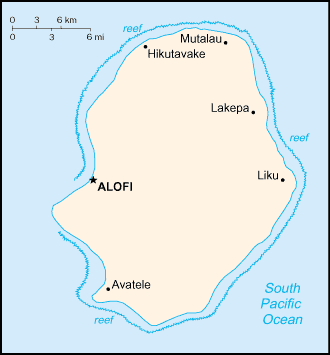
Oceania, island in the South Pacific Ocean, east of Tonga
Geographic coordinates
19 02 S, 169 52 W
Map references
Oceania
Area
land: 260 sq km
water: 0 sq km
Area - comparative
1.5 times the size of Washington, D.C.
Land boundaries
Coastline
64 km
Maritime claims
exclusive economic zone: 200 nm
Climate
tropical; modified by southeast trade winds
Terrain
steep limestone cliffs along coast, central plateau
Elevation
lowest point: Pacific Ocean 0 m
Natural resources
arable land, fish
Land use
agricultural land
agricultural land: arable land
agricultural land: permanent crops
agricultural land: permanent pasture
forest
other
Irrigated land
0 sq km (2022)
Population distribution
population distributed around the peripheral coastal areas of the island
Natural hazards
tropical cyclones
Geography - note
one of world's largest coral islands; the only major break in the surrounding coral reef occurs in the central western part of the coast
People & Society18
Population
male: 877 (2024 est.)
female: 938 (2024 est.)
Nationality
adjective: Niuean
Ethnic groups
Languages
Niuean 46% (official, a Polynesian language closely related to Tongan and Samoan), Niuean and English 32%, English (official) 11%, Niuean and others 5%, other 6% (2011 est.)
Religions
Ekalesia Niue 61.7%, Latter Day Saints 8.7%, Roman Catholic 8.4%, other 8.2%, not stated 5.1%, none 3.7%, Jehovah's Witnesses 2.7%, Seventh Day Adventist 1.4% (2017 est.)
Dependency ratios
youth dependency ratio: 38.2 (2024)
elderly dependency ratio: 26.4 (2024)
potential support ratio: 3.8 (2024)
Population growth rate
-0.03% (2021 est.)
Population distribution
population distributed around the peripheral coastal areas of the island
Urbanization
rate of urbanization: 1.43% annual rate of change (2020-25 est.)
Major urban areas - population
1,000 ALOFI (capital) (2018)
Life expectancy at birth
female: 75.7 years (2016 est.)
Drinking water source
unimproved: total: total: 3% of population (2022 est.)
Health expenditure
Health expenditure (as % of national budget): 6.9% of national budget (2022 est.)
Sanitation facility access
unimproved: total: total: 2.6% of population (2022 est.)
Obesity - adult prevalence rate
50% (2016)
Alcohol consumption per capita
beer: 4.28 liters of pure alcohol (2019 est.)
wine: 1.89 liters of pure alcohol (2019 est.)
spirits: 2.33 liters of pure alcohol (2019 est.)
other alcohols: 0 liters of pure alcohol (2019 est.)
Education expenditure
5.6% national budget (2025 est.)
Literacy
male: 100% (2022 est.)
female: 100% (2022 est.)
Government21
Country name
conventional short form: Niue
former: Savage Island
etymology: the origin of the name is obscure; in Niuean, the word translates as "behold the coconut;" the former name, Savage Island, was the result of an acrimonious meeting in 1774 between English explorer Captain James COOK and local people
Government type
parliamentary democracy
Dependency status
self-governing in free association with New Zealand since 1974; Niue is fully responsible for internal affairs; under the Niue Constitution Act of 1974, New Zealand provides necessary economic and administrative assistance to Niue, as well as assistance with foreign affairs, defense, and security if requested
Capital
geographic coordinates: 19 01 S, 169 55 W
time difference: UTC-11 (6 hours behind Washington, DC, during Standard Time)
etymology: a traditional name for an area of the island; became the name for the newly declared capital in the 20th century
Administrative divisions
no first-order administrative divisions as defined by the US government, but 14 villages are considered second-order
Legal system
English common law
Constitution
amendment process: proposed by the Assembly; passage requires at least two-thirds majority vote of the Assembly membership in each of three readings and approval by at least two-thirds majority votes in a referendum; passage of amendments to a number of sections, including Niue’s self-governing status, British nationality and New Zealand citizenship, external affairs and defense, economic and administrative assistance by New Zealand, and amendment procedures, requires at least two-thirds majority vote by the Assembly and at least two thirds of votes in a referendum
Suffrage
18 years of age; universal
Executive branch
chief of state
head of government
cabinet
election/appointment process
most recent election date
election results
expected date of next election
Legislative branch
legislature name
legislative structure
number of seats
electoral system
scope of elections
term in office
most recent election date
parties elected and seats per party
percentage of women in chamber
expected date of next election
Judicial branch
judge selection and term of office: Niue chief justice appointed by the governor general on the advice of the Cabinet and tendered by the premier; other judges appointed by the governor general on the advice of the Cabinet and tendered by the chief justice and the minister of justice; judges serve until age 68
subordinate courts: High Court
Political parties
none
Diplomatic representation in the US
none (self-governing territory in free association with New Zealand)
Diplomatic representation from the US
International organization participation
ACP, AOSIS, FAO, IFAD, OPCW, PIF, Sparteca, SPC, UNESCO, UPU, WHO, WIPO, WMO
Independence
19 October 1974 (Niue became a self-governing state in free association with New Zealand)
National holiday
Waitangi Day (Treaty of Waitangi established British sovereignty over New Zealand), 6 February (1840)
Flag
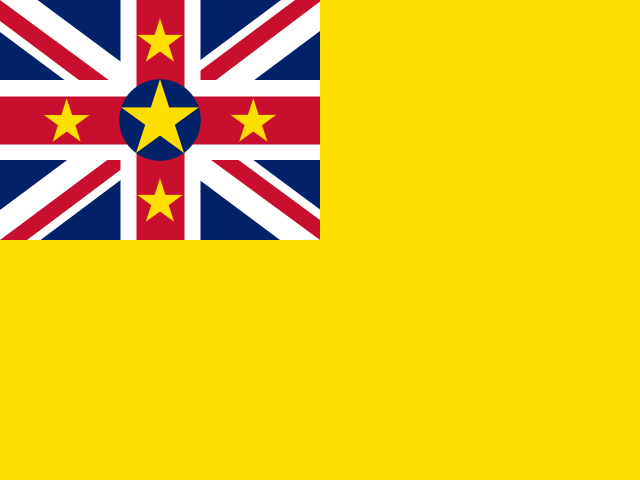
meaning: the large star represents Niue, and the smaller stars symbolize links with New Zealand; yellow stands for sunshine, as well as the warmth and friendship between Niue and New Zealand
National symbol(s)
yellow five-pointed star
National color(s)
yellow
National anthem(s)
lyrics/music: unknown
history: in use since 1745
Economy10
Economic overview
upper-middle-income self-governing New Zealand territorial economy; environmentally fragile; massive emigration; post-pandemic tourism rebound; postage stamps, small-scale agricultural processing, and subsistence farming; most recent Asian Development Bank member
Real GDP (purchasing power parity)
Real GDP (purchasing power parity) 2020: $19.9 million (2020 est.)
Real GDP (purchasing power parity) 2019: $20.9 million (2019 est.)
Real GDP per capita
Real GDP per capita 2020: $11,800 (2020 est.)
Real GDP per capita 2019: $12,400 (2019 est.)
Agricultural products
Industries
handicrafts, food processing
Exports - partners
Exports - commodities
Imports - partners
Imports - commodities
Exchange rates
Currency
Exchange rates 2024
Exchange rates 2023
Exchange rates 2022
Exchange rates 2021
Exchange rates 2020
Energy3
Electricity
consumption: 3 million kWh (2023 est.)
transmission/distribution losses: 400,000 kWh (2023 est.)
Electricity generation sources
Petroleum
Communications4
Telephones - fixed lines
subscriptions per 100 inhabitants: 52 (2021 est.)
Broadcast media
1 state-owned TV station, with many of the programs supplied by Television New Zealand; 1 state-owned radio station broadcasting in AM and FM (2019)
Internet country code
.nu
Internet users
Transportation3
Airports
1 (2025)
Merchant marine
by type: bulk carrier 5, container ship 2, general cargo 29, oil tanker 4, other 30
Ports
total ports
large
medium
small
very small
ports with oil terminals
key ports
Military & Security2
Military and security forces
no regular indigenous military forces; Niue Police Department
Military - note
under the Niue Constitution Act of 1974, New Zealand provides assistance with foreign affairs, defense, and security if requested by the Niue government