
Oman
Sultanate of Oman
Population
3.97M
Area
309,500 km²
GDP
$106.94B
GDP Per Capita
$36,700
Pop. Density
13/km²
Quick Facts
Currency
ر.ع.Omani rial(OMR)
Calling Code
+968
Timezone
UTC+04:00
Languages
Arabic+more
Driving Side
right
Demonym
Omani
Background
The inhabitants of the area of present-day Oman have long prospered from Indian Ocean trade. In the late 18th century, the nascent sultanate in Muscat signed the first in a series of friendship treaties with Britain. Over time, Oman's dependence on British political and military advisors increased, although the sultanate never became a British colony. In 1970, QABOOS bin Said Al Said overthrew his father and ruled as sultan for the next five decades. His extensive modernization program opened the country to the outside world. He prioritized strategic ties to the UK and US, and his moderate, independent foreign policy allowed Oman to maintain good relations with its neighbors and avoid external entanglements.
In 2011, the popular uprisings that swept the Middle East and North Africa inspired demonstrations in Oman that called for more jobs and economic benefits and an end to corruption. In response, QABOOS implemented economic and political reforms such as granting Oman’s legislative body more power and authorizing direct elections for its lower house. Additionally, the sultan increased unemployment benefits and issued a royal directive mandating a national public- and private-sector job creation plan. As part of the government's efforts to decentralize authority and allow greater citizen participation in local governance, Oman successfully conducted its first municipal council elections in 2012. QABOOS, Oman's longest reigning monarch, died in 2020. His cousin, HAYTHAM bin Tariq Al Said, former Minister of Heritage and Culture, was sworn in as Oman's new sultan the same day.
Historical Trends
GDP (USD)
↑151.6% since 2006Population
↑110.0% since 2006Life Expectancy at Birth
Latest: 80.0 yearsData source: World Bank Open Data
Geography18
Location
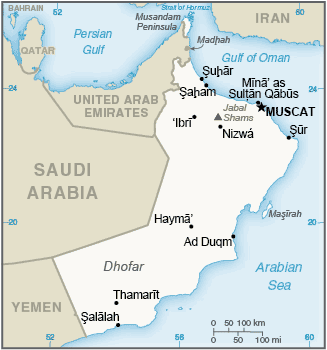
Middle East, bordering the Arabian Sea, Gulf of Oman, and Persian Gulf, between Yemen and the UAE
Geographic coordinates
21 00 N, 57 00 E
Map references
Middle East
Area
land: 309,500 sq km
water: 0 sq km
Area - comparative
twice the size of Georgia
Land boundaries
border countries: Saudi Arabia 658 km; UAE 609 km; Yemen 294 km
Coastline
2,092 km
Maritime claims
contiguous zone: 24 nm
exclusive economic zone: 200 nm
Climate
dry desert; hot, humid along coast; hot, dry interior; strong southwest summer monsoon (May to September) in far south
Terrain
central desert plain, rugged mountains in north and south
Elevation
lowest point: Arabian Sea 0 m
mean elevation: 310 m
Natural resources
petroleum, copper, asbestos, some marble, limestone, chromium, gypsum, natural gas
Land use
agricultural land
agricultural land: arable land
agricultural land: permanent crops
agricultural land: permanent pasture
forest
other
Irrigated land
1,162 sq km (2022)
Major aquifers
Arabian Aquifer System
Population distribution
the vast majority of the population is located in and around the Al Hagar Mountains in the north; another smaller cluster is found around the city of Salalah in the far south; most of the country remains sparsely populated
Natural hazards
summer winds often raise large sandstorms and dust storms in interior; periodic droughts
Geography - note
consists of Oman proper and two northern exclaves, Musandam and Al Madhah; the former is a peninsula that occupies a strategic location adjacent to the Strait of Hormuz
People & Society34
Population
male: 2,130,080
female: 1,839,744
Nationality
adjective: Omani
Ethnic groups
Arab, Baluchi, South Asian (Indian, Pakistani, Sri Lankan, Bangladeshi), African
Languages
major-language sample(s):
كتاب حقائق العالم، المصدر الذي لا يمكن الاستغناء عنه للمعلومات الأساسية (Arabic)
The World Factbook, the indispensable source for basic information.
Religions
Age structure
15-64 years: 66.2% (male 1,428,141/female 1,155,438)
65 years and over: 4% (2024 est.) (male 73,076/female 83,746)
Dependency ratios
youth dependency ratio: 44.6 (2025 est.)
elderly dependency ratio: 6.2 (2025 est.)
potential support ratio: 16.2 (2025 est.)
Median age
male: 28.1 years
female: 26.3 years
Population growth rate
1.7% (2025 est.)
Birth rate
20.65 births/1,000 population (2025 est.)
Death rate
3.17 deaths/1,000 population (2025 est.)
Net migration rate
-0.49 migrant(s)/1,000 population (2025 est.)
Population distribution
the vast majority of the population is located in and around the Al Hagar Mountains in the north; another smaller cluster is found around the city of Salalah in the far south; most of the country remains sparsely populated
Urbanization
rate of urbanization: 2.32% annual rate of change (2020-25 est.)
Major urban areas - population
1.650 million MUSCAT (capital) (2023)
Sex ratio
0-14 years: 1.05 male(s)/female
15-64 years: 1.24 male(s)/female
65 years and over: 0.87 male(s)/female
total population: 1.16 male(s)/female (2024 est.)
Maternal mortality ratio
13 deaths/100,000 live births (2023 est.)
Infant mortality rate
male: 15.1 deaths/1,000 live births
female: 12.6 deaths/1,000 live births
Life expectancy at birth
male: 75.5 years
female: 79.4 years
Total fertility rate
2.61 children born/woman (2025 est.)
Gross reproduction rate
1.27 (2025 est.)
Drinking water source
improved: urban
improved: rural
improved: total
unimproved: urban
unimproved: rural
unimproved: total
Health expenditure
Health expenditure (as % of national budget): 8.3% of national budget (2022 est.)
Physician density
1.99 physicians/1,000 population (2022)
Hospital bed density
1.2 beds/1,000 population (2020 est.)
Sanitation facility access
improved: urban
improved: rural
improved: total
unimproved: urban
unimproved: rural
unimproved: total
Obesity - adult prevalence rate
27% (2016)
Alcohol consumption per capita
beer: 0.17 liters of pure alcohol (2019 est.)
wine: 0.02 liters of pure alcohol (2019 est.)
spirits: 0.29 liters of pure alcohol (2019 est.)
other alcohols: 0 liters of pure alcohol (2019 est.)
Tobacco use
male: 17.9% (2025 est.)
female: 0.4% (2025 est.)
Children under the age of 5 years underweight
11.2% (2017 est.)
Currently married women (ages 15-49)
55.8% (2020 est.)
Education expenditure
Education expenditure (% national budget): 14.2% national budget (2022 est.)
Literacy
male: 98.6% (2022 est.)
female: 94.9% (2022 est.)
School life expectancy (primary to tertiary education)
male: 13 years (2021 est.)
female: 14 years (2021 est.)
Government25
Country name
conventional long form
conventional short form
local long form
local short form
former
etymology
Government type
absolute monarchy
Capital
geographic coordinates: 23 37 N, 58 35 E
time difference: UTC+4 (9 hours ahead of Washington, DC, during Standard Time)
etymology: the name derives from the Arabic name for the city, Masqat, which is said to mean "hidden" and refers to the range of hills that isolate the port city from the rest of the country
Administrative divisions
Legal system
mixed system of Anglo-Saxon law and Islamic law
Constitution
amendment process: promulgated by the sultan or proposed by the Council of Oman and drafted by a technical committee as stipulated by royal decree and then promulgated through royal decree
International law organization participation
has not submitted an ICJ jurisdiction declaration; non-party state to the ICCt
Citizenship
citizenship by descent only: the father must be a citizen of Oman
dual citizenship recognized: no
residency requirement for naturalization: unknown
Suffrage
Executive branch
head of government: Sultan and Prime Minister HAITHAM bin Tarik Al Said (since 11 January 2020)
cabinet: Cabinet appointed by the monarch
Legislative branch
legislative structure: bicameral
Legislative branch - lower chamber
chamber name
number of seats
electoral system
scope of elections
term in office
most recent election date
percentage of women in chamber
expected date of next election
Legislative branch - upper chamber
chamber name
number of seats
scope of elections
term in office
most recent election date
percentage of women in chamber
expected date of next election
Judicial branch
judge selection and term of office: judges nominated by the 9-member Supreme Judicial Council (chaired by the monarch) and appointed by the monarch; judges appointed for life
subordinate courts: Courts of Appeal; Administrative Court; Courts of First Instance; sharia courts; magistrates' courts; military courts
Political parties
Diplomatic representation in the US
chancery: 2535 Belmont Road, NW, Washington, DC 20008
telephone: [1] (202) 387-1980
FAX: [1] (202) 745-4933
email address and website:
washington@fm.gov.om
Embassy of the Sultanate of Oman, Washington, USA - FM.gov.om
Diplomatic representation from the US
chief of mission
embassy
mailing address
telephone
FAX
email address and website
ConsularMuscat@state.gov
https://om.usembassy.gov/
International organization participation
ABEDA, AFESD, AMF, CAEU, FAO, G-77, GCC, IAEA, IBRD, ICAO, ICC (NGOs), IDA, IDB, IFAD, IFC, IHO, ILO, IMF, IMO, IMSO, Interpol, IOC, IPU, ISO, ITSO, ITU, LAS, MIGA, NAM, OIC, OPCW, UN, UNCTAD, UNESCO, UNIDO, UNOOSA, UNWTO, UPU, WCO, WFTU (NGOs), WHO, WIPO, WMO, WTO
Independence
1650 (expulsion of the Portuguese)
National holiday
Flag
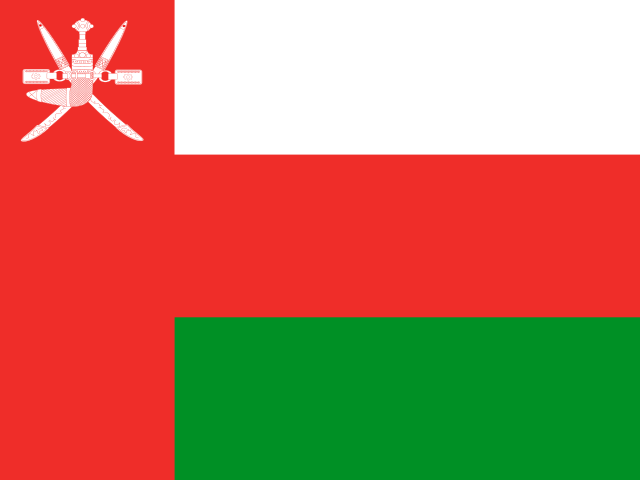
meaning: white stands for peace and prosperity, red for battles against foreign invaders, and green for the Jebel al Akhdar (Green Mountains) and fertility
National symbol(s)
khanjar dagger on top of two crossed swords
National color(s)
red, white, green
National anthem(s)
lyrics/music: Rashid bin Uzayyiz al KHUSAIDI/James Frederick MILLS, arranged by Bernard EBBINGHAUS
history: adopted 1932; new lyrics written after QABOOS bin Said al Said came to power in 1970; first performed by the band of the HMS Hawkins as a salute to the Sultan during a 1932 visit to Muscat; the ship's bandmaster did the arrangement
National heritage
selected World Heritage Site locales: Bahla Fort; Archaeological Sites of Bat; Land of Frankincense; Aflaj Irrigation Systems of Oman; Ancient Qalhat
Economy27
Economic overview
high-income, oil-based economy; large welfare system; growing government debt; citizenship-based labor force growth policy; US free trade agreement; diversifying portfolio; high female labor force participation
Real GDP (purchasing power parity)
Real GDP (purchasing power parity) 2023: $190.403 billion (2023 est.)
Real GDP (purchasing power parity) 2022: $188.169 billion (2022 est.)
Real GDP growth rate
Real GDP growth rate 2023: 1.2% (2023 est.)
Real GDP growth rate 2022: 8% (2022 est.)
Real GDP per capita
Real GDP per capita 2023: $37,700 (2023 est.)
Real GDP per capita 2022: $39,800 (2022 est.)
GDP (official exchange rate)
Inflation rate (consumer prices)
Inflation rate (consumer prices) 2022: 2.5% (2022 est.)
Inflation rate (consumer prices) 2021: 1.7% (2021 est.)
GDP - composition, by sector of origin
industry: 54.2% (2024 est.)
services: 46.5% (2024 est.)
GDP - composition, by end use
household consumption
government consumption
investment in fixed capital
investment in inventories
exports of goods and services
imports of goods and services
Agricultural products
Industries
crude oil production and refining, natural and liquefied natural gas production; construction, cement, copper, steel, chemicals, optic fiber
Industrial production growth rate
Labor force
Unemployment rate
Unemployment rate 2023: 3.2% (2023 est.)
Unemployment rate 2022: 3.3% (2022 est.)
Youth unemployment rate (ages 15-24)
male: 11% (2024 est.)
female: 30.9% (2024 est.)
Average household expenditures
on alcohol and tobacco: 0.1% of household expenditures (2023 est.)
Remittances
Remittances 2022: 0% of GDP (2022 est.)
Remittances 2021: 0% of GDP (2021 est.)
Budget
expenditures: $35.984 billion (2018 est.)
Public debt
Current account balance
Current account balance 2022: $4.362 billion (2022 est.)
Current account balance 2021: -$4.836 billion (2021 est.)
Exports
Exports 2022: $69.483 billion (2022 est.)
Exports 2021: $46.572 billion (2021 est.)
Exports - partners
Exports - commodities
Imports
Imports 2022: $46.682 billion (2022 est.)
Imports 2021: $37.216 billion (2021 est.)
Imports - partners
Imports - commodities
Reserves of foreign exchange and gold
Reserves of foreign exchange and gold 2023: $17.455 billion (2023 est.)
Reserves of foreign exchange and gold 2022: $17.606 billion (2022 est.)
Exchange rates
Currency
Exchange rates 2024
Exchange rates 2023
Exchange rates 2022
Exchange rates 2021
Exchange rates 2020
Energy7
Electricity access
Electricity
consumption: 40.738 billion kWh (2023 est.)
transmission/distribution losses: 4.267 billion kWh (2023 est.)
Electricity generation sources
solar: 3.8% of total installed capacity (2023 est.)
wind: 0.3% of total installed capacity (2023 est.)
Coal
exports: 70,000 metric tons (2023 est.)
imports: 323,000 metric tons (2023 est.)
Petroleum
refined petroleum consumption: 218,000 bbl/day (2023 est.)
crude oil estimated reserves: 5.373 billion barrels (2021 est.)
Natural gas
consumption: 28.646 billion cubic meters (2023 est.)
exports: 15.536 billion cubic meters (2023 est.)
imports: 1.924 billion cubic meters (2023 est.)
proven reserves: 651.287 billion cubic meters (2021 est.)
Energy consumption per capita
Communications6
Telephones - fixed lines
subscriptions per 100 inhabitants: 11 (2023 est.)
Telephones - mobile cellular
subscriptions per 100 inhabitants: 121 (2024 est.)
Broadcast media
1 state-run TV broadcaster; TV stations transmitting from Saudi Arabia, the UAE, Iran, and Yemen available via satellite TV; state-run radio operates multiple stations; first private radio station began operating in 2007, and several additional stations now operating (2019)
Internet country code
.om
Internet users
Broadband - fixed subscriptions
subscriptions per 100 inhabitants: 11 (2023 est.)
Transportation5
Civil aircraft registration country code prefix
A4O
Airports
37 (2025)
Heliports
20 (2025)
Merchant marine
by type: general cargo 11, other 46
Ports
total ports
large
medium
small
very small
ports with oil terminals
key ports
Military & Security6
Military and security forces
Royal Oman Police (ROP): Civil Defense, Immigration, Infrastructure Security Police, Coast Guard Police, Special Security Police, Special Task Force (2024)
Military expenditures
Military Expenditures 2023: 5.5% of GDP (2023 est.)
Military Expenditures 2022: 5.5% of GDP (2022 est.)
Military Expenditures 2021: 8% of GDP (2021 est.)
Military Expenditures 2020: 11% of GDP (2020 est.)
Military and security service personnel strengths
approximately 40,000 active Sultan's Armed Forces (2025)
Military equipment inventories and acquisitions
Military service age and obligation
Military - note
Oman's naval forces conduct maritime security operations along the country’s long coastline, including patrolling, ensuring freedom of navigation in the key naval chokepoint of the Strait of Hormuz, and countering piracy and smuggling; Oman participates in the US-led, multinational Combined Maritime Forces (CMF), which operates multinational task forces conducting maritime security in regional waters (2025)