
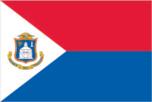
Sint Maarten
Country of Sint Maarten
Population
46.7K
Area
34 km²
GDP
$1.74B
GDP Per Capita
$45,800
Pop. Density
1,375/km²
Quick Facts
Currency
$Eastern Caribbean dollar(XCD)
Calling Code
+1869
Timezone
UTC-04:00
Languages
English+more
Driving Side
left
Demonym
Kittitian or Nevisian
Background
The establishment of cotton, tobacco, and sugar plantations dramatically expanded African slavery on the island in the 18th and 19th centuries; the practice was not abolished in the Dutch half until 1863. The island's economy declined until 1939 when it became a free port; the tourism industry was dramatically expanded beginning in the 1950s. In 1954, Sint Maarten and several other Dutch Caribbean possessions became part of the Kingdom of the Netherlands as the Netherlands Antilles. In a 2000 referendum, the citizens of Sint Maarten voted to become a self-governing country within the Kingdom of the Netherlands, effective in 2010. In 2017, Hurricane Irma hit Saint Martin/Sint Maarten, causing extensive damage to roads, communications, electrical power, and housing; the UN estimated that 90% of the buildings were damaged or destroyed.
Historical Trends
GDP (USD)
↑74.2% since 2006Population
↑0.6% since 2006Life Expectancy at Birth
Latest: 72.1 yearsData source: World Bank Open Data
Geography16
Location
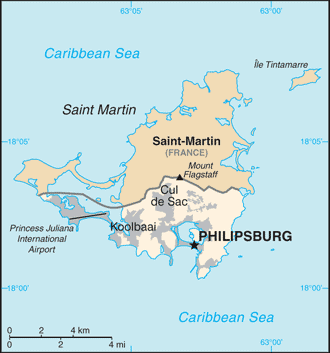
Caribbean, located in the Leeward Islands (northern) group; Dutch part of the island of Saint Martin in the Caribbean Sea; Sint Maarten lies east of the US Virgin Islands
Geographic coordinates
18 4 N, 63 4 W
Map references
Central America and the Caribbean
Area
land: 34 sq km
water: 0 sq km
Area - comparative
one-fifth the size of Washington, D.C.
Land boundaries
border countries: Saint Martin (France) 16 km
Coastline
58.9 km (for entire island)
Maritime claims
exclusive economic zone: 200 nm
Climate
tropical marine climate, ameliorated by northeast trade winds, results in moderate temperatures; average rainfall of 150 cm/year; hurricane season stretches from July to November
Terrain
low, hilly terrain, volcanic origin
Elevation
lowest point: Caribbean Sea 0 m
Natural resources
fish, salt
Land use
forest: 10.9% (2022 est.)
other: 89.1% (2022 est.)
Population distribution
the most populous areas are Lower Prince's Quarter (north of Philipsburg) and Cul de Sac
Natural hazards
subject to hurricanes from July to November
Geography - note
note 2: Simpson Bay Lagoon (aka, Simson Bay Lagoon or The Great Pond) is one of the largest inland lagoons in the West Indies; the border between the French and Dutch halves of the island of Saint Martin runs across the center of the lagoon, which is shared
People & Society19
Population
male: 23,071
female: 23,667
Ethnic groups
Languages
English (official) 67.5%, Spanish 12.9%, Creole 8.2%, Dutch (official) 4.2%, Papiamento (a Spanish-Portuguese-Dutch-English dialect) 2.2%, French 1.5%, other 3.5% (2001 est.)
Religions
Protestant 41.9% (Pentecostal 14.7%, Methodist 10.0%, Seventh Day Adventist 6.6%, Baptist 4.7%, Anglican 3.1%, other Protestant 2.8%), Roman Catholic 33.1%, Hindu 5.2%, Christian 4.1%, Jehovah's Witness 1.7%, Evangelical 1.4%, Muslim/Jewish 1.1%, other 1.3% (includes Buddhist, Sikh, Rastafarian), none 7.9%, no response 2.4% (2011 est.)
Age structure
15-64 years: 66.3% (male 15,158/female 15,496)
65 years and over: 15.2% (2024 est.) (male 3,250/female 3,788)
Dependency ratios
youth dependency ratio: 28.1 (2025 est.)
elderly dependency ratio: 24.7 (2025 est.)
potential support ratio: 4.1 (2025 est.)
Median age
male: 39 years
female: 42.8 years
Population growth rate
1.1% (2025 est.)
Birth rate
12 births/1,000 population (2025 est.)
Death rate
6.59 deaths/1,000 population (2025 est.)
Net migration rate
5.63 migrant(s)/1,000 population (2025 est.)
Population distribution
the most populous areas are Lower Prince's Quarter (north of Philipsburg) and Cul de Sac
Urbanization
rate of urbanization: 1.16% annual rate of change (2020-25 est. est.)
Major urban areas - population
1,327 PHILIPSBURG (capital) (2011)
Sex ratio
0-14 years: 1.07 male(s)/female
15-64 years: 0.98 male(s)/female
65 years and over: 0.86 male(s)/female
total population: 0.98 male(s)/female (2024 est.)
Infant mortality rate
male: 8.4 deaths/1,000 live births
female: 6.8 deaths/1,000 live births
Life expectancy at birth
male: 77.4 years
female: 82.2 years
Total fertility rate
1.96 children born/woman (2025 est.)
Gross reproduction rate
0.96 (2025 est.)
Government21
Country name
conventional long form
conventional short form
local long form
local short form
former
etymology
Government type
parliamentary democracy under a constitutional monarchy
Dependency status
Capital
geographic coordinates: 18 1 N, 63 2 W
time difference: UTC-4 (1 hour ahead of Washington, DC, during Standard Time)
etymology: founded and named in 1763 by John PHILIPS, a Scottish captain in the Dutch navy
Legal system
based on Dutch civil law system with some English common law influence
Constitution
amendment process: proposals initiated by the Government or by Parliament; passage requires at least a two-thirds majority of the Parliament membership; passage of amendments relating to fundamental rights, authorities of the governor and of Parliament must include the "views" of the Kingdom of the Netherlands Government prior to ratification by Parliament
Citizenship
see the Netherlands
Suffrage
18 years of age; universal
Executive branch
head of government: Prime Minister Luc MERCELINA (since 3 May 2024)
cabinet: Cabinet nominated by the prime minister and appointed by the governor
election/appointment process: the monarch is hereditary; governor appointed by the monarch for a 6-year term; following legislative elections, the Parliament usually elects the leader of the majority party as prime minister
Legislative branch
legislature name
legislative structure
number of seats
electoral system
scope of elections
term in office
most recent election date
parties elected and seats per party
percentage of women in chamber
expected date of next election
Judicial branch
judge selection and term of office: Joint Court judges appointed by the monarch serve for life
subordinate courts: Courts in First Instance
Political parties
National Alliance or NA
National Opportunity Wealth or NOW
Party for Progress or PFP
Sint Maarten Christian Party or SMCP
Unified Resilient St Maarten Movement or URSM
United People's Party or UPP
United Sint Maarten Party or US Party
Diplomatic representation in the US
none (represented by the Kingdom of the Netherlands)
Diplomatic representation from the US
International organization participation
Caricom (observer), ILO, Interpol, UNESCO (associate), UPU, WMO
Independence
none (part of the Kingdom of the Netherlands)
National holiday
Flag
National symbol(s)
brown pelican, yellow sage (flower)
National color(s)
red, white, blue
National anthem(s)
lyrics/music: Philips VAN MARNIX van Sint Aldegonde (presumed)/unknown
history: adopted 1932
Economy19
Economic overview
high-income, tourism-based Dutch autonomous constituent economy; severe hurricane- and COVID-19-related economic recessions; multilateral trust fund helping offset economic downturn; no property taxation; re-exporter to Saint Martin
Real GDP (purchasing power parity)
Real GDP (purchasing power parity) 2023: $1.919 billion (2023 est.)
Real GDP (purchasing power parity) 2022: $1.849 billion (2022 est.)
Real GDP growth rate
Real GDP growth rate 2023: 3.8% (2023 est.)
Real GDP growth rate 2022: 9.8% (2022 est.)
Real GDP per capita
Real GDP per capita 2023: $44,900 (2023 est.)
Real GDP per capita 2022: $43,900 (2022 est.)
GDP (official exchange rate)
Inflation rate (consumer prices)
Inflation rate (consumer prices) 2016: 0.1% (2016 est.)
Inflation rate (consumer prices) 2015: 0.3% (2015 est.)
GDP - composition, by sector of origin
services: 89.3% (2021 est.)
Agricultural products
sugar
Industries
tourism, light industry
Industrial production growth rate
Remittances
Remittances 2022: 3.2% of GDP (2022 est.)
Remittances 2021: 3.4% of GDP (2021 est.)
Current account balance
Current account balance 2022: -$56.984 million (2022 est.)
Current account balance 2021: -$311.463 million (2021 est.)
Exports
Exports 2022: $1.375 billion (2022 est.)
Exports 2021: $790.938 million (2021 est.)
Exports - partners
Exports - commodities
Imports
Imports 2022: $1.32 billion (2022 est.)
Imports 2021: $1.003 billion (2021 est.)
Imports - partners
Imports - commodities
Exchange rates
Currency
Exchange rates 2024
Exchange rates 2023
Exchange rates 2022
Exchange rates 2021
Exchange rates 2020
Energy1
Electricity access
Communications3
Telephones - mobile cellular
subscriptions per 100 inhabitants: 205 (2022 est.)
Internet country code
.sx
Internet users
Transportation2
Airports
1 (2025)
Ports
total ports
large
medium
small
very small
ports with oil terminals
key ports
Military & Security2
Military and security forces
no regular military forces; Police Force of Sint Maarten (KPSM)
Military - note
defense is the responsibility of the Kingdom of the Netherlands; the KPSM is supported by the Royal Netherlands Marechaussee (Gendarmerie), the Dutch Caribbean Police Force (Korps Politie Caribisch Nederland, KPCN), and the Dutch Caribbean Coast Guard (DCCG or Kustwacht Caribisch Gebied (KWCARIB))
Transnational Issues1
Trafficking in persons
Compare Sint Maarten
See how Sint Maarten compares to other countries side by side.
Compare Countries