Spain
Kingdom of Spain
Population
47.28M
Area
505,370 km²
GDP
$1.72T
GDP Per Capita
$48,400
Pop. Density
94/km²
Quick Facts
Currency
€euro(EUR)
Calling Code
+34
Primary Timezone
UTC+01:00
Languages
Spanish, Catalan, Basque +1+more
Driving Side
right
Demonym
Spanish
Background
Spain's powerful world empire of the 16th and 17th centuries ultimately yielded command of the seas to England. Spain remained neutral during both World Wars but suffered through a devastating civil war (1936-39) resulting in a dictatorship. A peaceful transition to democracy after the death of dictator Francisco FRANCO in 1975 and rapid economic modernization after Spain joined the EU in 1986 gave Spain a dynamic and rapidly growing economy. After a severe recession in the wake of the global financial crisis in 2008, Spain has posted solid years of GDP growth above the EU average. Unemployment has fallen but remains high, especially among youth. Spain is the euro-zone's fourth-largest economy. The country has faced increased domestic turmoil in recent years due to the independence movement in its restive Catalonia region.
Historical Trends
GDP (USD)
↑36.8% since 2006Population
↑10.0% since 2006Life Expectancy at Birth
Latest: 83.9 yearsData source: World Bank Open Data
Geography18
Location
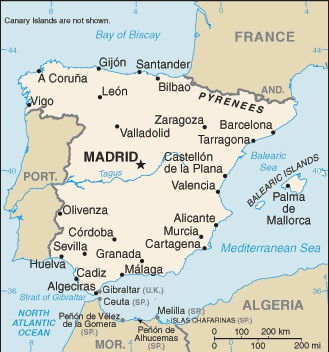
Southwestern Europe, bordering the Mediterranean Sea, North Atlantic Ocean, Bay of Biscay, and Pyrenees Mountains; southwest of France
Geographic coordinates
40 00 N, 4 00 W
Map references
Europe
Area
land: 498,980 sq km
water: 6,390 sq km
Area - comparative
almost five times the size of Kentucky; slightly more than twice the size of Oregon
Land boundaries
border countries: Andorra 63 km; France 646 km; Gibraltar 1.2 km; Portugal 1,224 km; Morocco (Ceuta) 8 km and Morocco (Melilla) 10.5 km
Coastline
4,964 km
Maritime claims
contiguous zone: 24 nm
exclusive economic zone: 200 nm (applies only to the Atlantic Ocean)
Climate
temperate; clear, hot summers in interior, more moderate and cloudy along coast; cloudy, cold winters in interior, partly cloudy and cool along coast
Terrain
large, flat to dissected plateau surrounded by rugged hills; Pyrenees Mountains in north
Elevation
lowest point: Atlantic Ocean 0 m
mean elevation: 660 m
Natural resources
coal, lignite, iron ore, copper, lead, zinc, uranium, tungsten, mercury, pyrites, magnesite, fluorspar, gypsum, sepiolite, kaolin, potash, hydropower, arable land
Land use
agricultural land
agricultural land: arable land
agricultural land: permanent crops
agricultural land: permanent pasture
forest
other
Irrigated land
38,012 sq km (2022)
Major rivers (by length in km)
note: [s] after country name indicates river source; [m] after country name indicates river mouth
Population distribution
with the notable exception of Madrid, Sevilla, and Zaragoza, the largest urban agglomerations are found along the Mediterranean and Atlantic coasts; numerous smaller cities are spread throughout the interior; very dense settlement around the capital of Madrid, as well as the port city of Barcelona
Natural hazards
volcanism: volcanic activity in the Canary Islands, located off Africa's northwest coast; Teide (3,715 m) has been deemed a Decade Volcano by the International Association of Volcanology and Chemistry of the Earth's Interior, worthy of study due to its explosive history and close proximity to human populations; La Palma (2,426 m) is the most active of the Canary Islands volcanoes; Lanzarote is the only other historically active volcano
Geography - note
strategic location along approaches to Strait of Gibraltar; Spain controls a number of territories in northern Morocco, including the enclaves of Ceuta and Melilla and the islands of Penon de Velez de la Gomera, Penon de Alhucemas, and Islas Chafarinas; Spain's Canary Islands are one of four North Atlantic archipelagos that make up Macaronesia; the others are the Azores (Portugal), Madeira (Portugal), and Cabo Verde
People & Society34
Population
male: 23,069,327
female: 24,211,106
Nationality
adjective: Spanish
Ethnic groups
Languages
major-language sample(s):
La Libreta Informativa del Mundo, la fuente indispensable de información básica. (Spanish)
The World Factbook, the indispensable source for basic information.
Religions
Roman Catholic 58.2%, atheist 16.2%, agnostic 10.8%, other 2.7%, non-believer 10.5%, unspecified 1.7% (2021 est.)
Age structure
15-64 years: 66.1% (male 15,662,492/female 15,585,138)
65 years and over: 20.9% (2024 est.) (male 4,259,816/female 5,613,147)
Dependency ratios
youth dependency ratio: 19.7 (2024 est.)
elderly dependency ratio: 31.6 (2024 est.)
potential support ratio: 3.2 (2024 est.)
Median age
male: 45.7 years
female: 47.8 years
Population growth rate
0.12% (2025 est.)
Birth rate
7.16 births/1,000 population (2025 est.)
Death rate
9.98 deaths/1,000 population (2025 est.)
Net migration rate
3.98 migrant(s)/1,000 population (2025 est.)
Population distribution
with the notable exception of Madrid, Sevilla, and Zaragoza, the largest urban agglomerations are found along the Mediterranean and Atlantic coasts; numerous smaller cities are spread throughout the interior; very dense settlement around the capital of Madrid, as well as the port city of Barcelona
Urbanization
rate of urbanization: 0.24% annual rate of change (2020-25 est.)
Major urban areas - population
6.751 million MADRID (capital), 5.687 million Barcelona, 838,000 Valencia (2023)
Sex ratio
0-14 years: 1.04 male(s)/female
15-64 years: 1 male(s)/female
65 years and over: 0.76 male(s)/female
total population: 0.95 male(s)/female (2024 est.)
Mother's mean age at first birth
31.2 years (2020 est.)
Maternal mortality ratio
3 deaths/100,000 live births (2023 est.)
Infant mortality rate
male: 2.7 deaths/1,000 live births
female: 2.1 deaths/1,000 live births
Life expectancy at birth
male: 80.3 years
female: 85.8 years
Total fertility rate
1.32 children born/woman (2025 est.)
Gross reproduction rate
0.65 (2025 est.)
Drinking water source
improved: urban
improved: rural
improved: total
unimproved: urban
unimproved: rural
unimproved: total
Health expenditure
Health expenditure (as % of national budget): 15.2% of national budget (2022 est.)
Physician density
4.29 physicians/1,000 population (2022)
Hospital bed density
2.9 beds/1,000 population (2021 est.)
Sanitation facility access
improved: urban
improved: rural
improved: total
unimproved: urban
unimproved: rural
unimproved: total
Obesity - adult prevalence rate
23.8% (2016)
Alcohol consumption per capita
beer: 4.67 liters of pure alcohol (2019 est.)
wine: 3.52 liters of pure alcohol (2019 est.)
spirits: 2.34 liters of pure alcohol (2019 est.)
other alcohols: 0.19 liters of pure alcohol (2019 est.)
Tobacco use
male: 25.8% (2025 est.)
female: 22% (2025 est.)
Currently married women (ages 15-49)
50.2% (2021 est.)
Education expenditure
Education expenditure (% national budget): 9.9% national budget (2022 est.)
Literacy
male: 99.8% (2021 est.)
female: 99.6% (2021 est.)
School life expectancy (primary to tertiary education)
male: 17 years (2023 est.)
female: 18 years (2023 est.)
Government25
Country name
conventional short form: Spain
local long form: Reino de España
local short form: España
etymology: derivation of the name España is uncertain; the Basque words ezpain or espan ("edge," as in a river bank) are possible sources, or the Punic word span, meaning "rabbit;" some academics tie it to the god Hesperus from Greco-Roman mythology
Government type
parliamentary constitutional monarchy
Capital
name
geographic coordinates
time difference
daylight saving time
time zone note
etymology
Administrative divisions
Legal system
civil law system with regional variations
Constitution
amendment process: proposed by the government, by the General Courts (the Congress or the Senate), or by the self-governing communities submitted through the government; passage requires three-fifths majority vote by both houses and passage by referendum if requested by one tenth of the members of either house; proposals disapproved by both houses are submitted to a joint committee, which submits an agreed upon text for another vote; passage requires two-thirds majority vote in Congress and simple majority vote in the Senate
International law organization participation
accepts compulsory ICJ jurisdiction with reservations; accepts ICCt jurisdiction
Citizenship
citizenship by descent only: at least one parent must be a citizen of Spain
dual citizenship recognized: only with select Latin American countries
residency requirement for naturalization: 10 years for persons with no ties to Spain
Suffrage
18 years of age; universal
Executive branch
chief of state
head of government
cabinet
election/appointment process
most recent election date
election results
expected date of next election
Legislative branch
legislative structure: bicameral
Legislative branch - lower chamber
chamber name
number of seats
electoral system
scope of elections
term in office
most recent election date
parties elected and seats per party
percentage of women in chamber
expected date of next election
Legislative branch - upper chamber
chamber name
number of seats
electoral system
scope of elections
term in office
most recent election date
parties elected and seats per party
percentage of women in chamber
expected date of next election
Judicial branch
judge selection and term of office: Supreme Court judges appointed by the monarch from candidates proposed by the General Council of the Judiciary Power, a 20-member governing board chaired by the monarch; judges can serve until age 70; Constitutional Court judges nominated by the National Assembly, executive branch, and the General Council of the Judiciary, and appointed by the monarch for 9-year terms
subordinate courts: National High Court; High Courts of Justice (in each of the autonomous communities); provincial courts; courts of first instance
Political parties
Basque Country Unite (Euskal Herria Bildu) or EH Bildu (coalition of 4 Basque pro-independence parties)
Basque Nationalist Party or PNV or EAJ
Canarian Coalition or CC (coalition of 5 parties)
Ciudadanos Party (Citizens Party) or Cs
Compromis - Compromise Coalition
Navarrese People's Union or UPN
Together for Catalonia or Junts
People's Party or PP
Republican Left of Catalonia or ERC
Spanish Socialist Workers Party or PSOE
Teruel Existe or TE
Unidas (Unite) or Sumar (electoral coalition formed in March 2022) (formerly Unidas Podemos or UP)
Vox or VOX
Diplomatic representation in the US
chief of mission
chancery
telephone
FAX
email address and website
emb.washington@maec.es
https://www.exteriores.gob.es/Embajadas/washington/en/Paginas/index.aspx
consulate(s) general
Diplomatic representation from the US
chief of mission
embassy
mailing address
telephone
FAX
email address and website
askACS@state.gov
https://es.usembassy.gov/
consulate(s) general
International organization participation
ADB (nonregional member), AfDB (nonregional member), Arctic Council (observer), Australia Group, BCIE, BIS, CABEI, CAN (observer), CBSS (observer), CD, CE, CERN, EAPC, EBRD, ECB, EIB, EITI (implementing country), EMU, ESA, EU, FAO, FATF, IADB, IAEA, IBRD, ICAO, ICC (national committees), ICCt, ICRM, IDA, IEA, IFAD, IFC, IFRCS, IHO, ILO, IMF, IMO, IMSO, Interpol, IOC, IOM, IPU, ISO, ITSO, ITU, ITUC (NGOs), LAIA (observer), MIGA, NATO, NEA, NSG, OAS (observer), OECD, OPCW, OSCE, Pacific Alliance (observer), Paris Club, PCA, PIF (partner), Schengen Convention, SELEC (observer), SICA (observer), UN, UNCTAD, UNESCO, UNHCR, UNIDO, UNIFIL, Union Latina, UNOCI, UNOOSA, UNRWA, UNWTO, UPU, Wassenaar Arrangement, WCO, WHO, WIPO, WMO, WTO, ZC
Independence
National holiday
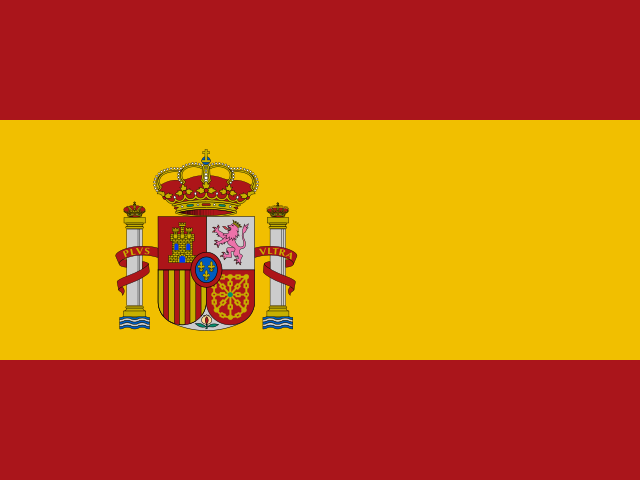
Flag
National symbol(s)
Pillars of Hercules
National color(s)
red, yellow
National anthem(s)
lyrics/music: no lyrics/unknown
history: adopted 1942;officially in use between 1770 and 1931, restored in 1939; the Spanish anthem was the first to be officially adopted; it first appeared in a 1761 military bugle-call book and was replaced by "Himno de Riego" in the years between 1931 and 1939; the long version of the anthem is used for the king, and the short version is used for the prince, prime minister, and occasions such as sporting events
National heritage
selected World Heritage Site locales: Cave of Altamira and Paleolithic Cave Art of Northern Spain (c); Works of Antoni Gaudí (c); Santiago de Compostela (Old Town) (c); Historic City of Toledo (c); Archaeological Ensemble of Mérida (c); Tower of Hercules (c); Doñana National Park (n); Pyrénées - Mont Perdu (m); Alhambra, Generalife, and Albayzín in Granada (c); Old City of Salamanca (c); Teide National Park (n); Historic Walled Town of Cuenca (c); Old Town of Segovia and its Aqueduct (c); Historic Cordoba (c); Royal Site of Saint Lorenzo de El Escorial (c); Cathedral, Alcázar, and Archivo de Indias in Seville
Economy31
Economic overview
high-income, core-EU and eurozone economy; strong growth driven by public consumption, tourism, and other service exports; tight labor market despite high structural unemployment; efforts to narrow persistent fiscal deficits through tax and spending measures; high but declining unemployment supported by job growth and immigration
Real GDP (purchasing power parity)
Real GDP (purchasing power parity) 2023: $2.289 trillion (2023 est.)
Real GDP (purchasing power parity) 2022: $2.229 trillion (2022 est.)
Real GDP growth rate
Real GDP growth rate 2023: 2.7% (2023 est.)
Real GDP growth rate 2022: 6.2% (2022 est.)
Real GDP per capita
Real GDP per capita 2023: $47,300 (2023 est.)
Real GDP per capita 2022: $46,600 (2022 est.)
GDP (official exchange rate)
Inflation rate (consumer prices)
Inflation rate (consumer prices) 2023: 3.5% (2023 est.)
Inflation rate (consumer prices) 2022: 8.4% (2022 est.)
GDP - composition, by sector of origin
industry: 19.5% (2024 est.)
services: 69.1% (2024 est.)
GDP - composition, by end use
household consumption
government consumption
investment in fixed capital
investment in inventories
exports of goods and services
imports of goods and services
Agricultural products
Industries
textiles and apparel (including footwear), food and beverages, metals and metal manufactures, chemicals, shipbuilding, automobiles, machine tools, tourism, clay and refractory products, footwear, pharmaceuticals, medical equipment
Industrial production growth rate
Labor force
Unemployment rate
Unemployment rate 2023: 12.2% (2023 est.)
Unemployment rate 2022: 13% (2022 est.)
Youth unemployment rate (ages 15-24)
male: 26.4% (2024 est.)
female: 27.7% (2024 est.)
Population below poverty line
Gini Index coefficient - distribution of family income
Average household expenditures
on alcohol and tobacco: 4% of household expenditures (2023 est.)
Household income or consumption by percentage share
highest 10%: 24.8% (2022 est.)
Remittances
Remittances 2023: 0.3% of GDP (2023 est.)
Remittances 2022: 0.3% of GDP (2022 est.)
Budget
expenditures: $549.772 billion (2023 est.)
Public debt
Taxes and other revenues
Current account balance
Current account balance 2023: $43.012 billion (2023 est.)
Current account balance 2022: $4.482 billion (2022 est.)
Exports
Exports 2023: $616.648 billion (2023 est.)
Exports 2022: $573.598 billion (2022 est.)
Exports - partners
Exports - commodities
Imports
Imports 2023: $552.948 billion (2023 est.)
Imports 2022: $561.448 billion (2022 est.)
Imports - partners
Imports - commodities
Reserves of foreign exchange and gold
Reserves of foreign exchange and gold 2023: $103.089 billion (2023 est.)
Reserves of foreign exchange and gold 2022: $92.905 billion (2022 est.)
Exchange rates
Currency
Exchange rates 2024
Exchange rates 2023
Exchange rates 2022
Exchange rates 2021
Exchange rates 2020
Energy8
Electricity access
Electricity
consumption: 227.187 billion kWh (2023 est.)
exports: 25.279 billion kWh (2023 est.)
imports: 11.315 billion kWh (2023 est.)
transmission/distribution losses: 24.532 billion kWh (2023 est.)
Electricity generation sources
fossil fuels
nuclear
solar
wind
hydroelectricity
biomass and waste
Nuclear energy
Net capacity of operational nuclear reactors: 7.12GW (2025 est.)
Percent of total electricity production: 20.3% (2023 est.)
Number of nuclear reactors permanently shut down: 3 (2025)
Coal
consumption: 7.388 million metric tons (2023 est.)
exports: 1.629 million metric tons (2023 est.)
imports: 9.798 million metric tons (2023 est.)
proven reserves: 1.187 billion metric tons (2023 est.)
Petroleum
refined petroleum consumption: 1.325 million bbl/day (2024 est.)
crude oil estimated reserves: 150 million barrels (2021 est.)
Natural gas
consumption: 29.041 billion cubic meters (2023 est.)
exports: 6.576 billion cubic meters (2023 est.)
imports: 35.252 billion cubic meters (2023 est.)
proven reserves: 2.549 billion cubic meters (2021 est.)
Energy consumption per capita
Communications6
Telephones - fixed lines
subscriptions per 100 inhabitants: 38 (2023 est.)
Telephones - mobile cellular
subscriptions per 100 inhabitants: 124 (2022 est.)
Broadcast media
mix of publicly operated and privately owned TV and radio stations; hundreds of TV channels available, including national, regional, local, public, and international channels; satellite and cable TV available; multiple national radio networks, large number of regional radio networks, and larger number of local radio stations (2019)
Internet country code
.es
Internet users
Broadband - fixed subscriptions
subscriptions per 100 inhabitants: 38 (2023 est.)
Transportation6
Civil aircraft registration country code prefix
EC
Airports
365 (2025)
Heliports
162 (2025)
Railways
Merchant marine
by type: bulk carrier 1, general cargo 33, oil tanker 24, other 445
Ports
total ports
large
medium
small
very small
size unknown
ports with oil terminals
key ports
Military & Security7
Military and security forces
Ministry of the Interior: Spanish National Police (Cuerpo Nacional de Policía, CNP) (2025)
note 2: the Emergency Response Unit was established in 2006 as a separate branch of service for responding to natural disasters and providing disaster relief both domestically and abroad; it has personnel from all the other military services
note 3: the Royal Guard is an independent joint-service regiment of the military dedicated to the protection of the King and members of the royal family
Military expenditures
Military Expenditures 2024: 1.4% of GDP (2024 est.)
Military Expenditures 2023: 1.2% of GDP (2023 est.)
Military Expenditures 2022: 1.1% of GDP (2022 est.)
Military Expenditures 2021: 1% of GDP (2021 est.)
Military and security service personnel strengths
approximately 120,000 active-duty military personnel; approximately 80,000 Guardia Civil (2025)
Military equipment inventories and acquisitions
the military's inventory is comprised of weapons and equipment that were produced domestically, co-produced with or imported from other European countries, or acquired from the US; key suppliers of major armaments include Germany and the US; Spain's defense industry manufactures land, air, and sea weapons systems and is integrated within the European defense-industrial sector (2025)
Military service age and obligation
note 2: the military recruits foreign nationals with residency in Spain from countries of its former empire, including Argentina, Costa Rica, Bolivia, Colombia, Chile, Cuba, Dominican Republic, Ecuador, El Salvador, Equatorial Guinea, Guatemala, Honduras, Mexico, Nicaragua, Panama, Paraguay, Peru, Uruguay, and Venezuela
Military deployments
Military - note
the Spanish military's history goes back to the 13th century; the Army has an infantry regiment, formed in the 13th century, that is considered the oldest still active military unit in the Western world; the Marine Corps, which traces its roots back to 1537, is the oldest naval infantry force in the world; Spain created a Spanish Legion for foreigners in 1920, but early on the Legion was primarily filled by native Spaniards due to difficulties in recruiting foreigners, and most of its foreign members were from the Republic of Cuba; it was modeled after the French Foreign Legion and its purpose was to provide a corps of professional troops to fight in Spain's colonial campaigns in North Africa; in more recent years, it has been used in NATO peacekeeping deployments; today’s Legion includes a mix of native Spaniards and foreigners with Spanish residency (2025)
Transnational Issues1
Refugees and internally displaced persons
IDPs: 3,960 (2024 est.)
stateless persons: 10,164 (2024 est.)