
Sudan
Republic of the Sudan
Population
50.47M
Area
1,861,484 km²
GDP
$49.91B
GDP Per Capita
$1,900
Pop. Density
27/km²
Quick Facts
Currency
ج.سSudanese pound(SDG)
Calling Code
+249
Timezone
UTC+03:00
Languages
Arabic, English+more
Driving Side
right
Demonym
Sudanese
Background
Long referred to as Nubia, modern-day Sudan was the site of the Kingdom of Kerma (ca. 2500-1500 B.C.) until it was absorbed into the New Kingdom of Egypt. By the 11th century B.C., the Kingdom of Kush gained independence from Egypt; it lasted in various forms until the middle of the 4th century A.D. After the fall of Kush, the Nubians formed three Christian kingdoms of Nobatia, Makuria, and Alodia, with the latter two enduring until around 1500. Between the 14th and 15th centuries, Arab nomads settled much of Sudan, leading to extensive Islamization between the 16th and 19th centuries. Following Egyptian occupation early in the 19th century, an agreement in 1899 set up a joint British-Egyptian government in Sudan, but it was effectively a British colony.
Military regimes favoring Islamic-oriented governments have dominated national politics since Sudan gained independence from Anglo-Egyptian co-rule in 1956. During most of the second half of the 20th century, Sudan was embroiled in two prolonged civil wars rooted in northern domination of the largely non-Muslim, non-Arab southern portion of the country. The first civil war ended in 1972, but another broke out in 1983. Peace talks gained momentum in 2002-04, and the final North/South Comprehensive Peace Agreement in 2005 granted the southern rebels autonomy for six years, followed by a referendum on independence for Southern Sudan. South Sudan became independent in 2011, but Sudan and South Sudan have yet to fully implement security and economic agreements to normalize relations between the two countries. Sudan has also faced conflict in Darfur, Southern Kordofan, and Blue Nile starting in 2003.
In 2019, after months of nationwide protests, the 30-year reign of President Omar Hassan Ahmad al-BASHIR ended when the military forced him out. Economist and former international civil servant Abdalla HAMDOUK al-Kinani was selected to serve as the prime minister of a transitional government as the country prepared for elections in 2022. In late 2021, however, the Sudanese military ousted HAMDOUK and his government and replaced civilian members of the Sovereign Council (Sudan’s collective Head of State) with individuals selected by the military. HAMDOUK was briefly reinstated but resigned in January 2022. General Abd-al-Fatah al-BURHAN Abd-al-Rahman, the Chair of Sudan’s Sovereign Council and Commander-in-Chief of the Sudanese Armed Forces, currently serves as de facto head of state and government. He presides over a Sovereign Council consisting of military leaders, former armed opposition group representatives, and military-appointed civilians. A cabinet of acting ministers handles day-to-day administration.
Historical Trends
GDP (USD)
↑9.7% since 2006Population
↑57.7% since 2006Life Expectancy at Birth
Latest: 66.3 yearsData source: World Bank Open Data
Geography20
Location
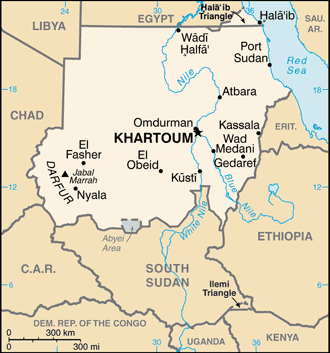
north-eastern Africa, bordering the Red Sea, between Egypt and Eritrea
Geographic coordinates
15 00 N, 30 00 E
Map references
Africa
Area
land: 1,731,671 sq km
water: 129,813 sq km
Area - comparative
slightly less than one-fifth the size of the US
Land boundaries
border countries: Central African Republic 174 km; Chad 1,403 km; Egypt 1,276 km; Eritrea 682 km; Ethiopia 744 km; Libya 382 km; South Sudan 2,158 km
Coastline
853 km
Maritime claims
contiguous zone: 18 nm
continental shelf: 200-m depth or to the depth of exploitation
Climate
hot and dry; arid desert; rainy season varies by region (April to November)
Terrain
generally flat, featureless plain; desert dominates the north
Elevation
lowest point: Red Sea 0 m
mean elevation: 568 m
Natural resources
petroleum; small reserves of iron ore, copper, chromium ore, zinc, tungsten, mica, silver, gold; hydropower
Land use
agricultural land
agricultural land: arable land
agricultural land: permanent crops
agricultural land: permanent pasture
forest
other
Irrigated land
15,504 sq km (2019)
Major rivers (by length in km)
An Nīl (Nile) (shared with Rwanda [s], Tanzania, Uganda, South Sudan, and Egypt [m]) - 6,650 km; Blue Nile river mouth (shared with Ethiopia [s]) - 1,600 km
note: [s] after country name indicates river source; [m] after country name indicates river mouth
Major watersheds (area sq km)
Internal (endorheic basin) drainage: Lake Chad (2,497,738 sq km)
Major aquifers
Nubian Aquifer System, Sudd Basin (Umm Ruwaba Aquifer)
Population distribution
with the exception of a ribbon of settlement that corresponds to the banks of the Nile, northern Sudan is sparsely populated; sizeable areas of population are found around Khartoum, southeast between the Blue and White Nile Rivers, and throughout South Darfur, as shown on this population distribution map
Natural hazards
dust storms and periodic persistent droughts
Geography - note
the Nile is Sudan's primary water source; its major tributaries, the White Nile and the Blue Nile, meet at Khartoum to form the River Nile, which flows northward through Egypt to the Mediterranean Sea
People & Society29
Population
male: 25,335,092
female: 25,132,186
Nationality
adjective: Sudanese
Ethnic groups
Sudanese Arab (approximately 70%), Fur, Beja, Nuba, Ingessana, Uduk, Fallata, Masalit, Dajo, Gimir, Tunjur, Berti; there are over 500 ethnic groups
Languages
major-language sample(s):
كتاب حقائق العالم، المصدر الذي لا يمكن الاستغناء عنه للمعلومات الأساسية (Arabic)
The World Factbook, the indispensable source for basic information. (English)
Religions
Sunni Muslim, small Christian minority
Age structure
15-64 years: 56.7% (male 14,211,514/female 14,390,486)
65 years and over: 3.2% (2024 est.) (male 845,125/female 792,357)
Dependency ratios
youth dependency ratio: 70.7 (2024 est.)
elderly dependency ratio: 5.7 (2024 est.)
potential support ratio: 17.5 (2024 est.)
Median age
male: 19 years
female: 19.6 years
Population growth rate
2.54% (2025 est.)
Birth rate
32.95 births/1,000 population (2025 est.)
Death rate
6 deaths/1,000 population (2025 est.)
Net migration rate
-1.55 migrant(s)/1,000 population (2025 est.)
Population distribution
with the exception of a ribbon of settlement that corresponds to the banks of the Nile, northern Sudan is sparsely populated; sizeable areas of population are found around Khartoum, southeast between the Blue and White Nile Rivers, and throughout South Darfur, as shown on this population distribution map
Urbanization
rate of urbanization: 3.43% annual rate of change (2020-25 est.)
Major urban areas - population
6.344 million KHARTOUM (capital), 1.057 million Nyala (2023)
Sex ratio
0-14 years: 1.03 male(s)/female
15-64 years: 0.99 male(s)/female
65 years and over: 1.07 male(s)/female
total population: 1.01 male(s)/female (2024 est.)
Maternal mortality ratio
256 deaths/100,000 live births (2023 est.)
Infant mortality rate
male: 46 deaths/1,000 live births
female: 34.8 deaths/1,000 live births
Life expectancy at birth
male: 65.5 years
female: 70.2 years
Total fertility rate
4.41 children born/woman (2025 est.)
Gross reproduction rate
2.15 (2025 est.)
Drinking water source
improved: urban
improved: rural
improved: total
unimproved: urban
unimproved: rural
unimproved: total
Health expenditure
Health expenditure (as % of national budget): 6.7% of national budget (2022 est.)
Physician density
0.25 physicians/1,000 population (2017)
Hospital bed density
0.7 beds/1,000 population (2020 est.)
Obesity - adult prevalence rate
6.6% (2014)
Alcohol consumption per capita
beer: 0 liters of pure alcohol (2019 est.)
wine: 0 liters of pure alcohol (2019 est.)
spirits: 0.29 liters of pure alcohol (2019 est.)
other alcohols: 1.63 liters of pure alcohol (2019 est.)
Children under the age of 5 years underweight
33% (2014)
School life expectancy (primary to tertiary education)
male: 7 years (2015 est.)
female: 7 years (2015 est.)
Government22
Country name
conventional long form
conventional short form
local long form
local short form
former
etymology
Government type
presidential republic
Capital
geographic coordinates: 15 36 N, 32 32 E
time difference: UTC+3 (8 hours ahead of Washington, DC, during Standard Time)
etymology: the name derives from the Arabic words ras (head or end) and al-khurtum (elephant's trunk), referring to the narrow strip of land between the Blue and White Niles where the city is located
Administrative divisions
Legal system
mixed system of Islamic law and English common law
Constitution
International law organization participation
accepts compulsory ICJ jurisdiction with reservations; withdrew acceptance of ICCt jurisdiction in 2008
Citizenship
citizenship by descent only: the father must be a citizen of Sudan
dual citizenship recognized: no
residency requirement for naturalization: 10 years
Suffrage
17 years of age; universal
Executive branch
chief of state
head of government
cabinet
election/appointment process
election results
expected date of next election
Judicial branch
judge selection and term of office: National Supreme Court and Constitutional Court judges selected by the Supreme Judicial Council
subordinate courts: Court of Appeal; other national courts; public courts; district, town, and rural courts
Political parties
Democratic Unionist Party or DUP
Federal Umma Party
Muslim Brotherhood or MB
National Congress Party or NCP
National Umma Party or NUP
Popular Congress Party or PCP
Reform Movement Now
Sudan National Front
Sudanese Communist Party or SCP
Sudanese Congress Party or SCoP
Umma Party for Reform and Development
Unionist Movement Party or UMP
Diplomatic representation in the US
chancery: 2210 Massachusetts Avenue NW, Washington, DC 20008
telephone: [1] (202) 338-8565
FAX: [1] (202) 667-2406
email address and website:
consular@sudanembassy.org
https://www.sudanembassy.org/
Diplomatic representation from the US
embassy: P.O. Box 699, Kilo 10, Soba, Khartoum
mailing address: 2200 Khartoum Place, Washington DC 20521-2200
telephone: [249] 187-0-22000
email address and website:
ACSKhartoum@state.gov
https://sd.usembassy.gov/
International organization participation
ABEDA, ACP, AfDB, AFESD, AMF, AU (suspended), CAEU, COMESA, FAO, G-77, IAEA, IBRD, ICAO, ICC (NGOs), ICRM, IDA, IDB, IFAD, IFC, IFRCS, IGAD, ILO, IMF, IMO, Interpol, IOC, IOM, IPU, ISO, ITSO, ITU, LAS, MIGA, NAM, OIC, OPCW, PCA, UN, UNCTAD, UNESCO, UNHCR, UNHRC, UNIDO, UNOOSA, UNWTO, UPU, WCO, WFTU (NGOs), WHO, WIPO, WMO, WTO (observer)
Independence
1 January 1956 (from Egypt and the UK)
National holiday
Independence Day, 1 January (1956)
Flag
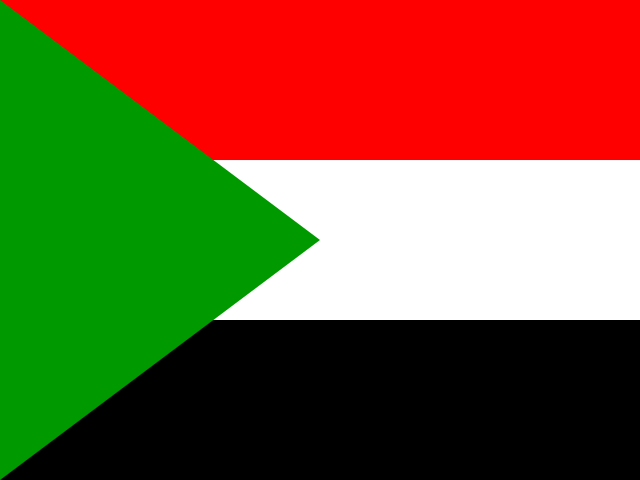
meaning: red stands for the struggle for freedom; white for peace, light, and love, black for the people; green for Islam, agriculture, and prosperity
history: colors and design are based on the Arab Revolt flag of World War I
National symbol(s)
secretary bird
National color(s)
red, white, black, green
National anthem(s)
lyrics/music: Sayed Ahmad Muhammad SALIH/Ahmad MURJAN
history: adopted 1956; originally served as the anthem of the Sudanese military
National heritage
selected World Heritage Site locales: Gebel Barkal and the Sites of the Napatan Region (c); Archaeological Sites of the Island of Meroe (c); Sanganeb Marine National Park and Dungonab Bay – Mukkawar Island Marine National Park (n)
Economy28
Economic overview
low-income Sahel economy devastated by ongoing civil war; major impacts on rural income, basic commodity prices, industrial production, agricultural supply chain, communications and commerce; hyperinflation and currency depreciation worsening food access and humanitarian conditions
Real GDP (purchasing power parity)
Real GDP (purchasing power parity) 2023: $109.147 billion (2023 est.)
Real GDP (purchasing power parity) 2022: $154.672 billion (2022 est.)
Real GDP growth rate
Real GDP growth rate 2023: -29.4% (2023 est.)
Real GDP growth rate 2022: -1% (2022 est.)
Real GDP per capita
Real GDP per capita 2023: $2,200 (2023 est.)
Real GDP per capita 2022: $3,100 (2022 est.)
GDP (official exchange rate)
Inflation rate (consumer prices)
Inflation rate (consumer prices) 2021: 359.1% (2021 est.)
Inflation rate (consumer prices) 2020: 163.3% (2020 est.)
GDP - composition, by sector of origin
industry: 23% (2024 est.)
services: 54.9% (2024 est.)
GDP - composition, by end use
household consumption
government consumption
investment in fixed capital
investment in inventories
exports of goods and services
imports of goods and services
Agricultural products
Industries
oil, cotton ginning, textiles, cement, edible oils, sugar, soap distilling, shoes, petroleum refining, pharmaceuticals, armaments, automobile/light truck assembly, milling
Industrial production growth rate
Labor force
Unemployment rate
Unemployment rate 2022: 7.6% (2022 est.)
Unemployment rate 2021: 11.1% (2021 est.)
Youth unemployment rate (ages 15-24)
male: 11.8% (2022 est.)
female: 13.1% (2022 est.)
Remittances
Remittances 2022: 2.9% of GDP (2022 est.)
Remittances 2021: 3.3% of GDP (2021 est.)
Budget
expenditures: $9.103 billion (2015 est.)
Public debt
Taxes and other revenues
Current account balance
Current account balance 2021: -$2.62 billion (2021 est.)
Current account balance 2020: -$5.841 billion (2020 est.)
Exports
Exports 2021: $6.664 billion (2021 est.)
Exports 2020: $5.065 billion (2020 est.)
Exports - partners
Exports - commodities
Imports
Imports 2021: $10.271 billion (2021 est.)
Imports 2020: $10.52 billion (2020 est.)
Imports - partners
Imports - commodities
Reserves of foreign exchange and gold
Reserves of foreign exchange and gold 2016: $168.284 million (2016 est.)
Reserves of foreign exchange and gold 2015: $173.516 million (2015 est.)
Debt - external
Exchange rates
Currency
Exchange rates 2022
Exchange rates 2021
Exchange rates 2020
Exchange rates 2019
Exchange rates 2018
Energy7
Electricity access
electrification - urban areas: 84%
electrification - rural areas: 49.4%
Electricity
consumption: 13.983 billion kWh (2023 est.)
imports: 882 million kWh (2023 est.)
transmission/distribution losses: 3.646 billion kWh (2023 est.)
Electricity generation sources
solar: 0.8% of total installed capacity (2023 est.)
hydroelectricity: 68.7% of total installed capacity (2023 est.)
biomass and waste: 0.6% of total installed capacity (2023 est.)
Coal
imports: 200 metric tons (2023 est.)
Petroleum
refined petroleum consumption: 129,000 bbl/day (2023 est.)
crude oil estimated reserves: 1.25 billion barrels (2021 est.)
Natural gas
Energy consumption per capita
Communications6
Telephones - fixed lines
subscriptions per 100 inhabitants: (2022 est.) less than 1
Telephones - mobile cellular
subscriptions per 100 inhabitants: 74 (2022 est.)
Broadcast media
state-owned broadcasters that self-censor but are somewhat independent (2022)
Internet country code
.sd
Internet users
Broadband - fixed subscriptions
subscriptions per 100 inhabitants: (2022 est.) less than 1
Transportation6
Civil aircraft registration country code prefix
ST
Airports
45 (2025)
Heliports
8 (2025)
Railways
narrow gauge: 5,851 km (2014) 1.067-m gauge
Merchant marine
by type: other 14
Ports
total ports
large
medium
small
very small
ports with oil terminals
key ports
Military & Security6
Military and security forces
Ministry of Interior: Sudan Police Forces (SPF), Central Reserve Police (CRP) (2025)
note 2: the Central Reserve Police (aka Abu Tira) is a combat-trained paramilitary force
note 3: the October 2020 peace agreement provided for the establishment of a Joint Security Keeping Forces (JSKF) tasked with securing the Darfur region in the place of the UN African Union Hybrid Operation in Darfur (UNAMID), a joint African Union-UN peacekeeping force that operated in the war-torn region from 2007-December 2020; the force was intended to include the SAF, RSF, police, intelligence, and representatives from armed groups involved in peace negotiations; while the first 2,000 members of the JSKF completed training in September 2022, the status of the force since the start of the civil war is not available
note 4: there are also numerous armed militias operating in Sudan
Military expenditures
Military Expenditures 2020: 1% of GDP (2020 est.)
Military Expenditures 2019: 2.4% of GDP (2019 est.)
Military Expenditures 2018: 2% of GDP (2018 est.)
Military Expenditures 2017: 3.6% of GDP (2017 est.)
Military and security service personnel strengths
prior to the outbreak of fighting between the SAF and the RSF in 2023, size estimates for Sudan's armed forces varied widely: up to 200,000 SAF; up to 100,000 RSF; up to 80,000 Central Reserve Police (2023)
Military equipment inventories and acquisitions
note 2: the RSF traditionally has been a lightly armed paramilitary force but over the years is reported to have acquired some heavier armaments such as armored vehicles, artillery, and anti-aircraft guns; it has captured some SAF arms and equipment during the ongoing conflict; since the start of the conflict, both the RSF and the SAF are reported to have received additional weaponry from various foreign suppliers
Military service age and obligation
Military - note
the Sudanese military has been a dominant force in the ruling of the country since its independence in 1956; in addition, the military has a large role in the country's economy, reportedly controlling over 200 commercial companies, including businesses involved in gold mining, rubber production, agriculture, and meat exports
the UN Interim Security Force for Abyei (UNISFA) has operated in the disputed Abyei region along the border between Sudan and South Sudan since 2011; UNISFA's mission includes ensuring security, protecting civilians, strengthening the capacity of the Abyei Police Service, de-mining, monitoring/verifying the redeployment of armed forces from the area, and facilitating the flow of humanitarian aid; as of 2025, UNISFA had approximately 3,800 personnel assigned (2025)
Transnational Issues2
Refugees and internally displaced persons
IDPs: 11,559,970 (2024 est.)