

Switzerland
Swiss Confederation
Population
8.93M
Area
41,277 km²
GDP
$936.56B
GDP Per Capita
$82,000
Pop. Density
216/km²
Quick Facts
Currency
Fr.Swiss franc(CHF)
Calling Code
+41
Timezone
UTC+01:00
Languages
French, Swiss German, Italian +1+more
Driving Side
right
Demonym
Swiss
Background
The Swiss Confederation was founded in 1291 as a defensive alliance among three cantons. In succeeding years, other localities joined the original three. The Swiss Confederation secured its independence from the Holy Roman Empire in 1499. A constitution of 1848, which was modified in 1874 to allow voters to introduce referenda on proposed laws, replaced the confederation with a centralized federal government. The major European powers have long honored Switzerland's sovereignty and neutrality, and the country was not involved in either World War. The political and economic integration of Europe over the past half-century, as well as Switzerland's role in many UN and international organizations, has strengthened Switzerland's ties with its neighbors. However, the country did not officially become a UN member until 2002. Switzerland remains active in many UN and international organizations but retains a strong commitment to neutrality.
Historical Trends
GDP (USD)
↑112.1% since 2006Population
↑20.3% since 2006Life Expectancy at Birth
Latest: 84.1 yearsData source: World Bank Open Data
Geography20
Location
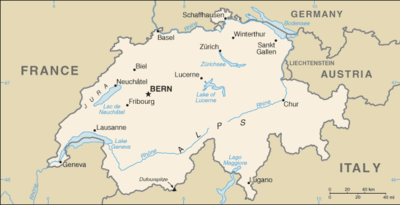
Central Europe, east of France, north of Italy
Geographic coordinates
47 00 N, 8 00 E
Map references
Europe
Area
land: 39,997 sq km
water: 1,280 sq km
Area - comparative
slightly less than twice the size of New Jersey
Land boundaries
border countries: Austria 158 km; France 525 km; Italy 698 km; Liechtenstein 41 km; Germany 348 km
Coastline
0 km (landlocked)
Maritime claims
none (landlocked)
Climate
temperate, but varies with altitude; cold, cloudy, rainy/snowy winters; cool to warm, cloudy, humid summers with occasional showers
Terrain
mostly mountains (Alps in south, Jura in northwest) with a central plateau of rolling hills, plains, and large lakes
Elevation
lowest point: Lake Maggiore 195 m
mean elevation: 1,350 m
Natural resources
hydropower potential, timber, salt
Land use
agricultural land
agricultural land: arable land
agricultural land: permanent crops
agricultural land: permanent pasture
forest
other
Irrigated land
494 sq km (2020)
Major lakes (area sq km)
Major rivers (by length in km)
note: [s] after country name indicates river source; [m] after country name indicates river mouth
Major watersheds (area sq km)
Population distribution
population distribution corresponds to elevation, with the northern and western areas far more heavily populated; the higher Alps of the south limit settlement
Natural hazards
avalanches, landslides; flash floods
Geography - note
landlocked; crossroads of northern and southern Europe; along with southeastern France, northern Italy, and southwestern Austria, has the highest elevations in the Alps
People & Society33
Population
male: 4,436,858
female: 4,488,883
Nationality
adjective: Swiss
Ethnic groups
Languages
major-language sample(s):
Das World Factbook, die unverzichtbare Quelle für grundlegende Informationen. (German)
The World Factbook, une source indispensable d'informations de base. (French)
L'Almanacco dei fatti del mondo, l'indispensabile fonte per le informazioni di base. (Italian)
The World Factbook, the indispensable source for basic information.
Religions
Roman Catholic 34.4%, Protestant 22.5%, other Christian 5.7%, Muslim 5.4%, other 1.5%, none 29.4%, unspecified 1.1% (2020 est.)
Age structure
15-64 years: 64.6% (male 2,887,767/female 2,834,842)
65 years and over: 20.3% (2024 est.) (male 830,117/female 971,825)
Dependency ratios
youth dependency ratio: 23.5 (2025 est.)
elderly dependency ratio: 32.3 (2025 est.)
potential support ratio: 3.1 (2025 est.)
Median age
male: 43.5 years
female: 44.9 years
Population growth rate
0.72% (2025 est.)
Birth rate
10.01 births/1,000 population (2025 est.)
Death rate
8.61 deaths/1,000 population (2025 est.)
Net migration rate
5.79 migrant(s)/1,000 population (2025 est.)
Population distribution
population distribution corresponds to elevation, with the northern and western areas far more heavily populated; the higher Alps of the south limit settlement
Urbanization
rate of urbanization: 0.79% annual rate of change (2020-25 est.)
Major urban areas - population
1.432 million Zurich, 441,000 BERN (capital) (2023)
Sex ratio
0-14 years: 1.05 male(s)/female
15-64 years: 1.02 male(s)/female
65 years and over: 0.85 male(s)/female
total population: 0.99 male(s)/female (2024 est.)
Mother's mean age at first birth
31.1 years (2020 est.)
Maternal mortality ratio
5 deaths/100,000 live births (2023 est.)
Infant mortality rate
male: 3.4 deaths/1,000 live births
female: 2.5 deaths/1,000 live births
Life expectancy at birth
male: 82 years
female: 85.8 years
Total fertility rate
1.59 children born/woman (2025 est.)
Gross reproduction rate
0.78 (2025 est.)
Drinking water source
improved: urban
improved: rural
improved: total
unimproved: urban
unimproved: rural
unimproved: total
Health expenditure
Health expenditure (as % of national budget): 12.4% of national budget (2022 est.)
Physician density
4.48 physicians/1,000 population (2022)
Hospital bed density
4.4 beds/1,000 population (2021 est.)
Sanitation facility access
improved: urban
improved: rural
improved: total
unimproved: urban
unimproved: rural
unimproved: total
Obesity - adult prevalence rate
19.5% (2016)
Alcohol consumption per capita
beer: 3.17 liters of pure alcohol (2019 est.)
wine: 4.35 liters of pure alcohol (2019 est.)
spirits: 1.76 liters of pure alcohol (2019 est.)
other alcohols: 0.12 liters of pure alcohol (2019 est.)
Tobacco use
male: 25.5% (2025 est.)
female: 20.1% (2025 est.)
Currently married women (ages 15-49)
57.5% (2022 est.)
Education expenditure
Education expenditure (% national budget): 15.4% national budget (2022 est.)
School life expectancy (primary to tertiary education)
male: 17 years (2023 est.)
female: 17 years (2023 est.)
Government25
Country name
conventional long form
conventional short form
local long form
local short form
abbreviation
etymology
Government type
federal republic (formally a confederation)
Capital
geographic coordinates: 46 55 N, 7 28 E
time difference: UTC+1 (6 hours ahead of Washington, DC, during Standard Time)
daylight saving time: +1hr, begins last Sunday in March; ends last Sunday in October
etymology: the origin of the name is uncertain; it is sometimes associated with the German word Baer (bear), but a more likely origin is an Indo-European root word ber, meaning "marshy place"
Administrative divisions
note 2: 6 of the cantons -- Appenzell Ausserrhoden, Appenzell Innerrhoden, Basel-Landschaft, Basel-Stadt, Nidwalden, Obwalden -- are referred to as half cantons because they elect only one member (instead of two) to the Council of States, and in popular referendums where a majority of popular votes and cantonal votes are required, these 6 cantons have a half vote
Legal system
civil law system; judicial review of legislative acts, except federal decrees of a general obligatory character
Constitution
amendment process: proposed by the two houses of the Federal Assembly or by petition of at least one hundred thousand voters (called the "federal popular initiative"); passage of proposals requires majority vote in a referendum; following drafting of an amendment by the Assembly, its passage requires approval by majority vote in a referendum and approval by the majority of cantons
International law organization participation
accepts compulsory ICJ jurisdiction with reservations; accepts ICCt jurisdiction
Citizenship
citizenship by descent only: at least one parent must be a citizen of Switzerland
dual citizenship recognized: yes
residency requirement for naturalization: 12 years including at least 3 of the last 5 years prior to application
Suffrage
18 years of age; universal
Executive branch
chief of state
head of government
cabinet
election/appointment process
most recent election date
election results
2023: Viola AMHERD elected president for 2024; Federal Assembly vote - Viola AMHERD (The Center) 158 of 204; Karin KELLER-SUTTER (FDP.The Liberals) elected vice president for 2024; Federal Assembly vote - 138 of 196
2022: Alain BERSET elected president for 2023; Federal Assembly vote - Alain BERSET (SP) 140 OF 181; Viola AMHERD elected vice president; Federal assembly vote - 207 of 223
expected date of next election
Legislative branch
legislative structure: bicameral
Legislative branch - lower chamber
chamber name
number of seats
electoral system
scope of elections
term in office
most recent election date
parties elected and seats per party
percentage of women in chamber
expected date of next election
Legislative branch - upper chamber
chamber name
number of seats
electoral system
scope of elections
term in office
most recent election date
parties elected and seats per party
percentage of women in chamber
expected date of next election
Judicial branch
judge selection and term of office: judges elected by the Federal Assembly for 6-year terms; judges are affiliated with political parties and are elected according to linguistic and regional criteria in approximate proportion to party representation in the Federal Assembly
subordinate courts: Federal Criminal Court (established in 2004); Federal Administrative Court (established in 2007)
Political parties
Evangelical Peoples' Party or EVP/PEV
Federal Democrats or EDU
Geneva Citizens Movement or MCR/MCG
Green Liberal Party (Gruenliberale Partei or GLP, Parti vert liberale or PVL, Partito Verde-Liberale or PVL, Partida Verde Liberale or PVL)
Green Party (Gruene Partei der Schweiz or Gruene, Parti Ecologiste Suisse or Les Verts, Partito Ecologista Svizzero or I Verdi, Partida Ecologica Svizra or La Verda)
The Liberals or FDP.The Liberals (FDP.Die Liberalen, PLR.Les Liberaux-Radicaux, PLR.I Liberali, Ils Liberals)
Social Democratic Party (Sozialdemokratische Partei der Schweiz or SP, Parti Socialiste Suisse or PSS, Partito Socialista Svizzero or PSS, Partida Socialdemocratica de la Svizra or PSS)
Swiss People's Party (Schweizerische Volkspartei or SVP, Union Democratique du Centre or UDC, Unione Democratica di Centro or UDC, Uniun Democratica dal Center or UDC)
Diplomatic representation in the US
chief of mission
chancery
telephone
FAX
email address and website
washington@eda.admin.ch
https://www.eda.admin.ch/washington
consulate(s) general
consulate(s)
Diplomatic representation from the US
chief of mission
embassy
mailing address
telephone
FAX
email address and website
https://ch.usembassy.gov/
International organization participation
ADB (nonregional member), AfDB (nonregional member), Australia Group, BIS, CD, CE, CERN, EAPC, EBRD, EFTA, EITI (implementing country), ESA, FAO, FATF, G-10, IADB, IAEA, IBRD, ICAO, ICC (national committees), ICCt, ICRM, IDA, IEA, IFAD, IFC, IFRCS, IGAD (partners), ILO, IMF, IMO, IMSO, Interpol, IOC, IOM, IPU, ISO, ITSO, ITU, ITUC (NGOs), LAIA (observer), MIGA, MONUSCO, NEA, NSG, OAS (observer), OECD, OIF, OPCW, OSCE, Pacific Alliance (observer), Paris Club, PCA, PFP, Schengen Convention, UN, UNCTAD, UNESCO, UNHCR, UNIDO, UNITAR, UNMISS, UNMOGIP, UNOOSA, UNRWA, UNTSO, UNWTO, UPU, Wassenaar Arrangement, WCO, WHO, WIPO, WMO, WTO, ZC
Independence
1 August 1291 (founding of the Swiss Confederation)
National holiday
Flag
history: the origin of the flag is unclear, but a white cross was used to identify Swiss Confederation troops at the Battle of Laupen (1339)
National symbol(s)
Swiss cross (white cross on red field)
National color(s)
red, white
National anthem(s)
lyrics/music: Leonhard WIDMER [German], Charles CHATELANAT [French], Camillo VALSANGIACOMO [Italian], and Flurin CAMATHIAS [Romansch]/Alberik ZWYSSIG
history: adopted 1981; all four of the versions (German, French, Italian, Romansch) are considered official
National heritage
selected World Heritage Site locales: Old City of Berne (c); Swiss Alps Jungfrau-Aletsch (n); Monte San Giorgio (n); Abbey of St Gall (c); Three Castles, Defensive Wall, and Ramparts of the Market-Town of Bellinzona (c); Rhaetian Railway in the Albula/Bernina Landscapes (c); La Chaux-de-Fonds/Le Locle, Watchmaking Town Planning (c); Prehistoric Pile Dwellings around the Alps (c); Benedictine Convent of St John at Müstair (c); Lavaux, Vineyard Terraces (c)
Economy31
Economic overview
high-income, non-EU European economy; top ten in GDP per capita; renowned banking and financial hub; low unemployment and inflation; slowed GDP growth post-pandemic; highly skilled but aging workforce; key pharmaceutical and precision manufacturing exporter; leader in innovation and competitiveness indices
Real GDP (purchasing power parity)
Real GDP (purchasing power parity) 2023: $731.508 billion (2023 est.)
Real GDP (purchasing power parity) 2022: $726.544 billion (2022 est.)
Real GDP growth rate
Real GDP growth rate 2023: 0.7% (2023 est.)
Real GDP growth rate 2022: 3% (2022 est.)
Real GDP per capita
Real GDP per capita 2023: $82,300 (2023 est.)
Real GDP per capita 2022: $82,800 (2022 est.)
GDP (official exchange rate)
Inflation rate (consumer prices)
Inflation rate (consumer prices) 2023: 2.1% (2023 est.)
Inflation rate (consumer prices) 2022: 2.8% (2022 est.)
GDP - composition, by sector of origin
industry: 24.7% (2024 est.)
services: 72% (2024 est.)
GDP - composition, by end use
household consumption
government consumption
investment in fixed capital
investment in inventories
exports of goods and services
imports of goods and services
Agricultural products
Industries
machinery, chemicals, watches, textiles, precision instruments, tourism, banking, insurance, pharmaceuticals
Industrial production growth rate
Labor force
Unemployment rate
Unemployment rate 2023: 4.1% (2023 est.)
Unemployment rate 2022: 4.2% (2022 est.)
Youth unemployment rate (ages 15-24)
male: 8.3% (2024 est.)
female: 7.5% (2024 est.)
Population below poverty line
Gini Index coefficient - distribution of family income
Average household expenditures
on alcohol and tobacco: 3.5% of household expenditures (2023 est.)
Household income or consumption by percentage share
highest 10%: 26.6% (2021 est.)
Remittances
Remittances 2023: 0.4% of GDP (2023 est.)
Remittances 2022: 0.4% of GDP (2022 est.)
Budget
expenditures: $152.488 billion (2023 est.)
Public debt
Taxes and other revenues
Current account balance
Current account balance 2023: $47.455 billion (2023 est.)
Current account balance 2022: $72.325 billion (2022 est.)
Exports
Exports 2023: $654.175 billion (2023 est.)
Exports 2022: $628.737 billion (2022 est.)
Exports - partners
Exports - commodities
Imports
Imports 2023: $556.351 billion (2023 est.)
Imports 2022: $518.002 billion (2022 est.)
Imports - partners
Imports - commodities
Reserves of foreign exchange and gold
Reserves of foreign exchange and gold 2023: $863.892 billion (2023 est.)
Reserves of foreign exchange and gold 2022: $923.628 billion (2022 est.)
Exchange rates
Currency
Exchange rates 2024
Exchange rates 2023
Exchange rates 2022
Exchange rates 2021
Exchange rates 2020
Energy8
Electricity access
Electricity
consumption: 55.643 billion kWh (2023 est.)
exports: 33.856 billion kWh (2023 est.)
imports: 27.462 billion kWh (2023 est.)
transmission/distribution losses: 4.81 billion kWh (2023 est.)
Electricity generation sources
fossil fuels
nuclear
solar
wind
hydroelectricity
biomass and waste
Nuclear energy
Net capacity of operational nuclear reactors: 2.97GW (2025 est.)
Percent of total electricity production: 32.4% (2023 est.)
Number of nuclear reactors permanently shut down: 2 (2025)
Coal
exports: 300 metric tons (2023 est.)
imports: 156,000 metric tons (2023 est.)
Petroleum
refined petroleum consumption: 194,000 bbl/day (2024 est.)
Natural gas
imports: 2.869 billion cubic meters (2023 est.)
Energy consumption per capita
Communications6
Telephones - fixed lines
subscriptions per 100 inhabitants: 34 (2023 est.)
Telephones - mobile cellular
subscriptions per 100 inhabitants: 129 (2024 est.)
Broadcast media
publicly owned Swiss Broadcasting Corporation (SRG/SSR) has 8 national TV networks, 3 broadcasting in German, 3 in French, and 2 in Italian; private commercial TV stations broadcast regionally and locally; German, Italian, and French TV broadcasts widely available via multi-channel cable and satellite TV; SRG/SSR has 17 radio stations (2019)
Internet country code
.ch
Internet users
Broadband - fixed subscriptions
subscriptions per 100 inhabitants: 49 (2023 est.)
Transportation5
Civil aircraft registration country code prefix
HB
Airports
66 (2025)
Heliports
52 (2025)
Railways
Merchant marine
by type: bulk carrier 14, general cargo 1, other 2 (includes Liechtenstein)
Military & Security7
Military and security forces
Military expenditures
Military Expenditures 2023: 0.7% of GDP (2023 est.)
Military Expenditures 2022: 0.7% of GDP (2022 est.)
Military Expenditures 2021: 0.7% of GDP (2021 est.)
Military Expenditures 2020: 0.7% of GDP (2020 est.)
Military and security service personnel strengths
Military equipment inventories and acquisitions
the military's inventory includes a mix of domestically produced and imported European and US weapons systems; the Swiss defense industry produces a range of military land vehicles (2025)
Military service age and obligation
Military deployments
200 Kosovo (NATO/KFOR) (2025)
Military - note
Transnational Issues1
Refugees and internally displaced persons
IDPs: 97 (2024 est.)
stateless persons: 1,267 (2024 est.)