

Tonga
Kingdom of Tonga
Population
104.5K
Area
747 km²
GDP
$508.74M
GDP Per Capita
$7,100
Pop. Density
140/km²
Quick Facts
Currency
T$Tongan paʻanga(TOP)
Calling Code
+676
Timezone
UTC+13:00
Languages
English, Tongan+more
Driving Side
left
Demonym
Tongan
Background
Dutch navigators explored the islands in the 1600s, followed by the British in the 1770s, who named them the Friendly Islands. Between 1799 and 1852 Tonga went through a period of war and disorder. In the 1830s, a low-ranking chief from Ha’apai began to consolidate control over the islands and was crowned King George TUPOU I in 1845, establishing the only still-extant Polynesian monarchy. During TUPOU's reign (1845–93), Tonga became a unified and independent country with a modern constitution (1875), legal code, and administrative structure. In separate treaties, Germany (1876), Great Britain (1879), and the US (1888) recognized Tonga’s independence. His son and successor, King George TUPOU II, agreed to enter a protectorate agreement with the UK in 1900 after rival Tongan chiefs tried to overthrow him. As a protectorate, Tonga never completely lost its indigenous governance, but it did become more isolated and the social hierarchy became more stratified between a group of nobles and a large class of commoners. Today, about one third of parliamentary seats are reserved for nobles.
Tonga regained full control of domestic and foreign affairs and became a fully independent nation within the Commonwealth in 1970. A pro-democracy movement gained steam in the early 2000s, led by ‘Akilisi POHIVA, and in 2006, riots broke out in Nuku’alofa to protest the lack of progress on reform. To appease the activists, in 2008, King George TUPOU V announced he was relinquishing most of his powers leading up to parliamentary elections in 2010 and henceforth most of the monarch’s governmental decisions, except those relating to the judiciary, were to be made in consultation with the prime minister. The 2010 Legislative Assembly was called Tonga’s first democratically elected Parliament. King George TUPOU V died in 2012 and was succeeded by his brother Crown Prince Tupouto‘a Lavaka who ruled as George TUPOU VI. In 2015, ‘Akalisi POHIVA became Tonga’s first non-noble prime minister.
Historical Trends
GDP (USD)
↑102.3% since 2006Population
↓2.0% since 2006Life Expectancy at Birth
Latest: 72.9 yearsData source: World Bank Open Data
Geography17
Location
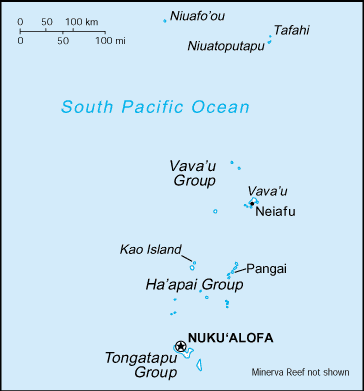
Oceania, archipelago in the South Pacific Ocean, about two-thirds of the way from Hawaii to New Zealand
Geographic coordinates
20 00 S, 175 00 W
Map references
Oceania
Area
land: 717 sq km
water: 30 sq km
Area - comparative
four times the size of Washington, D.C.
Land boundaries
Coastline
419 km
Maritime claims
exclusive economic zone: 200 nm
continental shelf: 200-m depth or to the depth of exploitation
Climate
tropical; modified by trade winds; warm season (December to May), cool season (May to December)
Terrain
mostly flat islands with limestone bedrock formed from uplifted coral formation; others have limestone overlying volcanic rock
Elevation
lowest point: Pacific Ocean 0 m
Natural resources
arable land, fish
Land use
agricultural land
agricultural land: arable land
agricultural land: permanent crops
agricultural land: permanent pasture
forest
other
Irrigated land
0 sq km (2022)
Population distribution
over two thirds of the population lives on the island of Tongatapu; only 45 of the nation's 171 islands are occupied
Natural hazards
volcanism: moderate volcanic activity; Fonualei (180 m) has had frequent activity in recent years, and Niuafo'ou (260 m) has forced evacuations; other historically active volcanoes include Late and Tofua
Geography - note
the western islands (making up the Tongan Volcanic Arch) are all of volcanic origin; the eastern islands are nonvolcanic and are composed of coral limestone and sand
People & Society35
Population
male: 52,421
female: 52,098
Nationality
adjective: Tongan
Ethnic groups
Tongan 96.5%, other (European, Fijian, Samoan, Indian, Chinese, other Pacific Islander, other Asian, other) 3.5% (2021 est.)
Languages
Religions
Protestant 63.9% (Free Wesleyan Church 34.2%, Free Church of Tonga 11.3%, Church of Tonga 6.8%, Seventh Day Adventist 2.5%, Assembly of God 2.5%, Tokaikolo/Maamafo'ou 1.5%, Constitutional Church of Tonga 1.2%, other Protestant 4%), Church of Jesus Christ 19.7%, Roman Catholic 13.7%, other 2.1%, none 0.6%, no answer 0.1% (2021 est.)
Age structure
15-64 years: 63.2% (male 33,445/female 32,867)
65 years and over: 7.4% (2024 est.) (male 3,534/female 4,274)
Dependency ratios
youth dependency ratio: 45.2 (2025 est.)
elderly dependency ratio: 11.9 (2025 est.)
potential support ratio: 8.4 (2025 est.)
Median age
male: 25.4 years
female: 26.4 years
Population growth rate
-0.37% (2025 est.)
Birth rate
19.43 births/1,000 population (2025 est.)
Death rate
4.98 deaths/1,000 population (2025 est.)
Net migration rate
-18.18 migrant(s)/1,000 population (2025 est.)
Population distribution
over two thirds of the population lives on the island of Tongatapu; only 45 of the nation's 171 islands are occupied
Urbanization
rate of urbanization: 0.99% annual rate of change (2020-25 est.)
Major urban areas - population
23,000 NUKU'ALOFA (2018)
Sex ratio
0-14 years: 1.03 male(s)/female
15-64 years: 1.02 male(s)/female
65 years and over: 0.83 male(s)/female
total population: 1.01 male(s)/female (2024 est.)
Mother's mean age at first birth
Maternal mortality ratio
67 deaths/100,000 live births (2023 est.)
Infant mortality rate
male: 12.8 deaths/1,000 live births
female: 10.8 deaths/1,000 live births
Life expectancy at birth
male: 76.4 years
female: 79.7 years
Total fertility rate
2.59 children born/woman (2025 est.)
Gross reproduction rate
1.28 (2025 est.)
Drinking water source
improved: urban
improved: rural
improved: total
unimproved: urban
unimproved: rural
unimproved: total
Health expenditure
Health expenditure (as % of national budget): 8.7% of national budget (2022 est.)
Physician density
1.01 physicians/1,000 population (2021)
Sanitation facility access
improved: urban
improved: rural
improved: total
unimproved: urban
unimproved: rural
unimproved: total
Obesity - adult prevalence rate
48.2% (2016)
Alcohol consumption per capita
beer: 0.03 liters of pure alcohol (2019 est.)
wine: 0.17 liters of pure alcohol (2019 est.)
spirits: 0.11 liters of pure alcohol (2019 est.)
other alcohols: 0 liters of pure alcohol (2019 est.)
Tobacco use
male: 46.1% (2025 est.)
female: 15.8% (2025 est.)
Children under the age of 5 years underweight
0.8% (2019 est.)
Currently married women (ages 15-49)
50.7% (2021 est.)
Child marriage
women married by age 18: 10.1% (2019)
men married by age 18: 2.8% (2019)
Education expenditure
Education expenditure (% national budget): 9.3% national budget (2024 est.)
Literacy
male: 83.8% (2019 est.)
female: 97.6% (2019 est.)
School life expectancy (primary to tertiary education)
male: 16 years (2020 est.)
female: 19 years (2020 est.)
Government22
Country name
conventional long form
conventional short form
local long form
local short form
former
etymology
Government type
constitutional monarchy
Capital
geographic coordinates: 21 08 S, 175 12 W
time difference: UTC+13 (18 hours ahead of Washington, DC, during Standard Time)
daylight saving time: +1hr, begins first Sunday in November; ends second Sunday in January
etymology: name is said to be composed of the local words nuku, meaning "residence or abode," and alofa, meaning "love;" it may also mean "the south," describing Tonga's position in relation to most other Polynesian islands
Administrative divisions
5 island divisions; 'Eua, Ha'apai, Ongo Niua, Tongatapu, Vava'u
Legal system
English common law
Constitution
amendment process: proposed by the Legislative Assembly; passage requires approval by the Assembly in each of three readings, the unanimous approval of the Privy Council (a high-level advisory body to the monarch), the Cabinet, and assent to by the monarch
International law organization participation
has not submitted an ICJ jurisdiction declaration; non-party state to the ICCt
Citizenship
citizenship by descent only: the father must be a citizen of Tonga; if a child is born out of wedlock, the mother must be a citizen of Tonga
dual citizenship recognized: yes
residency requirement for naturalization: 5 years
Suffrage
21 years of age; universal
Executive branch
chief of state
head of government
cabinet
election/appointment process
most recent election date
election results
2024: Aisake Valu EKE elected prime minister by the Legislative Assembly; Aisake Valu EKE (Independent) 16 votes, Viliami LATU (Independent) 8
Legislative branch
legislature name
legislative structure
number of seats
electoral system
scope of elections
term in office
most recent election date
percentage of women in chamber
expected date of next election
Judicial branch
judge selection and term of office: judge appointments and tenures made by the King in Privy Council and subject to consent of the Legislative Assembly
subordinate courts: Supreme Court; Magistrates' Courts; Land Courts
Political parties
Tonga People's Party (Paati ʻa e Kakai ʻo Tonga) or PAK or TPPI
Diplomatic representation in the US
chief of mission
chancery
telephone
FAX
email address and website
tongaconsnot@gmail.com
consulate(s) general
Diplomatic representation from the US
embassy: although the US opened an embassy in Tonga on 9 May 2023, the US Ambassador to Fiji is accredited to Tonga while the Embassy is being staffed
International organization participation
ACP, ADB, AOSIS, C, FAO, G-77, IBRD, ICAO, ICRM, IDA, IFAD, IFC, IFRCS, IHO, IMF, IMO, IMSO, Interpol, IOC, IPU, ITU, ITUC (NGOs), OPCW, PIF, Sparteca, SPC, UN, UNCTAD, UNESCO, UNIDO, UPU, WCO, WHO, WIPO, WMO, WTO
Independence
4 June 1970 (from UK protectorate status)
National holiday
Flag
meaning: the cross stands for Christianity in Tonga, red for Christ's blood and sacrifice, and white for purity
National symbol(s)
red cross on white field
National color(s)
red, white
National anthem(s)
lyrics/music: Uelingatoni Ngu TUPOUMALOHI/Karl Gustavus SCHMITT
history: in use since 1874; more commonly known as "Fasi Fakafonua" (National Song)
Economy31
Economic overview
upper middle-income Pacific island economy; enormous diaspora and remittance reliance; key tourism and agricultural sectors; major fish exporter; rapidly growing Chinese infrastructure investments; rising methamphetamine hub
Real GDP (purchasing power parity)
Real GDP (purchasing power parity) 2022: $724.972 million (2022 est.)
Real GDP (purchasing power parity) 2021: $742.114 million (2021 est.)
Real GDP growth rate
Real GDP growth rate 2022: -2.3% (2022 est.)
Real GDP growth rate 2021: 0.4% (2021 est.)
Real GDP per capita
Real GDP per capita 2022: $6,900 (2022 est.)
Real GDP per capita 2021: $7,000 (2021 est.)
GDP (official exchange rate)
Inflation rate (consumer prices)
Inflation rate (consumer prices) 2023: 6.4% (2023 est.)
Inflation rate (consumer prices) 2022: 11% (2022 est.)
GDP - composition, by sector of origin
industry: 13.5% (2023 est.)
services: 50.2% (2023 est.)
GDP - composition, by end use
household consumption
government consumption
investment in fixed capital
investment in inventories
exports of goods and services
imports of goods and services
Agricultural products
Industries
tourism, construction, fishing
Industrial production growth rate
Labor force
Unemployment rate
Unemployment rate 2023: 2.3% (2023 est.)
Unemployment rate 2022: 2.4% (2022 est.)
Youth unemployment rate (ages 15-24)
male: 3.9% (2024 est.)
female: 10% (2024 est.)
Population below poverty line
Gini Index coefficient - distribution of family income
Household income or consumption by percentage share
highest 10%: 22% (2021 est.)
Remittances
Remittances 2022: 41.9% of GDP (2022 est.)
Remittances 2021: 42% of GDP (2021 est.)
Budget
expenditures: $244.97 million (2023 est.)
Public debt
Taxes and other revenues
Current account balance
Current account balance 2023: -$30.087 million (2023 est.)
Current account balance 2022: -$27.749 million (2022 est.)
Exports
Exports 2023: $95.345 million (2023 est.)
Exports 2022: $59.926 million (2022 est.)
Exports - partners
Exports - commodities
Imports
Imports 2023: $383.475 million (2023 est.)
Imports 2022: $330.306 million (2022 est.)
Imports - partners
Imports - commodities
Reserves of foreign exchange and gold
Reserves of foreign exchange and gold 2023: $396.53 million (2023 est.)
Reserves of foreign exchange and gold 2022: $375.564 million (2022 est.)
Debt - external
Exchange rates
Currency
Exchange rates 2024
Exchange rates 2023
Exchange rates 2022
Exchange rates 2021
Exchange rates 2020
Energy5
Electricity access
Electricity
consumption: 67.01 million kWh (2023 est.)
transmission/distribution losses: 5.99 million kWh (2023 est.)
Electricity generation sources
solar: 9.6% of total installed capacity (2023 est.)
wind: 1.4% of total installed capacity (2023 est.)
Petroleum
Energy consumption per capita
Communications6
Telephones - fixed lines
subscriptions per 100 inhabitants: 3 (2022 est.)
Telephones - mobile cellular
subscriptions per 100 inhabitants: 62 (2022 est.)
Broadcast media
1 state-owned TV station and 3 privately owned TV stations; satellite and cable TV services available; 1 state-owned and 5 privately owned radio stations; Radio Australia available via satellite (2019)
Internet country code
.to
Internet users
Broadband - fixed subscriptions
subscriptions per 100 inhabitants: 8 (2022 est.)
Transportation4
Civil aircraft registration country code prefix
A3
Airports
6 (2025)
Merchant marine
by type: container ship 1, general cargo 13, oil tanker 1, other 14
Ports
total ports
large
medium
small
very small
ports with oil terminals
key ports
Military & Security6
Military and security forces
Ministry of Police and Fire Services: Tonga Police Force (2025)
Military expenditures
Military Expenditures 2023: 1.6% of GDP (2023 est.)
Military Expenditures 2022: 1.6% of GDP (2022 est.)
Military Expenditures 2021: 1.5% of GDP (2021 est.)
Military Expenditures 2020: 2.1% of GDP (2020 est.)
Military and security service personnel strengths
approximately 600 active Armed Forces (2025)
Military equipment inventories and acquisitions
the military's inventory consists of light weapons, as well as some naval patrol vessels acquired from Australia (2025)
Military service age and obligation
16-25 years of age for men and women to apply for trainee soldier; no conscription (2025)
Military - note
Tonga has a "shiprider" agreement with the US, which allows local maritime law enforcement officers to embark on US Coast Guard (USCG) and US Navy (USN) vessels, including to board and search vessels suspected of violating laws or regulations within Tonga's designated exclusive economic zone (EEZ) or on the high seas
Tonga participated in World War I as part of the New Zealand Expeditionary Force, but the Tonga Defense Force (TDF) was not established until 1939 at the beginning of World War II; in 1943, New Zealand helped train about 2,000 Tongan troops who saw action in the Solomon Islands; the TDF was disbanded at the end of the war, but was reactivated in 1946 as the Tonga Defense Services (TDS); in 2013, the name of the TDS was changed to His Majesty’s Armed Forces of Tonga (HMAF) (2025)