Turkey
Republic of Turkey
Population
84.63M
Area
783,562 km²
GDP
$1.32T
GDP Per Capita
$35,300
Pop. Density
108/km²
Background
Modern Turkey was founded in 1923 from the remnants of the Ottoman Empire by reformer and national hero Mustafa KEMAL, known as Ataturk or "Father of the Turks." One-party rule ended in 1950, and periods of instability and military coups have since fractured the multiparty democracy, in 1960, 1971, 1980, 1997, and 2016.
Turkey joined the UN in 1945 and NATO in 1952. In 1963, Turkey became an associate member of the European Community; it began accession talks with the EU in 2005. Turkey intervened militarily on Cyprus in 1974 to prevent a Greek takeover of the island and has since acted as patron state to the "Turkish Republic of Northern Cyprus," which only Turkey recognizes. The Kurdistan Workers' Party (PKK), a US-designated terrorist organization, began a separatist insurgency in Turkey in 1984, and the struggle has long dominated the attention of Turkish security forces. In 2013, the Turkish Government and the PKK conducted negotiations aimed at ending the violence, but intense fighting resumed in 2015.
The Turkish Government conducted a referendum in 2017 in which voters approved constitutional amendments changing Turkey from a parliamentary to a presidential system.
Geography20
Location
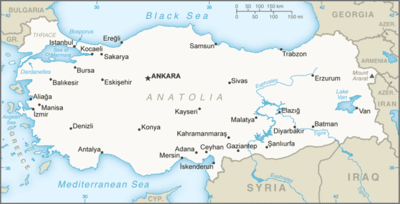
Southeastern Europe and Southwestern Asia (that portion of Turkey west of the Bosporus is geographically part of Europe), bordering the Black Sea, between Bulgaria and Georgia, and bordering the Aegean Sea and the Mediterranean Sea, between Greece and Syria
Geographic coordinates
39 00 N, 35 00 E
Map references
Middle East
Area
land: 769,632 sq km
water: 13,930 sq km
Area - comparative
slightly larger than Texas
Land boundaries
border countries: Armenia 311 km; Azerbaijan 17 km; Bulgaria 223 km; Georgia 273 km; Greece 192 km; Iran 534 km; Iraq 367 km; Syria 899 km
Coastline
7,200 km
Maritime claims
exclusive economic zone: in Black Sea only: to the maritime boundary agreed on with the former USSR
Climate
temperate; hot, dry summers with mild, wet winters; harsher in interior
Terrain
high central plateau (Anatolia); narrow coastal plain; several mountain ranges
Elevation
lowest point: Mediterranean Sea 0 m
mean elevation: 1,132 m
Natural resources
coal, iron ore, copper, chromium, antimony, mercury, gold, barite, borate, celestite (strontium), emery, feldspar, limestone, magnesite, marble, perlite, pumice, pyrites (sulfur), clay, arable land, hydropower
Land use
agricultural land
agricultural land: arable land
agricultural land: permanent crops
agricultural land: permanent pasture
forest
other
Irrigated land
52,150 sq km (2022)
Major lakes (area sq km)
salt water lake(s): Lake Van - 3,740 sq km; Lake Tuz - 1,640 sq km;
Major rivers (by length in km)
note: [s] after country name indicates river source; [m] after country name indicates river mouth
Major watersheds (area sq km)
Population distribution
the most densely populated area is found around the Bosporus in the northwest, where 20% of the population lives in Istanbul; with the exception of Ankara, urban centers remain small and scattered throughout the interior of Anatolia; an overall pattern of peripheral development exists, particularly along the Aegean Sea coast in the west, and the Tigris and Euphrates River systems in the southeast
Natural hazards
volcanism: limited volcanic activity; the three historically active volcanoes (Ararat, Nemrut Dagi, and Tendurek Dagi) have not erupted since the 19th century or earlier
Geography - note
strategic location controlling the Turkish Straits (Bosporus, Sea of Marmara, Dardanelles) that link the Black and Aegean Seas; the 3% of Turkish territory north of the Straits lies in Europe and goes by the names of European Turkey, Eastern Thrace, or Turkish Thrace; the 97% of the country in Asia is referred to as Anatolia; Istanbul, which straddles the Bosporus, is the only metropolis in the world located on two continents; Mount Ararat, reputed to be the landing place of Noah's ark, is in the far-eastern part of the country
People & Society36
Population
male: 42,489,277
female: 42,136,308
Nationality
adjective: Turkish
Ethnic groups
Turkish 70-75%, Kurdish 19%, other minorities 6-11% (2016 est.)
Languages
major-language sample(s):
The World Factbook, temel bilgi edinmek için vazgeçilmez bir kaynak. (Turkish)
ڕاستییەکانی جیهان، باشترین سەرچاوەیە بۆ زانیارییە بنەڕەتییەکان (Kurdish)
The World Factbook, the indispensable source for basic information.
Religions
Muslim 99.8% (mostly Sunni), other 0.2% (mostly Christians and Jews)
Age structure
15-64 years: 68.6% (male 29,219,389/female 28,494,315)
65 years and over: 9.6% (2024 est.) (male 3,669,330/female 4,444,113)
Dependency ratios
youth dependency ratio: 31.2 (2025 est.)
elderly dependency ratio: 14.6 (2025 est.)
potential support ratio: 6.9 (2025 est.)
Median age
male: 33.4 years
female: 34.6 years
Population growth rate
0.59% (2025 est.)
Birth rate
13.56 births/1,000 population (2025 est.)
Death rate
6.19 deaths/1,000 population (2025 est.)
Net migration rate
-1.51 migrant(s)/1,000 population (2025 est.)
Population distribution
the most densely populated area is found around the Bosporus in the northwest, where 20% of the population lives in Istanbul; with the exception of Ankara, urban centers remain small and scattered throughout the interior of Anatolia; an overall pattern of peripheral development exists, particularly along the Aegean Sea coast in the west, and the Tigris and Euphrates River systems in the southeast
Urbanization
rate of urbanization: 1.11% annual rate of change (2020-25 est.)
Major urban areas - population
15.848 million Istanbul, 5.397 million ANKARA (capital), 3.088 million Izmir, 2.086 million Bursa, 1.836 million Adana, 1.805 million Gaziantep (2023)
Sex ratio
0-14 years: 1.05 male(s)/female
15-64 years: 1.03 male(s)/female
65 years and over: 0.83 male(s)/female
total population: 1.01 male(s)/female (2024 est.)
Mother's mean age at first birth
26.6 years (2020 est.)
Maternal mortality ratio
15 deaths/100,000 live births (2023 est.)
Infant mortality rate
male: 19.9 deaths/1,000 live births
female: 16.7 deaths/1,000 live births
Life expectancy at birth
male: 74.4 years
female: 79.2 years
Total fertility rate
1.88 children born/woman (2025 est.)
Gross reproduction rate
0.92 (2025 est.)
Drinking water source
improved: urban
improved: rural
improved: total
unimproved: urban
unimproved: rural
unimproved: total
Health expenditure
Health expenditure (as % of national budget): 10% of national budget (2022 est.)
Physician density
2.24 physicians/1,000 population (2022)
Hospital bed density
3 beds/1,000 population (2020 est.)
Sanitation facility access
improved: urban
improved: rural
improved: total
unimproved: urban
unimproved: rural
unimproved: total
Obesity - adult prevalence rate
32.1% (2016)
Alcohol consumption per capita
beer: 0.67 liters of pure alcohol (2019 est.)
wine: 0.16 liters of pure alcohol (2019 est.)
spirits: 0.35 liters of pure alcohol (2019 est.)
other alcohols: 0 liters of pure alcohol (2019 est.)
Tobacco use
male: 40.1% (2025 est.)
female: 20.1% (2025 est.)
Children under the age of 5 years underweight
1.5% (2018 est.)
Currently married women (ages 15-49)
59.6% (2021 est.)
Child marriage
women married by age 18: 14.7% (2018)
Education expenditure
Education expenditure (% national budget): 11.3% national budget (2022 est.)
Literacy
male: 99.3% (2021 est.)
female: 95.3% (2021 est.)
School life expectancy (primary to tertiary education)
male: 20 years (2022 est.)
female: 20 years (2022 est.)
Government23
Country name
conventional short form: Turkey
local long form: Turkey Cumhuriyeti
local short form: Turkey
etymology: the name means "Land of the Turks"
Government type
presidential republic
Capital
geographic coordinates: 39 56 N, 32 52 E
time difference: UTC+3 (8 hours ahead of Washington, DC, during Standard Time)
etymology: the name probably derives from the Indo-European root word ang, meaning "bend" and relating to the settlement's original location in a winding gorge; the city was referred to as Angora by the 13th century; the name was officially modified to Ankara in 1923 when the Republic of Turkey was founded
Administrative divisions
Legal system
civil law system based on various European systems, notably the Swiss civil code
Constitution
amendment process: proposed by written consent of at least one third of Grand National Assembly (GNA) of Turkey (TBMM) members; adoption of draft amendments requires two debates in plenary TBMM session and three-fifths majority vote of all GNA members; the president of the republic can request TBMM reconsideration of the amendment and, if readopted by two-thirds majority TBMM vote, the president may submit the amendment to a referendum; passage by referendum requires absolute majority vote
International law organization participation
has not submitted an ICJ jurisdiction declaration; non-party state to the ICCt
Citizenship
citizenship by descent only: at least one parent must be a citizen of Turkey
dual citizenship recognized: yes, but requires prior permission from the government
residency requirement for naturalization: 5 years
Suffrage
18 years of age; universal
Executive branch
chief of state
head of government
cabinet
election/appointment process
most recent election date
election results
2023: Recep Tayyip ERDOGAN reelected president in second round - Recep Tayyip ERDOGAN (AKP) 52.2%, Kemal KILICDAROGLU (CHP) 47.8%
2018: Recep Tayyip ERDOGAN reelected president in first round - Recep Tayyip ERDOGAN (AKP) 52.6%, Muharrem INCE (CHP) 30.6%, Selahattin DEMIRTAS (HDP) 8.4%, Meral AKSENER (IYI) 7.3%, other 1.1%
expected date of next election
Legislative branch
legislature name
legislative structure
number of seats
electoral system
scope of elections
term in office
most recent election date
parties elected and seats per party
percentage of women in chamber
expected date of next election
Judicial branch
judge selection and term of office: Constitutional Court members - 3 appointed by the Grand National Assembly and 12 by the president of the republic; court president and 2 deputy court presidents appointed from among its members for 4-year terms; judges serve 12-year, nonrenewable terms with mandatory retirement at age 65; Court of Cassation judges appointed by the Board of Judges and Prosecutors, a 13-member body of judicial officials; Court of Cassation judges serve until retirement at age 65; Council of State members appointed by the Board and by the president of the republic; members serve renewable, 4-year terms
subordinate courts: regional appeals courts; basic (first instance) courts; peace courts; aggravated crime courts; specialized courts, including administrative and audit
Political parties
Democrat Party or DP
Democratic Regions Party or DBP
Felicity Party (Saadet Party) or SP
Free Cause Party or HUDA PAR
Future Party (Gelecek Partisi) or GP
Good Party or IYI
Grand Unity Party or BBP
Justice and Development Party or AKP
Labor and Freedom Alliance (electoral alliance includes YSGP, HDP, TIP)
Nationalist Movement Party or MHP
New Welfare Party or YRP
Party of Greens and the Left Future or YSGP
People's Alliance (electoral alliance includes AKP, BBP, MHP, YRP)
Peoples' Democratic Party or HDP
Republican People's Party or CHP
Workers' Party of Turkey or TIP
Diplomatic representation in the US
chief of mission
chancery
telephone
FAX
email address and website
embassy.washingtondc@mfa.gov.tr
T.C. Dışişleri Bakanlığı - Turkish Embassy In Washington, D.C. (mfa.gov.tr)
consulate(s) general
Diplomatic representation from the US
chief of mission
embassy
mailing address
telephone
FAX
email address and website
Ankara-ACS@state.gov
https://tr.usembassy.gov/
consulate(s) general
consulate(s)
International organization participation
Independence
29 October 1923 (republic proclaimed, succeeding the Ottoman Empire)
National holiday
Republic Day, 29 October (1923)
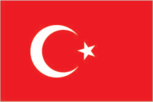
Flag
meaning: the flag colors and designs closely resemble the Ottoman Empire's flag; the crescent moon and star serve as insignia for Turkic peoples; according to one interpretation, the flag represents the reflection of the moon and a star in a pool of blood of Turkish warriors
National symbol(s)
vertical crescent moon with adjacent five-pointed star
National color(s)
red, white
National anthem(s)
lyrics/music: Mehmet Akif ERSOY/Zeki UNGOR
history: lyrics adopted 1921, music adopted 1932; the anthem's original music was adopted in 1924
National heritage
selected World Heritage Site locales: Archaeological Site of Troy (c); Ephesus (c); Diyarbakır Fortress and Hevsel Gardens Cultural Landscape (c); Hierapolis-Pamukkale (m); Göreme National Park and the Rock Sites of Cappadocia (m); Göbekli Tepe (c); Historic Areas of Istanbul (c); Selimiye Mosque and its Social Complex (c); Neolithic Site of Çatalhöyük (c); Bursa and Cumalıkızık: the Birth of the Ottoman Empire (c); Gordion (c); Great Mosque and Hospital of Divriği (c); Hattusha: the Hittite Capital (c); Nemrut Dağ (c); Xanthos-Letoon (c); City of Safranbolu (c); Pergamon and its Multi-Layered Cultural Landscape (c); Archaeological Site of Ani (c); Aphrodisias (c); Arslantepe Mound (c); Wooden Hypostyle Mosques of Medieval Anatolia (c); Turkmenistan (c); Sardis and the Lydian Tumuli of Bin Tepe (c)
Economy32
Economic overview
upper-middle-income, diversified Middle Eastern economy; industrializing economy that maintains large agricultural base; key energy, tourism, and construction sectors; high inflation, interest rates, and foreign debt pose risk to financial stability
Real GDP (purchasing power parity)
Real GDP (purchasing power parity) 2023: $2.925 trillion (2023 est.)
Real GDP (purchasing power parity) 2022: $2.783 trillion (2022 est.)
Real GDP growth rate
Real GDP growth rate 2023: 5.1% (2023 est.)
Real GDP growth rate 2022: 5.5% (2022 est.)
Real GDP per capita
Real GDP per capita 2023: $34,300 (2023 est.)
Real GDP per capita 2022: $32,700 (2022 est.)
GDP (official exchange rate)
Inflation rate (consumer prices)
Inflation rate (consumer prices) 2023: 53.9% (2023 est.)
Inflation rate (consumer prices) 2022: 72.3% (2022 est.)
GDP - composition, by sector of origin
industry: 25.9% (2024 est.)
services: 56.8% (2024 est.)
GDP - composition, by end use
household consumption
government consumption
investment in fixed capital
investment in inventories
exports of goods and services
imports of goods and services
Agricultural products
Industries
textiles, food processing, automobiles, electronics, mining (coal, chromate, copper, boron), steel, petroleum, construction, lumber, paper
Industrial production growth rate
Labor force
Unemployment rate
Unemployment rate 2023: 9.4% (2023 est.)
Unemployment rate 2022: 10.5% (2022 est.)
Youth unemployment rate (ages 15-24)
male: 12.4% (2024 est.)
female: 21.2% (2024 est.)
Population below poverty line
Gini Index coefficient - distribution of family income
Average household expenditures
on alcohol and tobacco: 2.3% of household expenditures (2023 est.)
Household income or consumption by percentage share
highest 10%: 35.2% (2022 est.)
Remittances
Remittances 2023: 0.1% of GDP (2023 est.)
Remittances 2022: 0.1% of GDP (2022 est.)
Budget
expenditures: $382.998 billion (2023 est.)
Public debt
Taxes and other revenues
Current account balance
Current account balance 2023: -$39.877 billion (2023 est.)
Current account balance 2022: -$46.283 billion (2022 est.)
Exports
Exports 2023: $357.588 billion (2023 est.)
Exports 2022: $346.602 billion (2022 est.)
Exports - partners
Exports - commodities
Imports
Imports 2023: $386.602 billion (2023 est.)
Imports 2022: $383.7 billion (2022 est.)
Imports - partners
Imports - commodities
Reserves of foreign exchange and gold
Reserves of foreign exchange and gold 2023: $140.868 billion (2023 est.)
Reserves of foreign exchange and gold 2022: $128.735 billion (2022 est.)
Debt - external
Exchange rates
Currency
Exchange rates 2024
Exchange rates 2023
Exchange rates 2022
Exchange rates 2021
Exchange rates 2020
Energy8
Electricity access
Electricity
consumption: 285.177 billion kWh (2023 est.)
exports: 1.993 billion kWh (2023 est.)
imports: 5.892 billion kWh (2023 est.)
transmission/distribution losses: 28.964 billion kWh (2023 est.)
Electricity generation sources
fossil fuels
solar
wind
hydroelectricity
geothermal
biomass and waste
Nuclear energy
Coal
consumption: 124.183 million metric tons (2023 est.)
exports: 685,000 metric tons (2023 est.)
imports: 41.119 million metric tons (2023 est.)
proven reserves: 10.975 billion metric tons (2023 est.)
Petroleum
refined petroleum consumption: 1.107 million bbl/day (2024 est.)
crude oil estimated reserves: 366 million barrels (2021 est.)
Natural gas
consumption: 50.211 billion cubic meters (2023 est.)
exports: 896.281 million cubic meters (2023 est.)
imports: 50.484 billion cubic meters (2023 est.)
proven reserves: 3.794 billion cubic meters (2021 est.)
Energy consumption per capita
Communications6
Telephones - fixed lines
subscriptions per 100 inhabitants: 11 (2023 est.)
Telephones - mobile cellular
subscriptions per 100 inhabitants: 108 (2024 est.)
Broadcast media
Turkish Radio and Television Corporation (TRT) operates multiple TV and radio networks and stations; multiple privately owned national TV stations and 567 private regional and local TV stations; multi-channel cable TV available; 1,007 private radio stations (2019)
Internet country code
.tr
Internet users
Broadband - fixed subscriptions
subscriptions per 100 inhabitants: 22 (2023 est.)
Transportation6
Civil aircraft registration country code prefix
TC
Airports
116 (2025)
Heliports
240 (2025)
Railways
standard gauge: 11,497 km (2018) 1.435-m gauge (1.435 km high speed train)
Merchant marine
by type: bulk carrier 43, container ship 43, general cargo 223, oil tanker 134, other 727
Ports
total ports
large
medium
small
very small
ports with oil terminals
key ports
Military & Security7
Military and security forces
Ministry of Interior: Gendarmerie General Command (aka Gendarmerie of the Turkish Republic), Turkish Coast Guard Command, General Directorate of Security (National Police) (2025)
Military expenditures
Military Expenditures 2024: 2.1% of GDP (2024 est.)
Military Expenditures 2023: 1.5% of GDP (2023 est.)
Military Expenditures 2022: 1.4% of GDP (2022 est.)
Military Expenditures 2021: 1.6% of GDP (2021 est.)
Military and security service personnel strengths
approximately 495,000 active military personnel; approximately 150,000 Gendarmerie (2025)
Military equipment inventories and acquisitions
Military service age and obligation
Military deployments
Military - note
Türkiye is active in international peacekeeping and other military/security operations under NATO and the UN, as well as under bilateral agreements with some countries, such as Azerbaijan, Libya, Somalia, and Qatar; Türkiye has been a member of NATO since 1952 and hosts the headquarters for a NATO Land Command and a Rapid Deployment Corps, multiple airbases for NATO and US aircraft, NATO air/missile defense systems, and training centers; the TAF is the second-largest military in NATO behind the US
the military traces its history back to 200 B.C., although the modern TAF was formed following the collapse of the Ottoman Empire at the conclusion of the Turkish War of Independence (1919-1923); the TAF traditionally has been viewed as the “guardian” of Turkish politics, but its political role was diminished after the failed 2016 coup attempt; the military has a stake in Türkiye's economy through a holding company that is involved in the automotive, defense, energy, finance, and logistics sectors, as well as iron and steel production (2025)
Transnational Issues1
Refugees and internally displaced persons
IDPs: 538,105 (2024 est.)
stateless persons: 420 (2024 est.)