
United Arab Emirates
Population
10.09M
Area
83,600 km²
GDP
$537.08B
GDP Per Capita
$68,600
Pop. Density
121/km²
Quick Facts
Currency
د.إUnited Arab Emirates dirham(AED)
Calling Code
+971
Timezone
UTC+04:00
Languages
Arabic+more
Driving Side
right
Demonym
Emirati
Background
The UAE's per-capita GDP is on par with those of leading West European nations. For more than three decades, oil and global finance drove the UAE's economy. In 2008-09, the confluence of falling oil prices, collapsing real estate prices, and the international banking crisis hit the UAE especially hard. The UAE did not experience the "Arab Spring" unrest seen elsewhere in the Middle East in 2010-11, partly because of the government's multi-year, $1.6-billion infrastructure investment plan for the poorer northern emirates, and its aggressive pursuit of advocates for political reform.
The UAE in recent years has played a growing role in regional affairs. In addition to donating billions of dollars in economic aid to help stabilize Egypt, the UAE was one of the first countries to join the Defeat ISIS coalition, and to participate as a key partner in a Saudi-led military campaign in Yemen. In 2020, the UAE and Bahrain signed a peace agreement (the Abraham Accords) with Israel -- brokered by the US -- in Washington, D.C. The UAE and Bahrain thus became the third and fourth Middle Eastern countries, along with Egypt and Jordan, to recognize Israel.
Historical Trends
GDP (USD)
↑148.7% since 2006Population
↑119.3% since 2006Life Expectancy at Birth
Latest: 82.9 yearsData source: World Bank Open Data
Geography17
Location
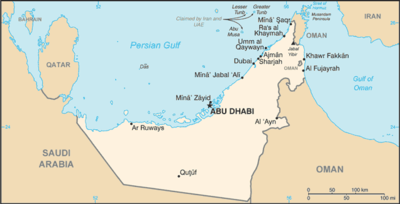
Middle East, bordering the Gulf of Oman and the Persian Gulf, between Oman and Saudi Arabia
Geographic coordinates
24 00 N, 54 00 E
Map references
Middle East
Area
land: 83,600 sq km
water: 0 sq km
Area - comparative
slightly larger than South Carolina; slightly smaller than Maine
Land boundaries
border countries: Oman 609 km; Saudi Arabia 457 km
Coastline
1,318 km
Maritime claims
contiguous zone: 24 nm
exclusive economic zone: 200 nm
continental shelf: 200 nm or to the edge of the continental margin
Climate
desert; cooler in eastern mountains
Terrain
flat, barren coastal plain merging into rolling sand dunes of vast desert; mountains in east
Elevation
lowest point: Persian Gulf 0 m
mean elevation: 149 m
Natural resources
petroleum, natural gas
Land use
agricultural land
agricultural land: arable land
agricultural land: permanent crops
agricultural land: permanent pasture
forest
other
Irrigated land
940 sq km (2022)
Population distribution
population is heavily concentrated to the northeast on the Musandam Peninsula; the three largest emirates -- Abu Dhabi, Dubai, and Sharjah -- are home to nearly 85% of the population
Natural hazards
frequent sand and dust storms
Geography - note
strategic location along southern approaches to Strait of Hormuz, a transit point for crude oil; Abu Zaby (Abu Dhabi) and Dubayy (Dubai) together account for over 90% of UAE's area and two-thirds of the population
People & Society33
Population
male: 6,831,802
female: 3,261,791
Nationality
adjective: Emirati
Ethnic groups
Languages
major-language sample(s):
كتاب حقائق العالم، المصدر الذي لا يمكن الاستغناء عنه للمعلومات الأساسية (Arabic)
The World Factbook, the indispensable source for basic information.
Religions
Age structure
15-64 years: 81.4% (male 5,812,470/female 2,353,750)
65 years and over: 2.2% (2024 est.) (male 169,084/female 52,030)
Dependency ratios
youth dependency ratio: 20.4 (2025 est.)
elderly dependency ratio: 3 (2025 est.)
potential support ratio: 33.4 (2025 est.)
Median age
male: 38.1 years
female: 29.8 years
Population growth rate
0.62% (2025 est.)
Birth rate
10.65 births/1,000 population (2025 est.)
Death rate
1.73 deaths/1,000 population (2025 est.)
Net migration rate
-2.67 migrant(s)/1,000 population (2025 est.)
Population distribution
population is heavily concentrated to the northeast on the Musandam Peninsula; the three largest emirates -- Abu Dhabi, Dubai, and Sharjah -- are home to nearly 85% of the population
Urbanization
rate of urbanization: 1.5% annual rate of change (2020-25 est.)
Major urban areas - population
3.008 million Dubai, 1.831 million Sharjah, 1.567 million ABU DHABI (capital) (2023)
Sex ratio
0-14 years: 1.05 male(s)/female
15-64 years: 2.47 male(s)/female
65 years and over: 3.25 male(s)/female
total population: 2.13 male(s)/female (2024 est.)
Maternal mortality ratio
3 deaths/100,000 live births (2023 est.)
Infant mortality rate
male: 5.5 deaths/1,000 live births
female: 4.4 deaths/1,000 live births
Life expectancy at birth
male: 78.6 years
female: 81.4 years
Total fertility rate
1.6 children born/woman (2025 est.)
Gross reproduction rate
0.78 (2025 est.)
Drinking water source
improved: urban
improved: rural
improved: total
unimproved: urban
unimproved: rural
unimproved: total
Health expenditure
Health expenditure (as % of national budget): 12.1% of national budget (2022 est.)
Physician density
2.99 physicians/1,000 population (2023)
Hospital bed density
2 beds/1,000 population (2021 est.)
Sanitation facility access
improved: urban
improved: rural
improved: total
unimproved: urban
unimproved: rural
unimproved: total
Obesity - adult prevalence rate
31.7% (2016)
Alcohol consumption per capita
beer: 0.21 liters of pure alcohol (2019 est.)
wine: 0.14 liters of pure alcohol (2019 est.)
spirits: 1.65 liters of pure alcohol (2019 est.)
other alcohols: 0.02 liters of pure alcohol (2019 est.)
Tobacco use
male: 13.9% (2025 est.)
female: 2.4% (2025 est.)
Currently married women (ages 15-49)
67.4% (2018 est.)
Education expenditure
Education expenditure (% national budget): 14.8% national budget (2021 est.)
Literacy
male: 99% (2024 est.)
female: 98.4% (2024 est.)
School life expectancy (primary to tertiary education)
male: 15 years (2023 est.)
female: 16 years (2023 est.)
Government23
Country name
conventional long form
conventional short form
local long form
local short form
former
abbreviation
etymology
Government type
federation of monarchies
Capital
geographic coordinates: 24 28 N, 54 22 E
time difference: UTC+4 (9 hours ahead of Washington, DC, during Standard Time)
etymology: in Arabic, abu means "father," and dhabi refers to a personal name, Dhabi or Zabi, that comes from the word zab, or "gazelle"
Administrative divisions
Legal system
mixed system of Islamic (sharia) law and civil law
Constitution
amendment process: proposed by the Supreme Council and submitted to the Federal National Council; passage requires at least a two-thirds majority vote of Federal National Council members present and approval of the Supreme Council president
International law organization participation
has not submitted an ICJ jurisdiction declaration; non-party state to the ICCt
Citizenship
citizenship by descent only: the father must be a citizen of the United Arab Emirates; if the father is unknown, the mother must be a citizen
dual citizenship recognized: no
residency requirement for naturalization: 30 years
Suffrage
Executive branch
chief of state
head of government
cabinet
election/appointment process
most recent election date
election results
2022: MUHAMMAD BIN ZAYID Al-Nuhayyan elected president; Federal Supreme Council vote - NA
expected date of next election
Legislative branch
legislature name
legislative structure
number of seats
electoral system
scope of elections
term in office
most recent election date
percentage of women in chamber
expected date of next election
Judicial branch
judge selection and term of office: judges appointed by the federal president after approval from the Federal Supreme Council, the highest executive and legislative authority consisting of the 7 emirate rulers; judges serve until retirement age or the expiration of their appointment terms
subordinate courts: Federal Court of Cassation (determines the constitutionality of laws); the emirates of Abu Dhabi, Dubai, and Ra's al Khaymah have parallel court systems; the other 4 emirates have incorporated their courts into the federal system
Political parties
Diplomatic representation in the US
chief of mission
chancery
telephone
FAX
email address and website
info@uaeembassy-usa.org
https://www.uae-embassy.org/
consulate(s) general
Diplomatic representation from the US
chief of mission
embassy
mailing address
telephone
FAX
email address and website
abudhabiacs@state.gov
https://ae.usembassy.gov/
consulate(s) general
International organization participation
ABEDA, AfDB (nonregional member), AFESD, AMF, BIS, BRICS, CAEU, CICA, FAO, G-77, GCC, IAEA, IBRD, ICAO, ICC (national committees), ICRM, IDA, IDB, IFAD, IFC, IFRCS, IHO, ILO, IMF, IMO, IMSO, Interpol, IOC, IPU, ISO, ITSO, ITU, LAS, MIGA, NAM, OAPEC, OIC, OIF (observer), OPCW, OPEC, PCA, UN, UNCTAD, UNESCO, UNHRC, UNIDO, UNOOSA, UNRWA, UNWTO, UPU, WCO, WHO, WIPO, WMO, WTO
Independence
2 December 1971 (from the UK)
National holiday
Independence Day (National Day), 2 December (1971)
Flag
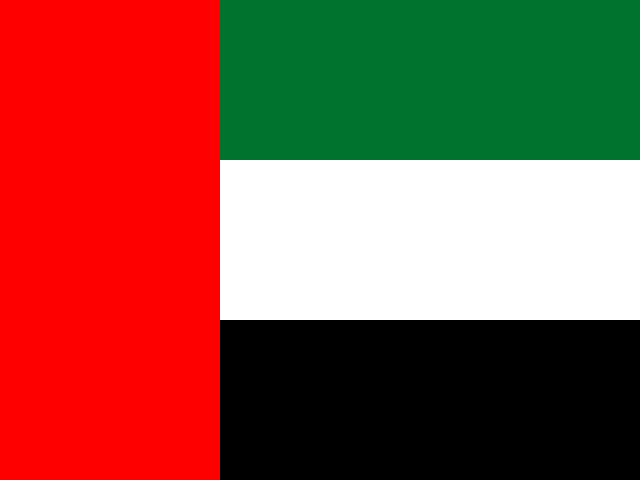
meaning: the flag incorporates all four pan-Arab colors, which in this case represent fertility (green), neutrality (white), oil (black), and unity (red); red is a traditional color that was part of all the emirates' flags before their unification
National symbol(s)
golden falcon
National color(s)
green, white, black, red
National anthem(s)
lyrics/music: AREF Al Sheikh Abdullah Al Hassan/Mohamad Abdel WAHAB
history: music adopted 1971, lyrics adopted 1986; Mohamad Abdel WAHAB also composed the music for Tunisia's and Libya's anthem
National heritage
selected World Heritage Site locales: Cultural Sites of Al Ain (Hafit, Hili, Bidaa Bint Saud, and Oases Areas); Faya Palaeolandscape (c)
Economy28
Economic overview
high-income, oil-driven Middle Eastern economy; fastest GDP growth of Gulf states; diversification through tourism, construction, and services; strong foreign direct investment orientation; continued government investment and business-friendly reforms
Real GDP (purchasing power parity)
Real GDP (purchasing power parity) 2023: $718.95 billion (2023 est.)
Real GDP (purchasing power parity) 2022: $693.842 billion (2022 est.)
Real GDP growth rate
Real GDP growth rate 2023: 3.6% (2023 est.)
Real GDP growth rate 2022: 7.5% (2022 est.)
Real GDP per capita
Real GDP per capita 2023: $68,600 (2023 est.)
Real GDP per capita 2022: $68,900 (2022 est.)
GDP (official exchange rate)
Inflation rate (consumer prices)
Inflation rate (consumer prices) 2023: 1.6% (2023 est.)
Inflation rate (consumer prices) 2022: 5.3% (2022 est.)
GDP - composition, by sector of origin
industry: 47.7% (2023 est.)
services: 51.6% (2023 est.)
GDP - composition, by end use
household consumption
government consumption
investment in fixed capital
investment in inventories
exports of goods and services
imports of goods and services
Agricultural products
Industries
petroleum and petrochemicals; fishing, aluminum, cement, fertilizer, commercial ship repair, construction materials, handicrafts, textiles
Industrial production growth rate
Labor force
Unemployment rate
Unemployment rate 2023: 2.2% (2023 est.)
Unemployment rate 2022: 2.9% (2022 est.)
Youth unemployment rate (ages 15-24)
male: 4.1% (2024 est.)
female: 12.1% (2024 est.)
Gini Index coefficient - distribution of family income
Average household expenditures
on alcohol and tobacco: 0.3% of household expenditures (2023 est.)
Household income or consumption by percentage share
highest 10%: 20.5% (2018 est.)
Budget
expenditures: $19.349 billion (2023 est.)
Public debt
Taxes and other revenues
Exports
Exports 2022: $521.897 billion (2022 est.)
Exports 2021: $425.156 billion (2021 est.)
Exports - partners
Exports - commodities
Imports
Imports 2022: $427.992 billion (2022 est.)
Imports 2021: $347.529 billion (2021 est.)
Imports - partners
Imports - commodities
Reserves of foreign exchange and gold
Reserves of foreign exchange and gold 2023: $189.491 billion (2023 est.)
Reserves of foreign exchange and gold 2022: $138.433 billion (2022 est.)
Exchange rates
Currency
Exchange rates 2024
Exchange rates 2023
Exchange rates 2022
Exchange rates 2021
Exchange rates 2020
Energy8
Electricity access
Electricity
consumption: 157.974 billion kWh (2023 est.)
exports: 613 million kWh (2023 est.)
imports: 501.067 million kWh (2023 est.)
transmission/distribution losses: 7.914 billion kWh (2023 est.)
Electricity generation sources
nuclear: 19.9% of total installed capacity (2023 est.)
solar: 4.8% of total installed capacity (2023 est.)
Nuclear energy
Net capacity of operational nuclear reactors: 5.35GW (2025 est.)
Percent of total electricity production: 19.7% (2023 est.)
Coal
exports: 82,000 metric tons (2023 est.)
imports: 5.512 million metric tons (2023 est.)
Petroleum
refined petroleum consumption: 846,000 bbl/day (2023 est.)
crude oil estimated reserves: 97.8 billion barrels (2021 est.)
Natural gas
consumption: 67.734 billion cubic meters (2023 est.)
exports: 6.863 billion cubic meters (2023 est.)
imports: 18.938 billion cubic meters (2023 est.)
proven reserves: 6.091 trillion cubic meters (2021 est.)
Energy consumption per capita
Communications6
Telephones - fixed lines
subscriptions per 100 inhabitants: 21 (2023 est.)
Telephones - mobile cellular
subscriptions per 100 inhabitants: 203 (2024 est.)
Broadcast media
most TV and radio stations state-owned, but many private organizations now operating in media free zones in Abu Dhabi and Dubai; widespread use of satellite dishes to access pan-Arab and other international broadcasts (2022)
Internet country code
.ae
Internet users
Broadband - fixed subscriptions
subscriptions per 100 inhabitants: 37 (2023 est.)
Transportation5
Civil aircraft registration country code prefix
A6
Airports
42 (2025)
Heliports
204 (2025)
Merchant marine
by type: bulk carrier 2, container ship 3, general cargo 122, oil tanker 16, other 512
Ports
total ports
large
medium
small
very small
ports with oil terminals
key ports
Military & Security7
Military and security forces
Military expenditures
Military Expenditures 2023: 4.3% of GDP (2023 est.)
Military Expenditures 2022: 4% of GDP (2022 est.)
Military Expenditures 2021: 4.5% of GDP (2021 est.)
Military Expenditures 2020: 6.1% of GDP (2020 est.)
Military and security service personnel strengths
approximately 65,000 active Armed Forces (45,000 Land Forces; 3,000 Navy; 5,000 Air Force; 12,000 Presidential Guard) (2025)
Military equipment inventories and acquisitions
Military service age and obligation
note 2: the UAE military employs a considerable number of foreign personnel on contracted service
Military deployments
maintains a few hundred troops in Somalia and Yemen (2025)
Military - note
the UAE has close security ties to France and the US; it hosts a multi-service French military base, which includes the French naval command for the Indian Ocean (ALINDIEN); the UAE has a defense cooperation agreement with the US and hosts thousands of US military troops, mostly air and naval personnel; it also has defense ties with a number of other countries, including Australia, China, Egypt, Israel, Jordan, Malaysia, South Korea, and the UK, as well as NATO and fellow members of the Gulf Cooperation Council, particularly Saudi Arabia
the UAEAF traces its origins to the establishment of the Trucial Oman Scouts in 1951, a joint UK-Abu Dhabi organization modeled after Jordan’s Arab Legion, which became the Abu Dhabi Defense Force in 1965; the modern UAEAF were formed in 1976 (2025)
Transnational Issues2
Refugees and internally displaced persons
Illicit drugs
major precursor-chemical producer (2025)
Compare United Arab Emirates
See how United Arab Emirates compares to other countries side by side.
Compare Countries